
Bunkering and Fuel Management
Fuel quality, safety and consumption management
Learning objectives
- Describe the sulphur limits applicable to marine fuels and the relevant Emission Control Areas (ECAs).
- Safely conduct or supervise a bunkering operation.
- Manage fuel sampling and quality verification.
- Carry out and check a bunker survey, from volume measurement to metric tonnes.
- Handle a commercial dispute over fuel quality or quantity.
- Identify fuel consumption optimisation levers.
- Understand the management implications of the transition to alternative fuels.
- Place the cost of carbon — EU ETS and FuelEU Maritime — within procurement decisions.
The regulatory framework on sulphur limits
Module objectiveApply global and ECA limits while distinguishing boundaries, operational dates, carriage for use, equivalent methods and documented fuel non-availability.
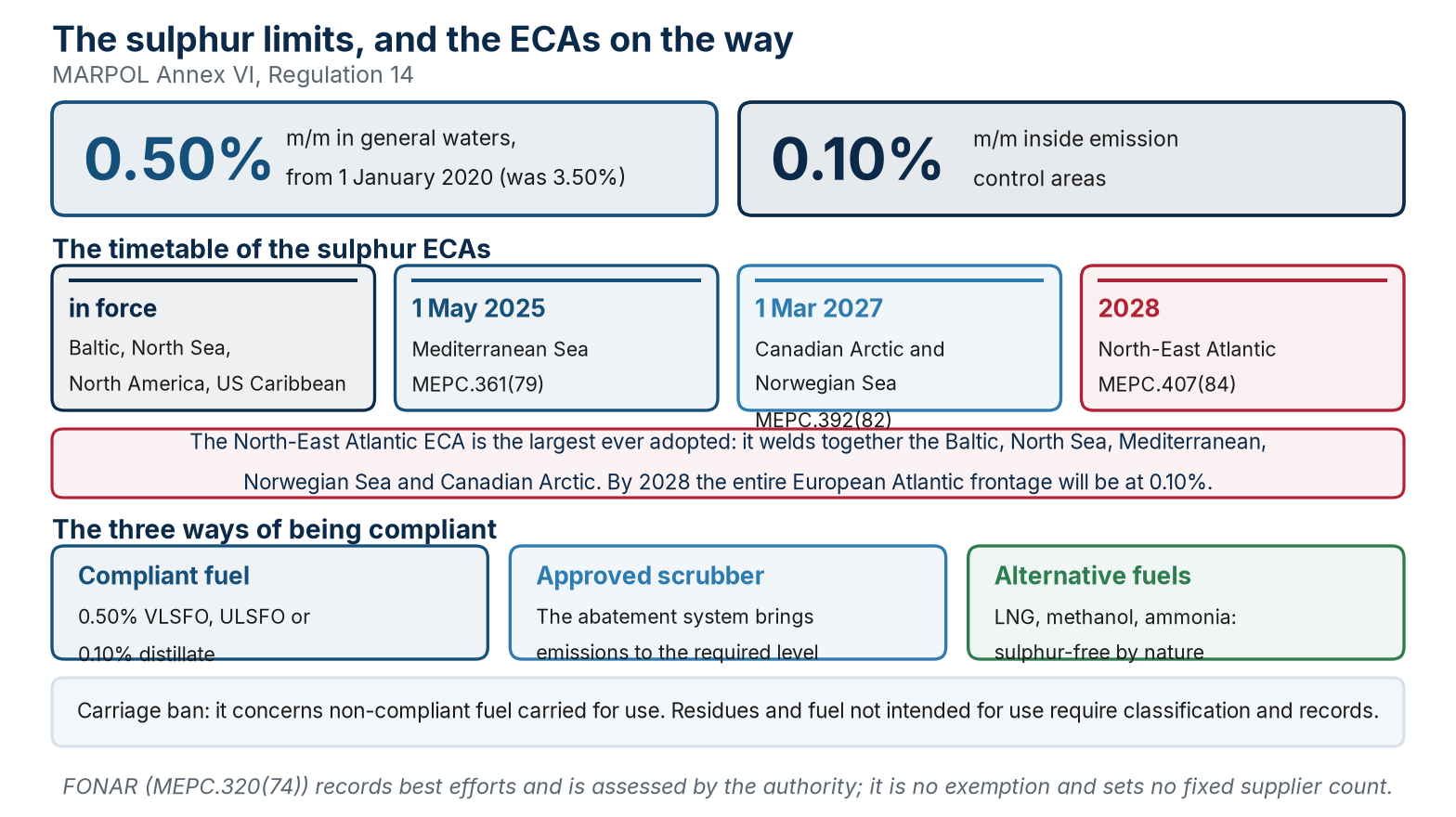
The global limit is 0.50% m/m; SOx/PM ECAs require 0.10%. The carriage ban concerns non-compliant fuel carried for use. An EGCS is an approved equivalent subject to monitoring and local discharge restrictions; segregated residues not intended for use require records and authority assessment.
The timetable concerns the SOx/PM limit: Mediterranean from 1 May 2025; Canadian Arctic and Norwegian Sea from 1 March 2027, with amendments in force from 1 March 2026. For the North-East Atlantic, MEPC.407(84) provides for entry into force on 1 September 2027, subject to acceptance, and the SOx/PM limit from 1 September 2028 under regulation 14.7’s twelve months. NOx has separate triggers: do not apply these dates indiscriminately to every pollutant. When separate fuels are used, complete changeover before entering the ECA under a written procedure, recording the tank volumes, date, time and position required by regulation 14.6.
Observe maker temperature and viscosity limits. A FONAR records best efforts and searches for alternatives; notify the flag and destination-port authority. It is not an exemption and sets neither a fixed supplier count nor a requirement for deviation or undue delay.
Key takeaways
- Each ECA requires its boundary, entry into force, operational date and pollutant scope.
- The carriage ban concerns non-compliant fuel carried for use, not every residue without distinction.
- A FONAR records best efforts and is assessed by the authority; it is not an exemption.
Planning the bunkering operation
Module objectivePrepare a shared transfer plan connecting tanks, compatibility, rates, communications, stop criteria and ship–supplier responsibilities.
The transfer plan
Before connection, verify tank plan, capacity and maximum filling limits, compatibility, segregation, tank sequence, valve line-up, rate and pressure.
Ship and supplier agree communications, emergency stop, slow-down/stop criteria, responsibilities, SIMOPS, weather and relative movement.
Monitoring continues through draining, disconnection, final measurements, BDN, samples, records and discrepancy management.
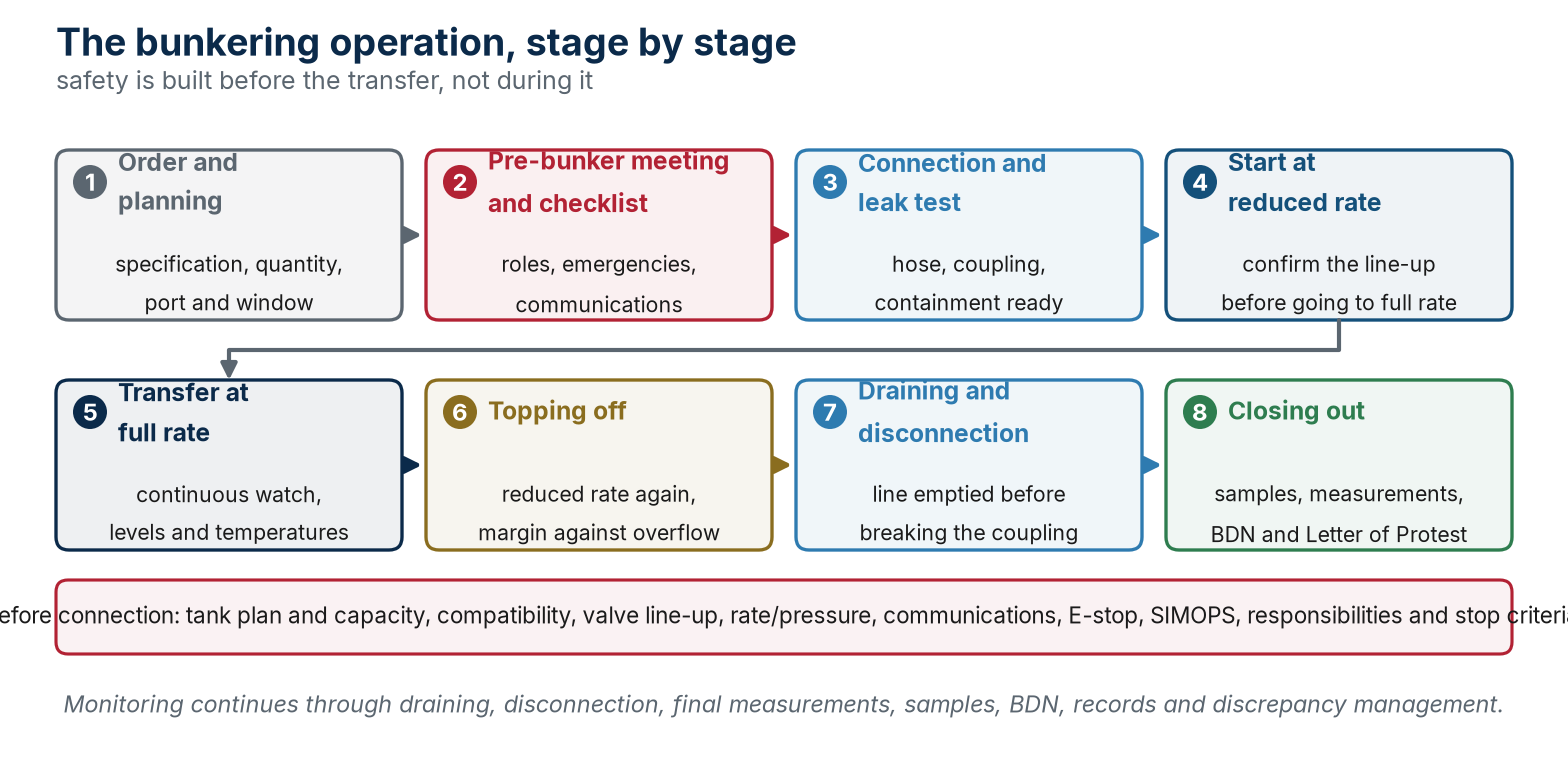
Also confirm grade, ordered quantity, safety data sheet, maximum filling limits and actual available capacity, hose condition and certification, connections and responsibilities. The pre-bunker meeting checks actual conditions, acknowledged communications, shutdown sequence and simultaneous operations (SIMOPS); PPE and permits follow the risk assessment and applicable procedures.
Key takeaways
- Available capacity must include maximum filling limits and tank sequence.
- The pre-bunker checklist and meeting verify actual conditions, not formal completion.
- Rate, pressure, E-stop, SIMOPS and communications must be agreed before connection.
Safety during bunkering
Module objectiveMonitor transfer and respond to anomalies under applicable roles, operating limits, containment and emergency procedures.
Monitoring and stop criteria
Qualified personnel continuously attend the stations designated by the plan; no universal formula requires everyone to remain only at the connection point.
Levels, vents and overflow, manifold, rate and pressure, moorings, scuppers, containment, lighting and communications are monitored together.
Leakage, loss of communication, alarm, abnormal pressure or exceeded limits trigger slow-down or stop under procedure.
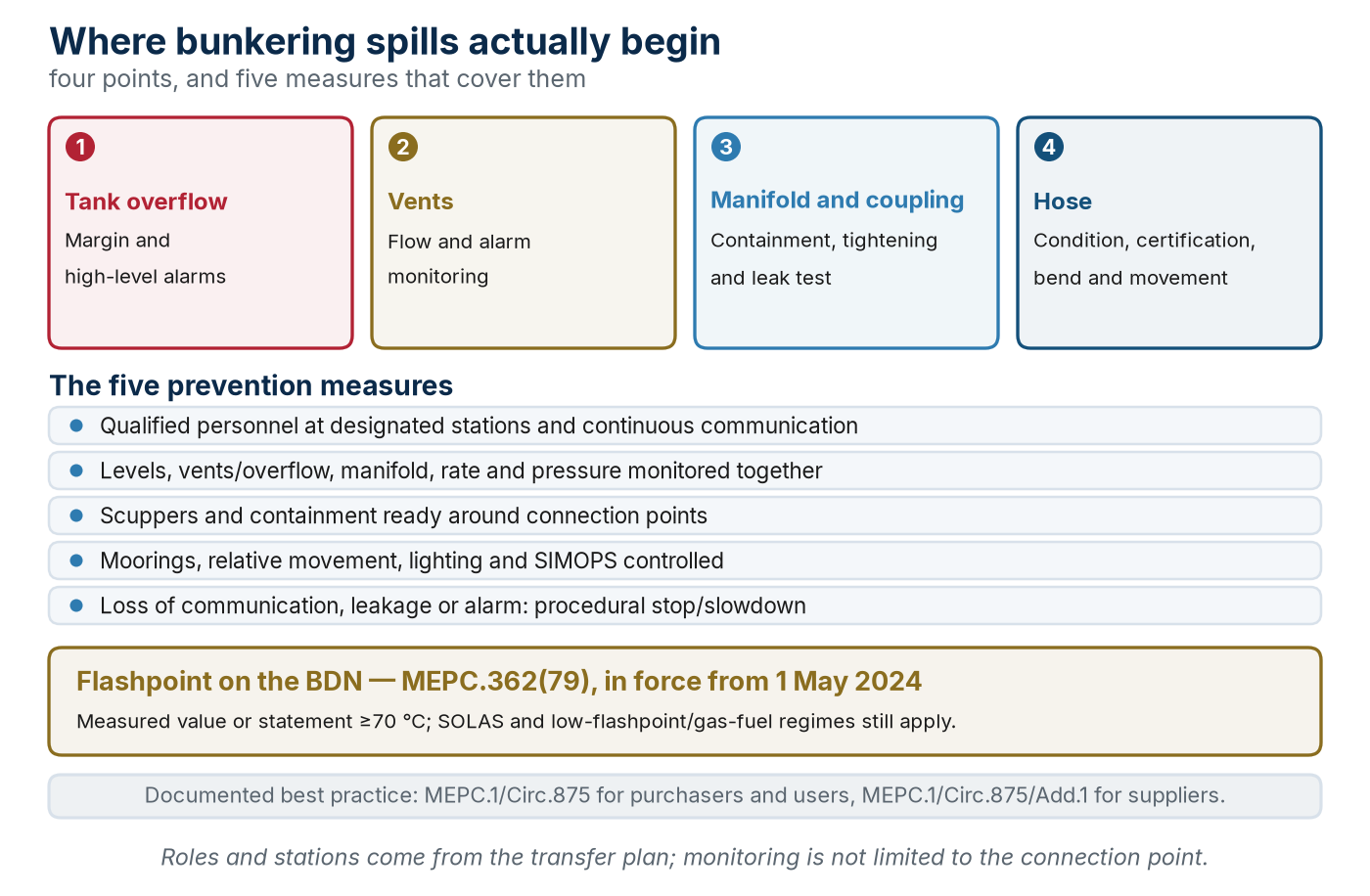
Fuel leakage or loss of communication requires safe shutdown under the agreed sequence, accounting for pressure surges: continuing at a reduced rate is insufficient. Activate containment, notifications and the emergency plan/SOPEP where applicable; do not discharge the spill overboard. Resume only after correcting the cause, verifying conditions and obtaining authorisation from the responsible persons.
Key takeaways
- Qualified personnel continuously attend the designated stations and maintain communication.
- Levels, vents, manifold, pressure, rate, moorings and containment are monitored together.
- Fuel leakage or loss of communication requires safe shutdown under the agreed sequence, accounting for pressure surges: continuing at a reduced rate is insufficient.
Sampling and quality verification
Module objectiveDistinguish delivered, in-use and onboard samples and correctly apply Appendix VI Part 1 and Part 2 procedures.
Three samples, two procedures
The delivered sample already existed; MEPC.324(75) formalised definitions and procedures for in-use and onboard samples and their sampling points.
Appendix VI Part 1 verifies the delivered sample using the mean of two valid subsamples; Part 2 applies limit plus 0.59R to in-use/onboard samples as an analytical decision rule, not a ship margin.
Systems serving only low-flashpoint or gas fuel fall within Regulation 14.12 exclusions. Sampling, sealing, custody, laboratory and retention remain traceable.
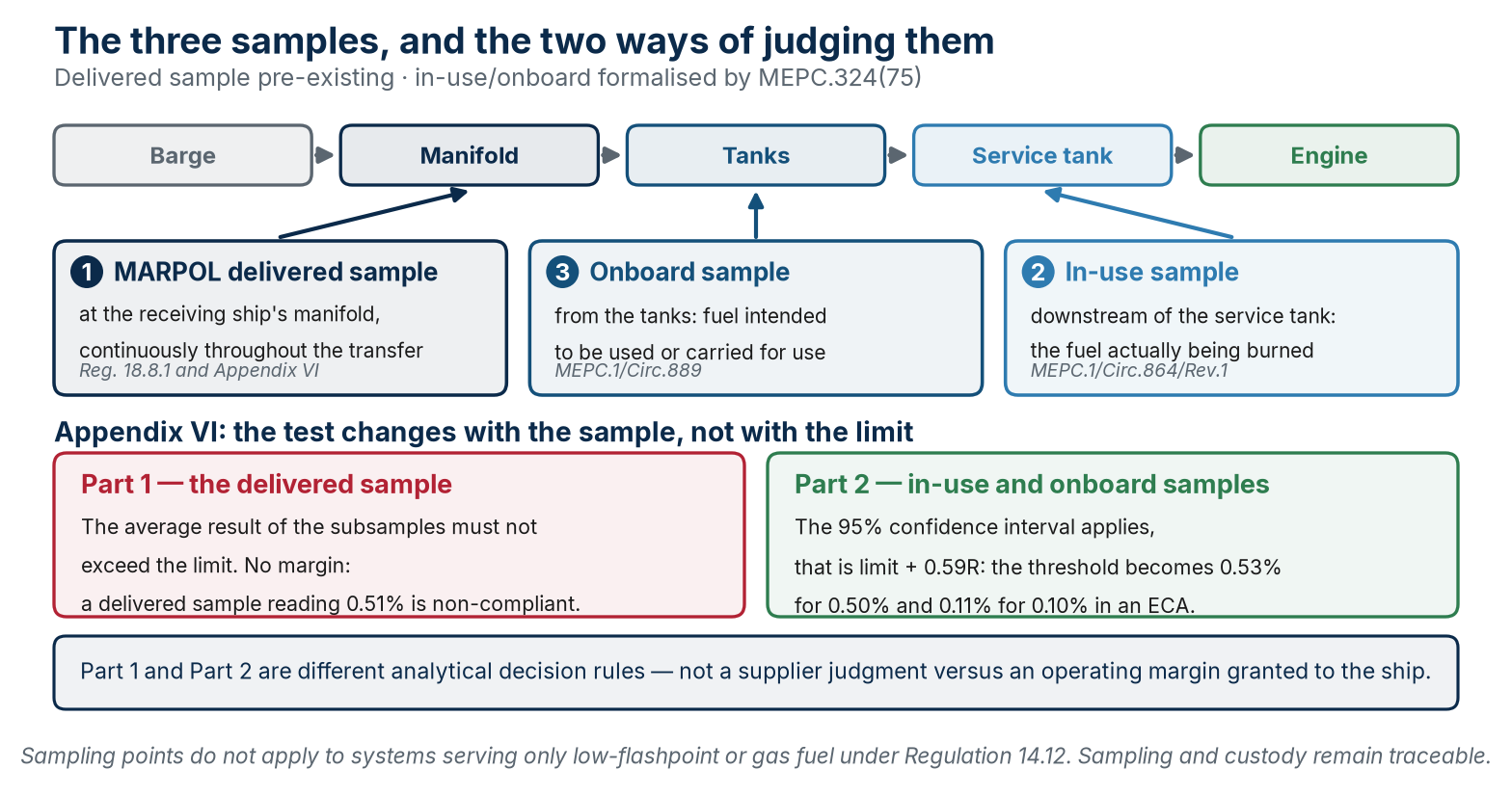
The delivered sample represents the delivery through continuous sampling at the receiving manifold under MEPC.182(59); in-use represents fuel being used, and onboard represents fuel intended or carried for use. Preserve seals, signatures and chain of custody; commercial samples are distinct and do not justify opening the statutory sample for routine analysis. Under Appendix VI the laboratory first checks repeatability r between two determinations. The valid Part 1 mean must be ≤ the limit; Part 2 uses ≤ limit + 0.59R, where R is method reproducibility. This is no allowance to purchase or deliberately use fuel above the limit. In-use points may be designated or installed according to the system: an installation change is not always needed. Low-flashpoint/gas exclusions concerning delivered samples follow separately from regulation 18.4.
Key takeaways
- The three samples represent different locations and purposes and are not interchangeable.
- Part 1 uses the mean of two valid subsamples; Part 2 uses limit + 0.59R.
- Sampling, sealing, custody, laboratory and retention must be traceable.
The Bunker Delivery Note and documentation
Module objectiveVerify the current BDN, distinguish oil fuel from low-flashpoint/gas fuel and separate the document, sample and commercial reservations.
Retain the BDN for at least three years. The MARPOL delivered sample remains under the ship’s control until the fuel is substantially consumed and for at least twelve months. For oil fuel the BDN records ship/IMO number, port, delivery commencement date, supplier, product, tonnes, density at 15 °C, sulphur, flashpoint and the Appendix V signed declaration. The option to declare a measured flashpoint ≥70 °C does not make 70 °C the SOLAS minimum: the general oil-fuel limit is 60 °C, subject to exceptions and approved regimes.
From 1 January 2026 MSC.520(106) also requires, before bunkering, a signed and certified declaration by the supplier’s representative of conformity with SOLAS II-2/4.2.1, including the flashpoint test method. This is distinct from the MARPOL BDN field. For low-flashpoint/gas, regulation 18.5.2 requires Appendix V items 1–6, density with an appropriate method and temperature, a regulation 18.3 compliance declaration and actual sulphur or, with port-authority agreement, a statement <0.001% m/m. Regulation 18.4 excludes 18.5.1 and 18.8.1–18.8.2 for these fuels; do not automatically extend oil-fuel sampling to gas.
Key takeaways
- Since 1 May 2024 the oil-fuel BDN includes flashpoint or a statement of ≥70°C.
- MEPC.385(81) introduces a specific BDN regime for low-flashpoint and gas fuel.
- BDN at least three years; sample under ship control until substantially consumed, minimum twelve months.
Quantity: measuring, comparing, protesting
Module objectiveEvaluate quantity by tank gauging or MFM, documenting method, uncertainty, controls and discrepancies without technical or legal shortcuts.
Tank gauging and MFM
Tank gauging uses sounding/ullage, temperature, tank table, trim/list and density: document method, measurement points and uncertainty.
An MFM reduces conversions but is not immune to air, configuration, zero drift, bypass or anomalies. Check certification, totaliser, events and applicable parameters.
There is no universal four-measurement rule, mandatory one-hour settling time or protest wording that automatically shifts burden of proof. Contract and port standard govern.
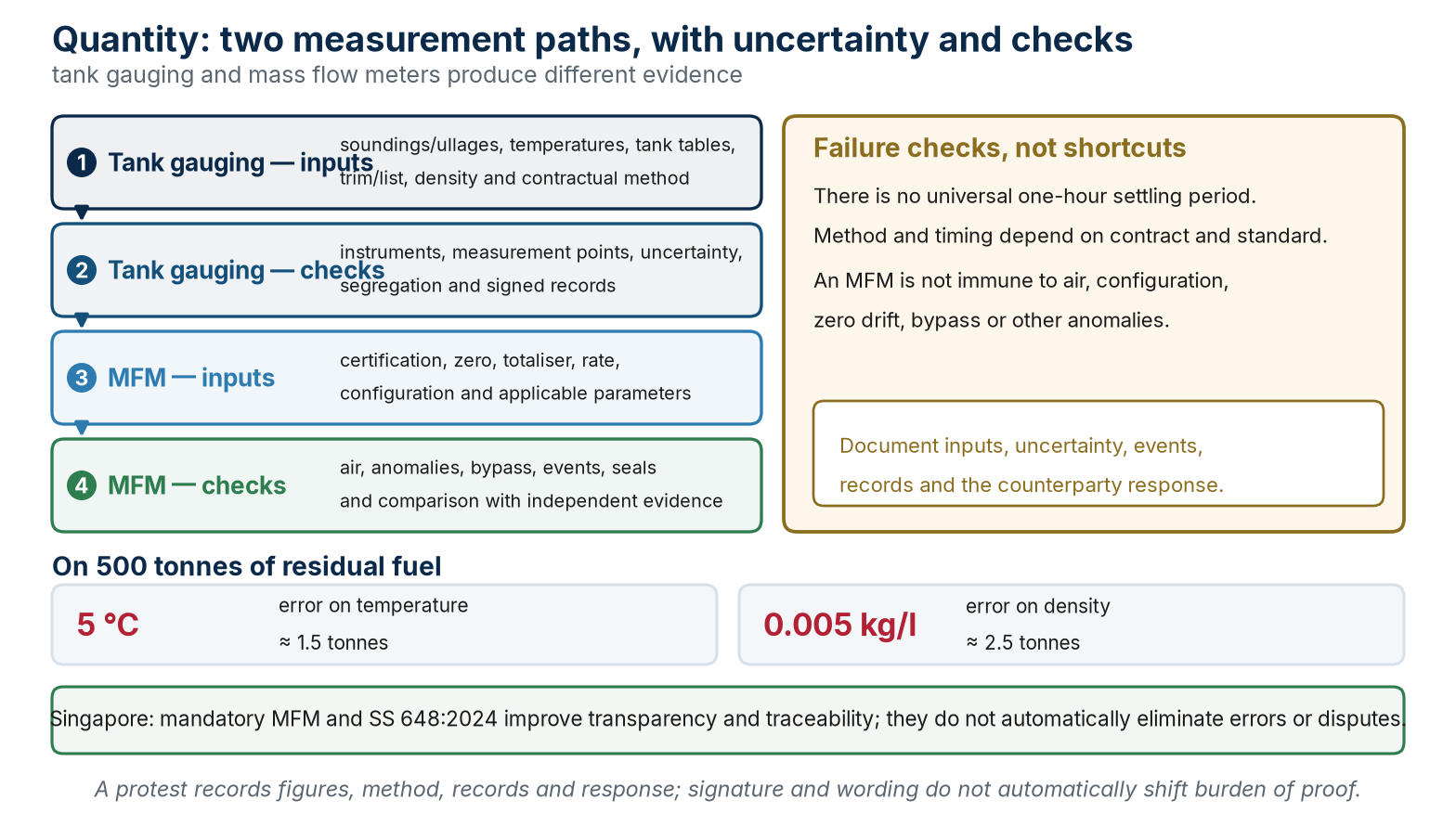
Illustrative tank-gauging example: 100 m³ observed × VCF 0.98 × density at 15 °C of 900 kg/m³ ÷ 1,000 = 88.2 t mass in vacuum. Derive VCF from the applicable method; it is not a constant. Any conversion to mass in air depends on the contractual basis; do not repeat it on an MFM already reporting the agreed basis. Reconcile before/after ROB with consumption and transfers during the period. Singapore applies SS 648:2024 from 1 April 2025: check certification, seals, totalisers and system events. A letter of protest preserves facts and reservations but does not automatically prove liability or shortage.
Key takeaways
- Contractual method and port standard determine measurement and primary evidence.
- MFM reduces conversions but is not immune to air, configuration or anomalies.
- Effective protests promptly record figures, method, records and counterparty response.
Managing quality disputes
Module objectiveManage suspected off-spec/off-quality fuel while preserving safety, samples, causation, notice and remedies under the contract and incorporated ISO 8217.
Off-spec and off-quality
The order or contract must incorporate the ISO 8217 edition, grade and additional limits. Families and limits vary and should not be reduced to one universal classification.
MARPOL and commercial samples have different purposes and chains of custody; each may matter in its context.
Segregate suspect fuel, notify, preserve samples and records, then assess safety impact, causal link, notice and mitigation. Clause 5 does not automatically decide the claim.
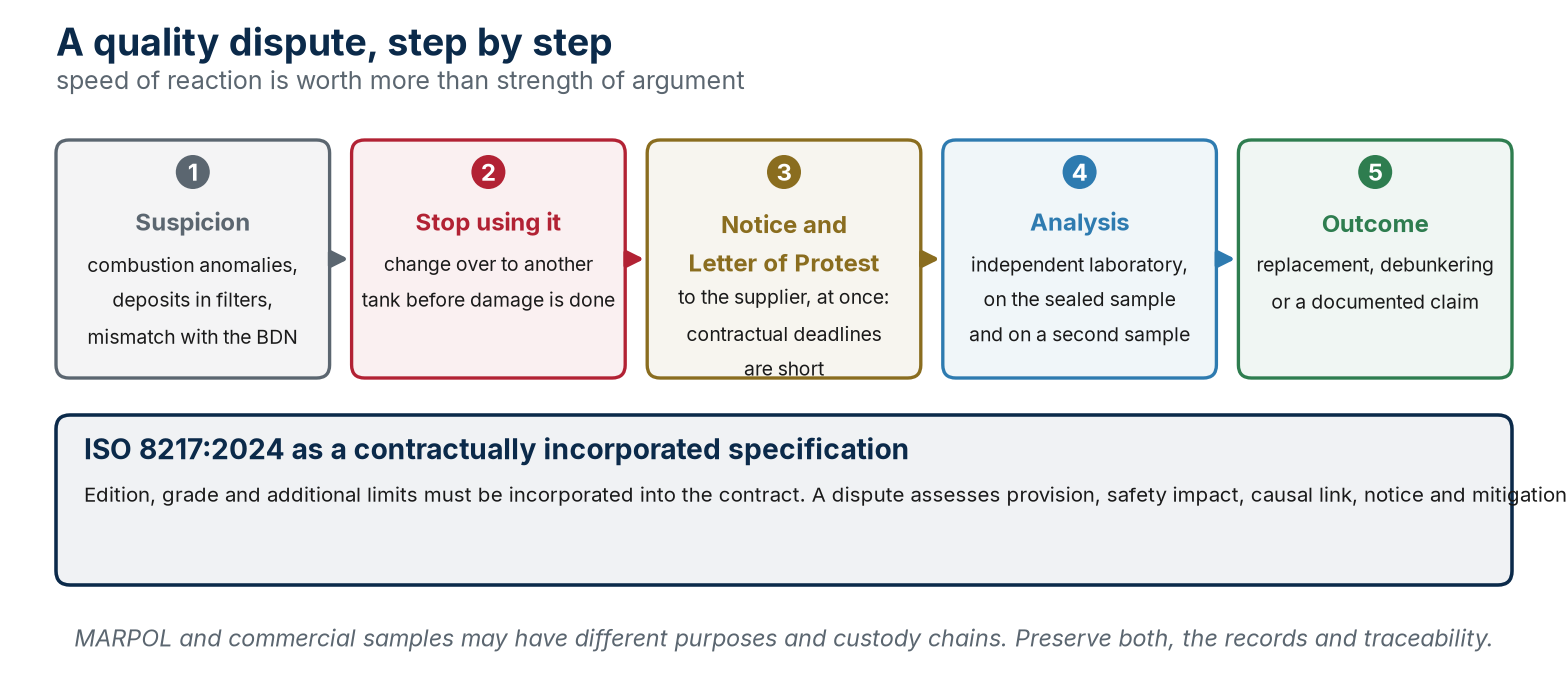
ISO 8217:2024, seventh edition, concerns fuel before onboard treatment. Use the edition, grade and any additional specifications incorporated into the contract. Cat-fines limits at delivery and engine inlet are not interchangeable: the former follows the specification and the latter OEM instructions. Distinguish individual-product stability from blend compatibility: two compliant fuels can produce a problematic blend. Assess methods and analytical precision under the contractual standard without automatically reusing the MARPOL decision rule for commercial disputes.
Key takeaways
- ISO edition, grade and limits must be incorporated into the order or contract.
- Commercial and MARPOL samples may serve different purposes and custody chains.
- Segregation, notice, expert assessment and mitigation precede use of suspect fuel.
Fuel consumption optimisation
Module objectiveEvaluate technical and operational levers with normalised metrics, distinguishing absolute consumption, engine efficiency and carbon-intensity indicators.
Measure distinct phenomena
Tonnes/day measures absolute consumption, tonnes/nm normalises distance and g/kWh describes engine efficiency; EEOI and CII include transport work or capacity proxies.
Each comparison accompanies fuel and distance with speed, draft, weather, fouling, power, operating mode and period.
Reducing fuel and energy can lower ETS emissions and affect FuelEU compliance balance and penalty exposure, even though unchanged fuel mix does not automatically change gCO2eq/MJ intensity.
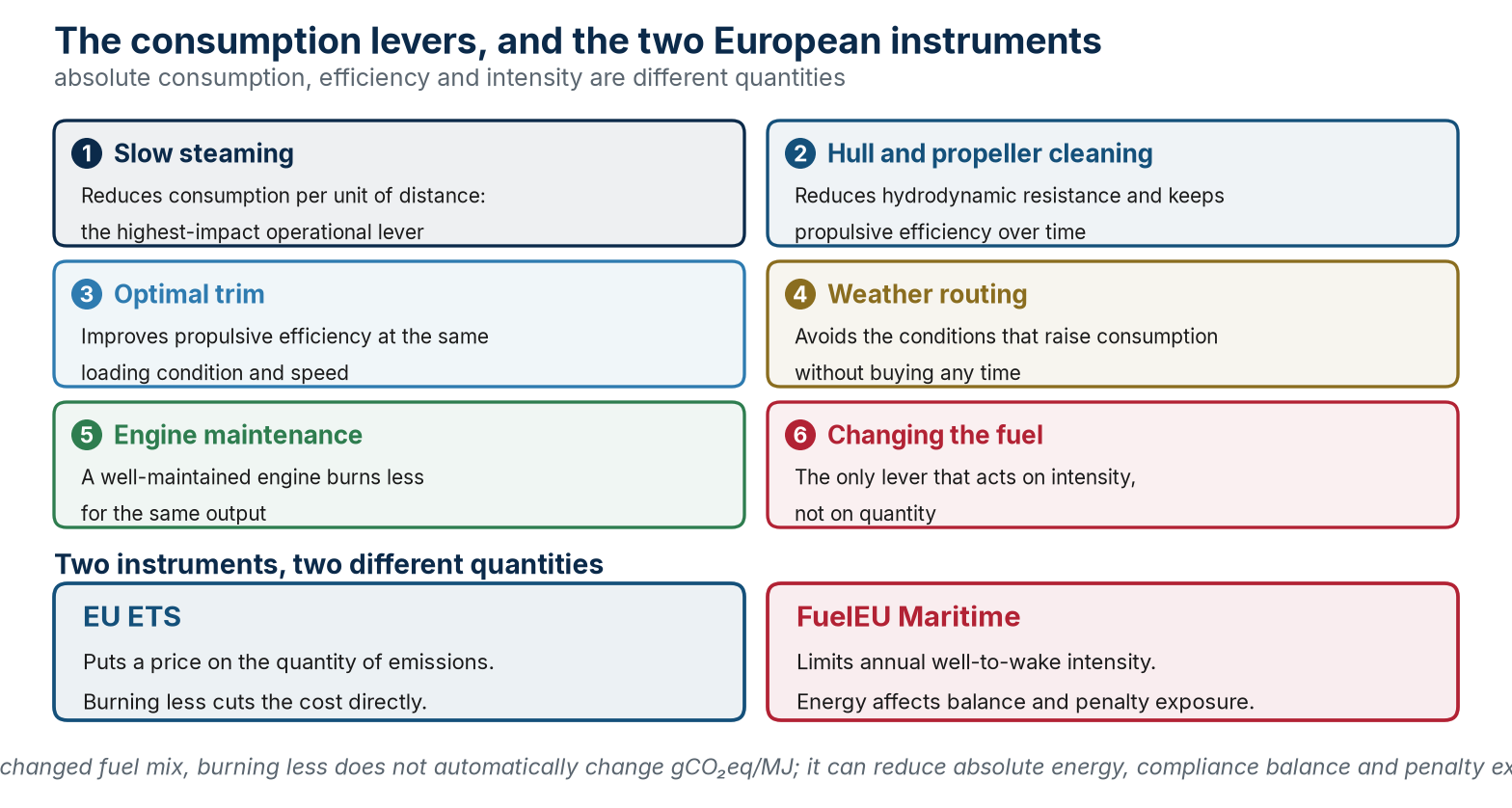
Optimise speed, route, trim, hull/propeller cleanliness and engine loading within safety and service constraints. Lower speed does not always guarantee lower consumption per mile: auxiliary loads, weather and part-load efficiency matter. For fuels with different calorific values compare energy as well as tonnes. With unchanged fuel mix, lower consumption does not automatically change FuelEU gCO₂eq/MJ but can reduce the absolute deficit and penalty exposure.
Key takeaways
- Tonnes/day, tonnes/nm, g/kWh and EEOI/CII measure different phenomena.
- Speed, draft, weather, fouling, power and operating mode must accompany comparison.
- Optimisation must not compromise safety, charter obligations or maintenance.
Onboard stock management
Module objectivePlan ROB and procurement considering uncertainty, reserve, unusable quantity, compatibility, quality and total risk-adjusted cost.
ROB, compatibility and risk
Measured ROB, measurement uncertainty, unpumpable/unusable quantity, minimum stock and safety reserve are different quantities.
New bunkers remain segregated until compatibility, analysis and the use plan permit commingling.
Procurement compares price with useful energy, quality, treatment loss, carbon exposure, supplier reliability and operational risk.
Reconcile opening stock + receipts − consumption − documented outflows = expected closing stock on a consistent measurement basis. Transfers between tanks do not change the ship total and must not be deducted twice. Compare the expected balance with measured ROB and investigate discrepancies beyond uncertainty. Distinguish available volume, pumpable quantity, operating reserve and segregated fuel; if segregation is unavailable, the plan must assess compatibility and risk measures beforehand.
Key takeaways
- Measured ROB, uncertainty, unpumpable quantity and safety reserve are not the same.
- New bunkers remain segregated until compatibility, analysis and the use plan permit otherwise.
- Price is assessed with energy, quality, treatment loss, carbon exposure and supplier performance.
The transition to alternative fuels
Module objectiveIdentify each fuel's safety framework, bunkering interfaces and competence requirements without transferring oil-fuel procedures.
One plan for each fuel
SOLAS II-1 Part G and the IGF Code form the general framework; detailed provisions and interim guidelines vary for LNG, alcohol fuels, LPG, ammonia, hydrogen and low-flashpoint oil.
Toxicity, flammability, cryogenics, material compatibility, ventilation, detection, PPE, exclusion zones and emergency response require fuel-specific risk assessment and bunkering plans.
STCW V/3 is not a generic certificate for every fuel. In 2026, fuel-specific training guidance for alcohol fuels and ammonia also applies according to ship, role and operation.
Check IGF scope and exclusions, including gas carriers under the relevant IGC regime. Mandatory provisions, flag approval and interim guidance have different roles. Training guidance STCW.7/Circ.26 (alcohols) and Circ.27 (ammonia), approved in 2026, must not be described as a new universal mandatory certificate. Assign competence by duty, ship and fuel, including drills and familiarisation with the bunkering interface.
Key takeaways
- The IGF Code is the general framework, but detailed provisions and interim guidelines vary by fuel.
- LNG, methanol, ammonia and hydrogen have different hazards and emergency response.
- STCW V/3 and specific guidance apply according to ship, role and fuel.
The cost of carbon: ETS, FuelEU and what the IMO still lacks
Module objectiveDistinguish quantity-based EU ETS from intensity-based FuelEU, connecting scope, data, compliance year and fuel-procurement decisions.
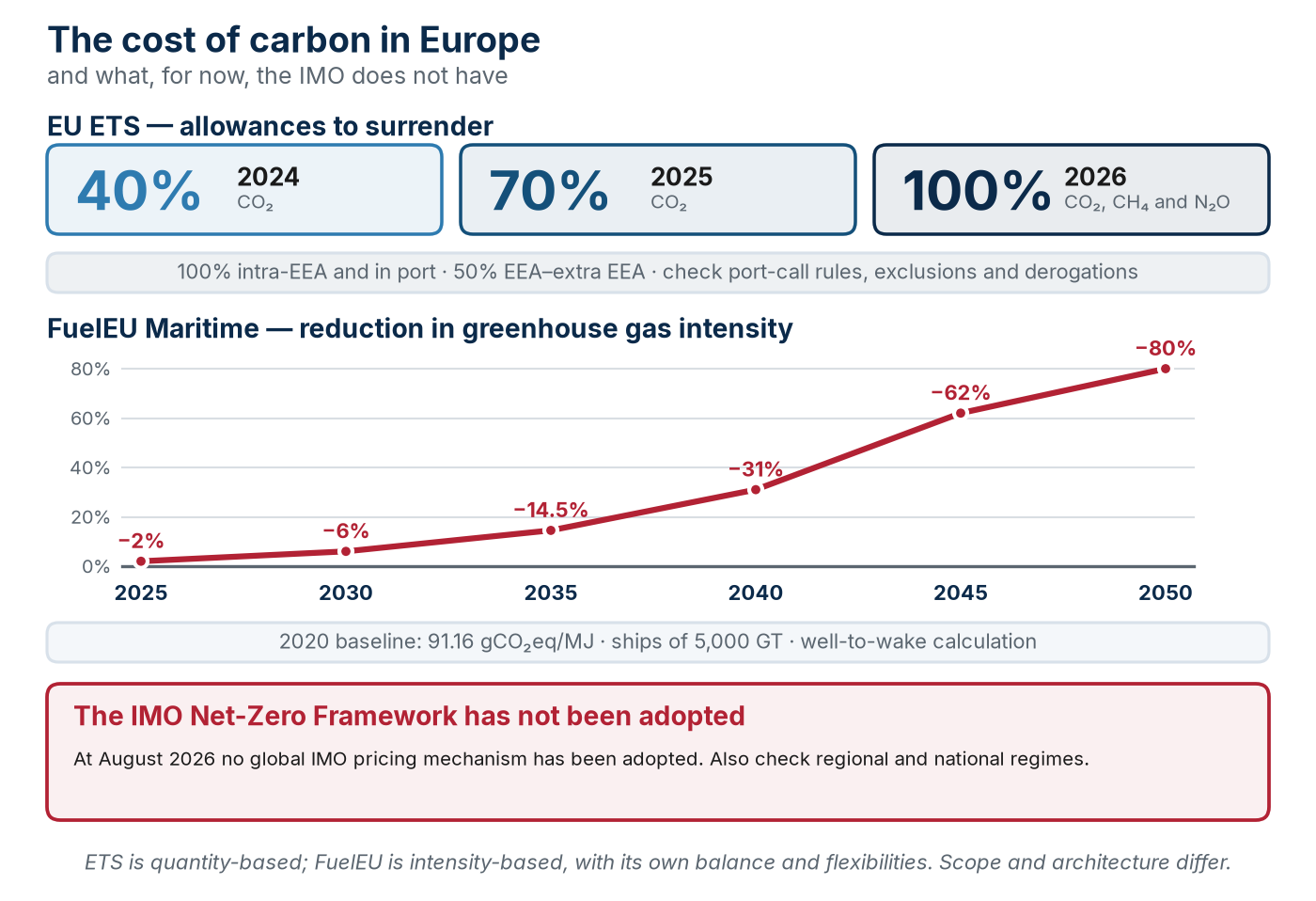
Separate emissions year from surrender: 40% of 2024 emissions by 30 September 2025; 70% of 2025 by 30 September 2026; 100% of 2026 by 30 September 2027. CH₄ and N₂O enter ETS from 2026 emissions. FuelEU assesses annual well-to-wake intensity and a balance that also depends on energy: lower consumption can reduce an absolute deficit while leaving the same mix’s intensity unchanged. At 15 September 2026 the IMO Net-Zero Framework is not adopted: ISWG-GHG 22 continued negotiations. A future meeting guarantees neither a decision nor an application date. Check EU scopes, derogations and sustainability evidence separately; the BDN alone does not establish every biofuel requirement.
Key takeaways
- Separate emissions year from surrender: 40% of 2024 emissions by 30 September 2025; 70% of 2025 by 30 September 2026; 100% of 2026 by 30 September 2027.
- FuelEU: intensity and balance are distinct; lower consumption can reduce the deficit.
- IMO Net-Zero Framework not adopted at 15 September 2026.
The role of fuel management in the chartering relationship
Module objectiveCoordinate technical duties, performance, bunker claims and ETS/FuelEU exposure with the allocations actually agreed in the charter.
Contractual allocation
Speed warranty, weather criteria, slow steaming, due despatch and CII cooperation are read together: there is no automatic conflict between warranted speed and CII.
The charter should allocate quality, quantity, sampling, notices, claims, ROB and redelivery, including data and decision times.
ETS allowances and FuelEU compliance balance, costs and data need dedicated clauses; commercial allocation does not change the regulated entity.
Define who provides data and samples, approves decisions, sends notices and manages deadlines and reservations. BIMCO clauses are contractual models to be read as incorporated and amended by the parties, not automatically applicable law. Maintain consistency between commercial instructions, ship safety and the company’s regulatory responsibility.
Key takeaways
- Speed warranty, weather, slow steaming, due despatch and CII cooperation should be read together.
- Quality, quantity, ROB, sampling and notices require clear contractual allocation.
- ETS allowances and FuelEU balance/cost require dedicated clauses and verifiable data.
Fuel management KPIs
Module objectiveBuild actionable KPIs with stated definitions, units, normalisation, uncertainty, data source and action owner.
An actionable dashboard
Each KPI states definition, unit, period, baseline, normalisation, source, uncertainty and action owner.
Quantity discrepancy and quality rate are segmented by method, supplier, port, grade and conditions; otherwise they mix different causes.
CII is a shared outcome of ship and commercial decisions, not the fuel manager’s exclusive KPI.
Calculation examples: quantity discrepancy (%) = (received on the agreed basis − declared) / declared × 100; specific consumption (g/kWh) = kg consumed × 1,000 / kWh produced; off-spec deliveries (%) = off-spec deliveries / tested deliveries × 100; energy cost (USD/GJ) = cost / (tonnes × lower calorific value in GJ/t). State period, scope and denominator; untested deliveries are not automatically compliant. Avoid zero denominators and segment by grade and method. CII does not determine the ETS allowance price.
Key takeaways
- An unnormalised KPI may reward or penalise a ship or supplier for unrelated causes.
- Quantity discrepancy and quality rate should be segmented by method, supplier, port and fuel grade.
- CII is a shared ship/commercial outcome, not the fuel manager's exclusive KPI.
Emerging trends
Module objectiveEvaluate digitalisation, multi-fuel operation and new regimes while distinguishing current requirements, interim guidance and unadopted proposals.
Current, interim, proposed
Real-time data and digital BDNs add value only with calibration, data quality, cybersecurity and governance.
Multi-fuel operation multiplies interfaces, compatibility checks, training, spare strategy and documentary evidence.
Label each development as in force, future operational date, interim guidance or unadopted proposal; the IMO Net-Zero framework remains under monitoring.
An electronic BDN does not remove mandatory fields, authenticity, authority access or retention. Provide access control, backups, change traceability and continuity during system outages. Assess sensors and automation with calibration and independent checks. Distinguish current requirements from future proposals, recording the verification date and source.
Key takeaways
- Real-time data gains value only with calibration, data quality and governance.
- Multi-fuel operation increases interfaces, compatibility, training and documentary evidence.
- At September 2026 no global IMO carbon-pricing mechanism has been adopted.
Recurring mistakes
From the Mistake Library of SuperbaKnowledge, filtered to the subjects this course covers. This view selects and organises content published in SuperbaKnowledge; it does not modify or replace it. The linked Knowledge page remains the reference version, while official texts remain authoritative.
| Topic | Mistake | Typical consequence | Topic sheet |
|---|---|---|---|
| Bunker Delivery Note | MARPOL sample not taken, or taken without a traceable procedure | Unable to prove fuel compliance in a subsequent check | See the topic sheet |
| Bunkering Operations and Fuel Quality Control | Pre-bunkering safety checklist completed as a formality without genuine verification of conditions | Spill risk not adequately mitigated | See the topic sheet |
| North-East Atlantic ECA | Passage planning and chart updates postponed close to the entry-into-force date (1 September 2027) | Risk of sailing in the new ECA without properly planned changeover procedures | See the topic sheet |
| Ammonia Engines | Crew training on alternative fuels treated generically, without distinguishing the specific protocols for ammonia's toxicity | Inadequate response in the event of release or exposure, given the different risk profile | See the topic sheet |
| New 2026 ECAs: Canadian Arctic and Norwegian Sea | The two new ECAs (Canadian Arctic and Norwegian Sea) confused with the future North-East Atlantic ECA, treating them as a single 2027 deadline | Non-compliant navigation in Arctic/Norwegian waters as early as 2026-2027, wrongly believing the deadline is single and further away | See the topic sheet |
Glossary of acronyms
| Acronym | Definition |
|---|---|
| BDN | Bunker Delivery Note |
| CII | Carbon Intensity Indicator |
| ECA | Emission Control Area (SECA where it covers sulphur only) |
| ETS | Emissions Trading System, the EU allowance trading scheme |
| FAME | Fatty Acid Methyl Esters, the biodiesel component of blends |
| FONAR | Fuel Oil Non-Availability Report |
| HFO | Heavy Fuel Oil |
| IAPP | International Air Pollution Prevention Certificate |
| IGF Code | International Code of Safety for Ships using Gases or other Low-flashpoint Fuels |
| ISO 8217 | International standard specification for marine fuels, seventh edition 2024 |
| LOP | Letter of Protest |
| MDO | Marine Diesel Oil |
| MFM | Mass Flow Meter |
| MGO | Marine Gas Oil |
| RFNBO | Renewable Fuels of Non-Biological Origin |
| ULSFO | Ultra Low Sulphur Fuel Oil |
| VCF | Volume Correction Factor, to standard volume at 15 °C |
| VLSFO | Very Low Sulphur Fuel Oil |
References and sources
Consolidated list of the sources cited. Updated as of September 2026.
- IMO — Fuel oil quality, regulation 18
- IMO — MARPOL Annex VI resolutions
- MEPC.324(75) — sampling
- MEPC.320(74) — FONAR
- MEPC.362(79) — BDN flashpoint
- MEPC.385(81) — low-flashpoint/gas
- MSC.520(106) — SOLAS flashpoint
- ISO 8217:2024
- MPA — SS 648:2024
- European Commission — maritime ETS FAQ
- FuelEU — Regulation (EU) 2023/1805
- IMO — MSC 111
- IMO — ISWG-GHG 22
ISO: edition and scope checked against the official record; consult the contractual standard for full limits and clauses. MEPC.182(59), MEPC.392(82) and MEPC.407(84): texts available through the IMO resolutions index.
This course is educational material for training purposes and does not constitute a professional certification or qualifying credential. Read the full disclaimer.