
Crewing Management
Crew planning and talent retention
Learning objectives
- Describe the full cycle of crew planning and management.
- Apply minimum STCW certification requirements to the main onboard roles.
- Distinguish CoC, CoP and flag endorsement, and manage the calendar of expiries and renewals.
- Understand the true cost of turnover, beyond the visible direct expenses alone.
- Identify the most relevant retention drivers for seafarers.
- Effectively manage a multinational, multicultural crew.
- Read a minimum safe manning document and connect it to the embarkation plan and the hours-of-rest limits.
- Build a crewing management KPI dashboard.
The crew management cycle
Module objectiveRecognise the seven phases of the crew management cycle and the regulatory control of familiarisation.
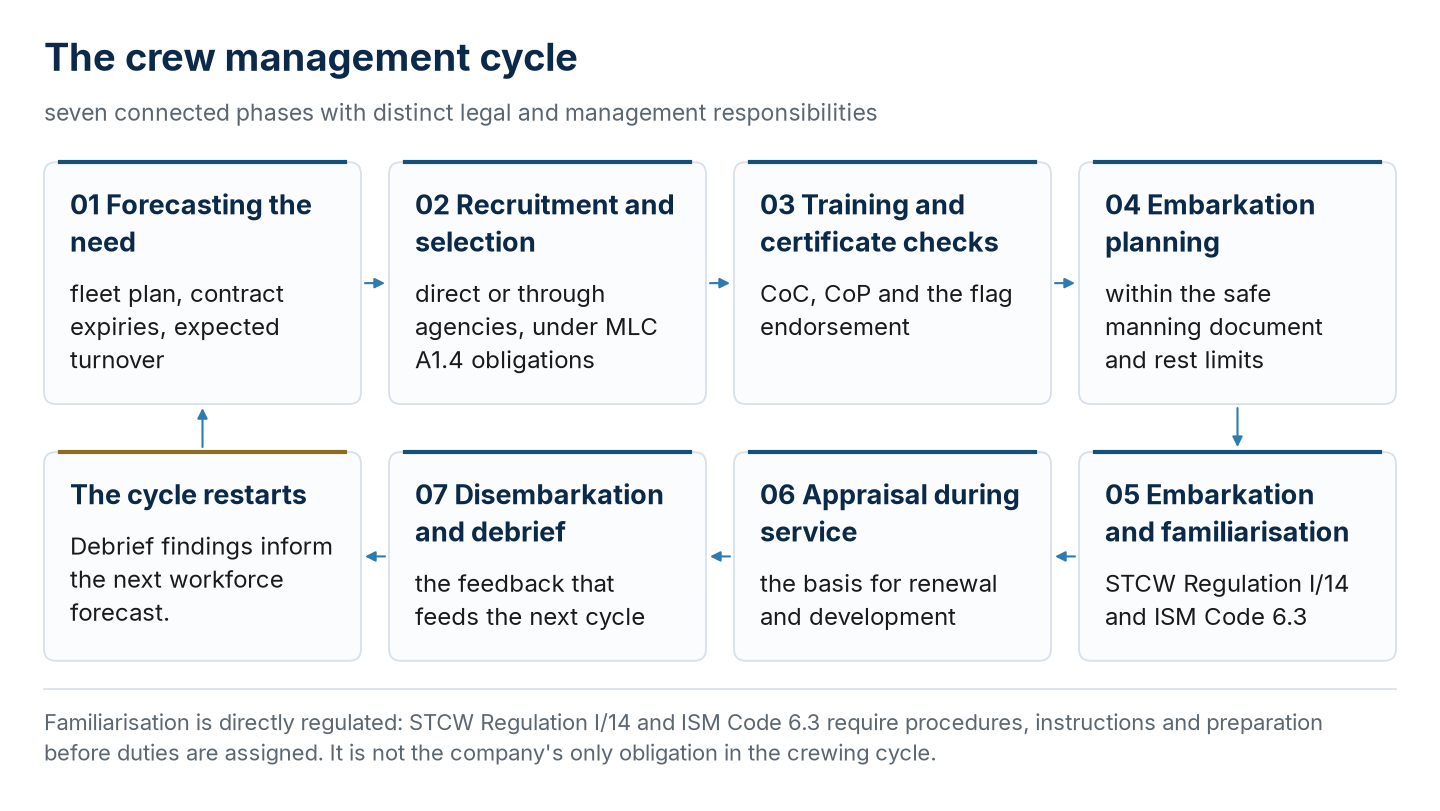
Crewing management is a continuous process, not a series of isolated events: from forecasting needs to post-embarkation evaluation, every phase affects the quality and stability of the fleet's crew.
The main phases
- Forecasting needs, based on the fleet plan, contract expiry dates and expected turnover rates.
- Recruitment and selection, direct or through manning services compliant with the applicable MLC requirements.
- Training and certification verification, consistent with the requirements of the role and the flag.
- Embarkation planning, balancing operational continuity and crew wellbeing.
- Embarkation and familiarisation with the specific ship: a phase directly regulated by STCW Regulation I/14 and ISM Code 6.3.
- Performance evaluation during the assignment.
- Disembarkation and debrief, to gather feedback useful for the next cycle.
STCW I/14 and A-I/14 place responsibilities on the company for familiarisation, instructions and preparation for duties. ISM 6.3 requires procedures for new or reassigned personnel and essential instructions identified, documented and given before sailing. Also check practical ability and coordination; a signature alone does not prove readiness. Assess any deficiency against company responsibilities and onboard implementation rather than automatically assigning it to a single person or category.
Effective crewing management treats every phase as connected to the others: an inaccurate needs forecast generates pressure on recruitment, which in turn can lower selection standards, with cascading effects on the fleet's operational quality.
Key takeaways
- Crewing management is a continuous process, not a series of isolated events: every phase affects the quality of the crew.
- STCW I/14 and ISM 6.3 require familiarisation: check documented instructions and practical ability together.
- An inaccurate needs forecast generates pressure on recruitment and can lower selection standards.
STCW certification requirements
Module objectiveRecognise how STCW requirements arise from crossing level of responsibility with function, and what a certificate authorises.
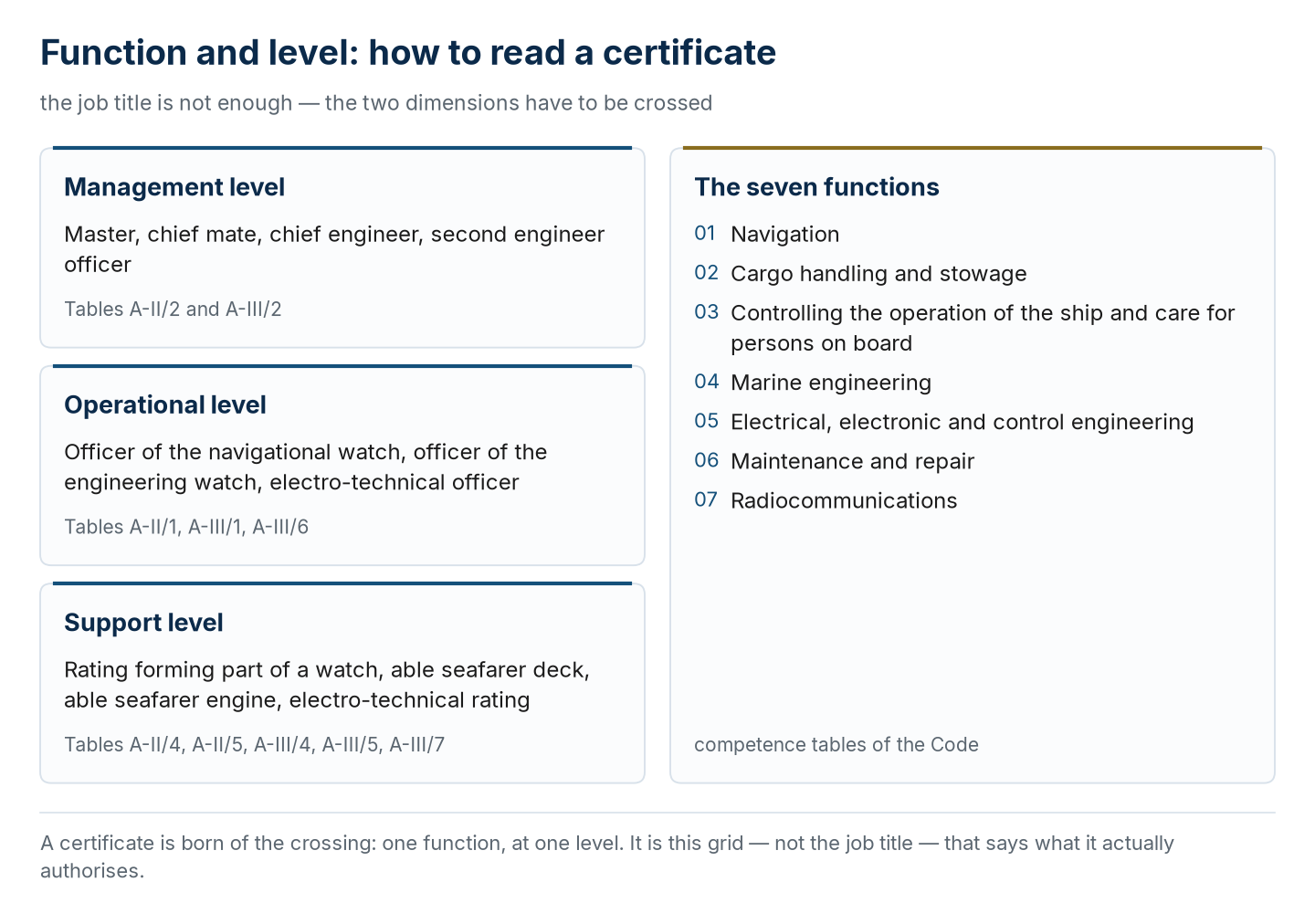
The 1978 STCW Convention (Standards of Training, Certification and Watchkeeping) sets minimum training and certification requirements for onboard roles. The Manila amendments, adopted on 25 June 2010, entered into force on 1 January 2012; the transitional authority to continue issuing, recognising or renewing certificates under the earlier requirements ended on 1 January 2017. The validity of an individual document must still be checked with its issuing Administration and the flag State. Requirements are read by crossing function and level of responsibility.
| Level | General characteristics |
|---|---|
| Management level (Master, Chief Mate, Chief Engineer, Second Engineer) | Overall responsibility; requires experience and higher-level certifications |
| Operational level (officers) | Watchkeeping responsibility and direct supervision of operations |
| Support level (ratings) | Performance of tasks under supervision, with role-specific competence and certification |
Table 2.1 — The three levels of STCW responsibility.
The level alone is not enough: in the competence tables of the Code (A-II/1, A-III/1 and following) it is crossed with the function — navigation; cargo handling and stowage; controlling the operation of the ship and care for persons on board; marine engineering; electrical, electronic and control engineering; maintenance and repair; radiocommunications. It is this grid, not the job title, that says what a certificate actually authorises.
A valid STCW certificate attests compliance with minimum formal requirements, but does not by itself guarantee that the person is ready for the specifics of a particular ship and company. Familiarisation and practical evaluation remain essential even with fully valid certifications.
Management level also includes chief mate and second engineer. Support level is not merely basic training; it requires role-specific competence. Check functions, level, tonnage, power, trading limits and other restrictions on the certificate as well as validity.
Key takeaways
- The transitional authority to use earlier requirements ended on 1 January 2017; each document's validity must still be checked.
- Management, operational and support levels distinguish overall responsibility, watchkeeping and tasks under supervision.
- A valid certificate attests minimum formal requirements, but familiarisation and practical evaluation remain essential.
Seafarer certification, in practice
Module objectiveDistinguish CoC, CoP and the flag endorsement, and the difference between holding a certificate and being able to use it.
The previous module says what competences STCW requires. This one says which documents follow from them, who issues them, how long they last and what it takes to renew them: it is the daily work of a crewing department, and the reason an assignment falls through at the last moment.
Three different documents, often confused
| Document | What it is | Who issues it |
|---|---|---|
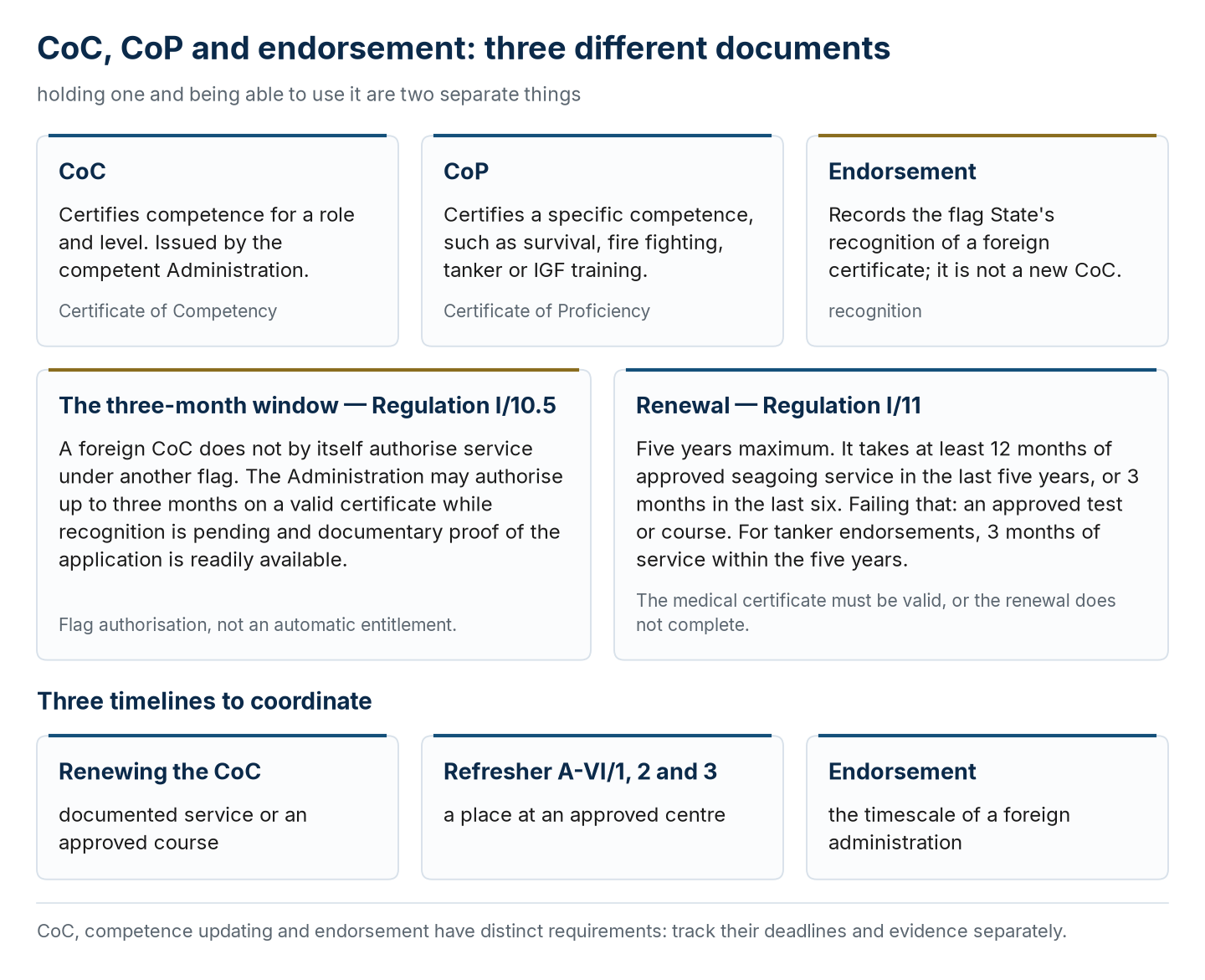
| Certificate of Competency (CoC) | Certifies competence for a role and a level: master, chief mate, chief engineer, officer of the watch. It is the licence | The competent issuing Administration |
| Certificate of Proficiency (CoP) | Certifies a specific, cross-cutting competence: personal survival, advanced fire fighting, fast rescue boats, tanker training, IGF, polar waters, security | The Administration or under its authority, as prescribed for the certificate |
| Endorsement attesting recognition | Not a new certificate: it is the recognition, by the flag State of the ship, of a CoC issued by another State | The Administration of the flag the seafarer is to serve under |
Table 3.1 — The three documents, and the difference between holding one and being able to use it.
A foreign CoC does not by itself authorise service under another flag. In cases covered by Regulation I/10, recognition is required. Regulation I/10.5 allows the flag Administration to authorise service for no more than three months on a valid foreign certificate while recognition is pending and documentary proof of the application is readily available. This is not an automatic entitlement or a cure for an expired certificate. The 2025 PSC Procedures also note that recognition covers the CoPs under Regulations V/1-1 and V/1-2 for masters and officers.
How long it lasts, and what renewal takes
| Requirement | Content |
|---|---|
| Periodicity | For certificates subject to I/11, revalidate at intervals not exceeding five years, with medical fitness and continued competence. |
| Service | Twelve months in total in the preceding five years or three months in the immediately preceding six months, in appropriate functions and approved service (A-I/11). |
| Other accepted routes | Recognised equivalent functions, an approved test, an approved course, or at least three months of approved service in a supernumerary capacity or lower officer rank under A-I/11 and national implementation. |
| Tankers | For required continued competence: three months of appropriate service in the preceding five years or relevant approved course or courses (A-I/11.3). |
| Medical fitness | Check certificate, expiry and restrictions. Medical validity does not necessarily coincide with CoC validity. |
Table 3.2 — Validity and renewal of the certificate of competency.
For competences covered by A-VI/1, A-VI/2 and A-VI/3, continued competence must be demonstrated every five years through routes accepted by the Administration. These cover personal survival and basic fire fighting, survival craft and rescue boats, fast rescue boats (A-VI/2), and advanced fire fighting (A-VI/3). Not every chapter VI course has the same periodic requirement; onboard training is accepted for specified competences. Track required evidence separately from the CoC.
Maintain a calendar showing expiry, competent authority, evidence and processing time for each document. Six- and three-month checks are an organisational choice, not universal STCW deadlines. Revalidation, updating and recognition can proceed in parallel, subject to dependencies. Fewer than twelve months at sea in five years do not automatically require a course; the three-month route within the last six months and other approved A-I/11 alternatives may apply.
The certificates the market is asking for now
For specialist training distinguish current STCW obligations from interim guidance; check ship type, actual duties and flag implementation.
- STCW Regulation V/3, introduced by resolution MSC.396(95) and in force since 1 January 2017, applies to personnel on ships subject to the IGF Code, with basic and advanced levels tied to actual responsibilities for the fuel and its systems.
- STCW V/4 concerns masters and deck officers on ships operating in polar waters. Training level and conditions depend on role and operation alongside the Polar Code; they do not apply identically to the whole crew.
- For new fuels, IMO issued interim guidance, not equivalent to new STCW obligations: generic guidelines in STCW.7/Circ.25 in September 2025 and specific guidelines in July 2026: STCW.7/Circ.26 for methyl/ethyl alcohol and STCW.7/Circ.27 for ammonia. Work on hydrogen, LPG, batteries and fuel cells continues, so issued instruments must be distinguished from work still in development.
Verify authenticity and status with the issuing authority, holder identity, limitations and flag recognition. An endorsement cannot extend the capacity or expiry of the recognised certificate. Keep originals or permitted electronic forms on board with the Administration’s required verification. For tankers, IGF ships, passenger ships, polar operations and security, build a duty-based applicability matrix; the general competence table alone is insufficient.
Key takeaways
- Regulation I/10.5 lets the flag authorise up to three months on a valid foreign certificate with a documented recognition application.
- STCW revalidation requires medical fitness and continued competence through approved service or other accepted routes.
- Revalidation, updating and endorsement have distinct deadlines and dependencies to plan before joining.
The true cost of turnover
Module objectiveRecognise the visible and hidden components of crew turnover cost and their effect on crewing management economic assessments.
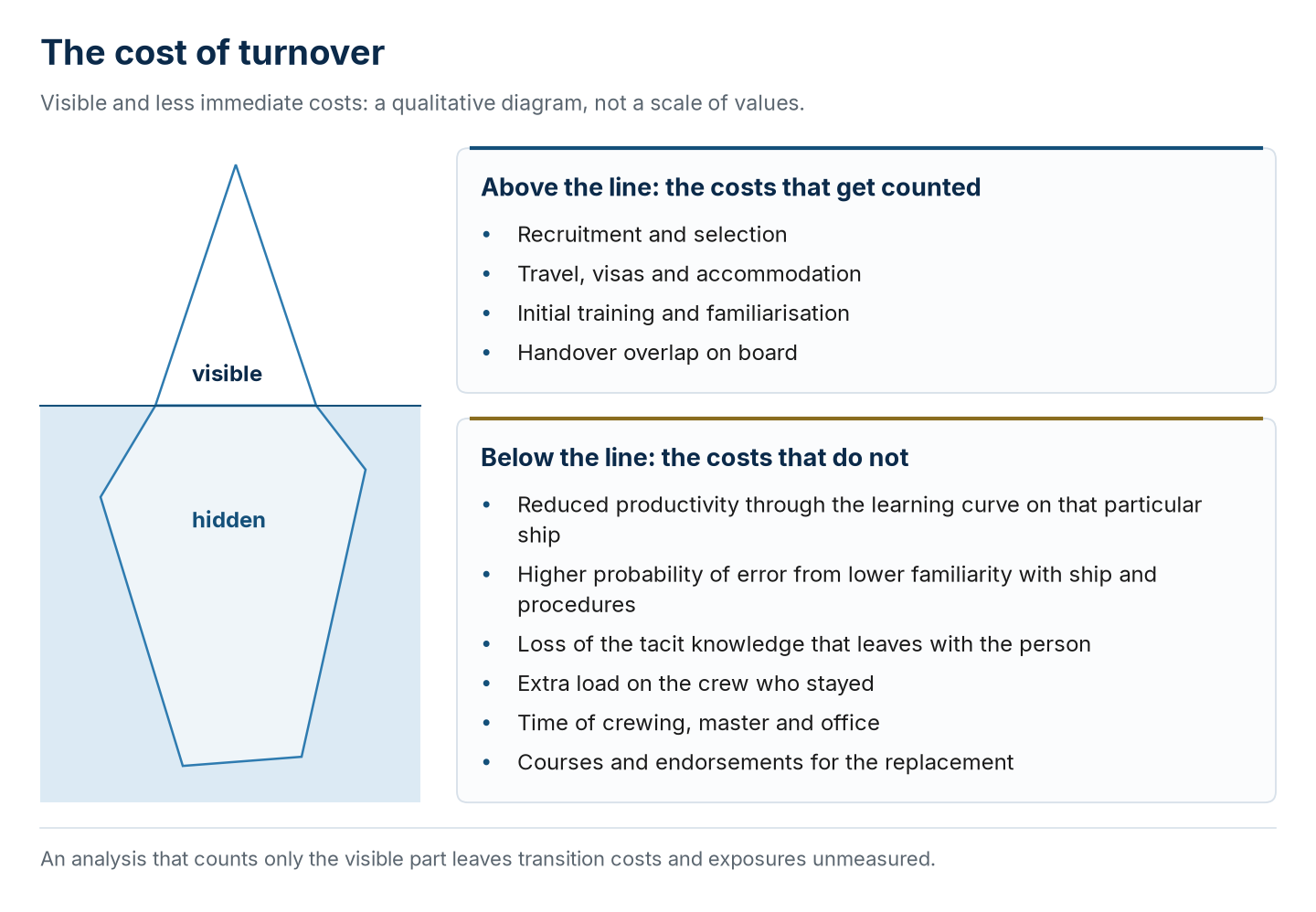
Crew turnover has a cost that goes well beyond the direct expenses of recruitment and travel, often underestimated in crewing management economic assessments.
| Type of cost | Example |
|---|---|
| Direct and visible | Recruitment, travel, initial training expenses |
| Reduced productivity | Time needed for the new member to reach full productivity |
| Operational risk | Higher likelihood of error due to lower familiarity with the ship and procedures |
| Loss of tacit knowledge | Experience accumulated on the specific ship that leaves with the person |
Table 4.1 — Components of turnover cost, visible and hidden.
An analysis limited to recruitment, travel and initial training excludes ship-specific experience, time to integrate and operational exposure during transition. Their weight must be estimated from company data; the course does not assume a universal ratio between visible and indirect costs.
Estimate incremental cost against a planned rotation; travel and training may also occur without turnover. Do not count courses, familiarisation time and productivity loss twice. Separate measured costs from unquantified risk exposure.
Key takeaways
- Recruitment, travel and initial training expenses are the direct and visible part of turnover cost.
- Turnover may reduce productivity and ship-specific knowledge; distinguish observed costs from potential risks.
- Considering only direct replacement costs can lead to undervaluing investment in retention.
Retention drivers
Module objectiveRecognise what actually retains a qualified seafarer beyond pay, in order to build effective retention policies.
Understanding what actually retains a qualified seafarer at a company, beyond pay alone, is central to building effective retention policies in a global and competitive maritime labour market.
Beyond pay
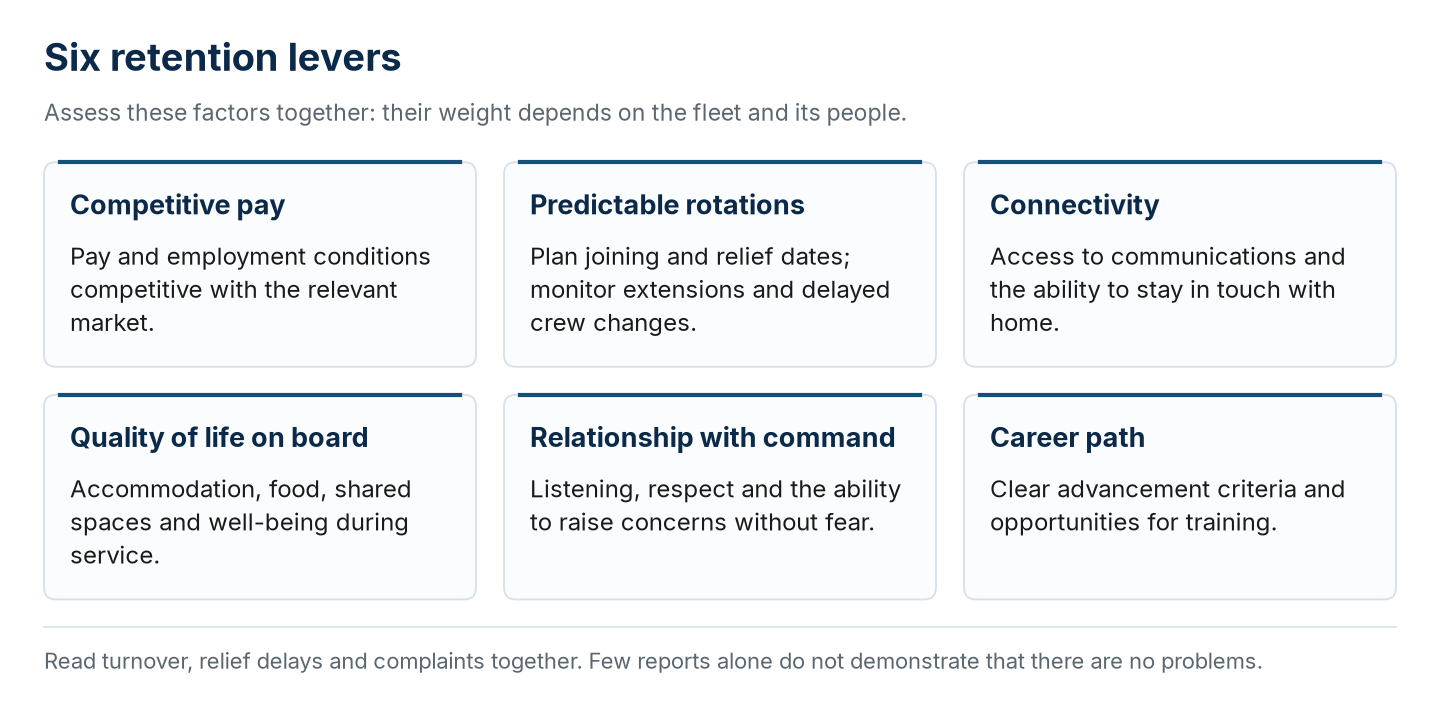
Pay, onboard quality of life, connectivity, predictable rotations, relations with command and career development are six levers proposed in this course. They are neither a universal ranking nor an exhaustive list. Assess their importance through interviews, exit reasons and fleet data, separating associations from causal effects.
Reasonably reliable joining and leaving dates support personal planning. A company can test their association with retention by comparing schedule variance, extensions and contract renewals rather than assuming an identical causal effect across every fleet.
Few complaints do not prove satisfaction or absence of problems. High turnover may have several causes; check trust in reporting channels, exit reasons and actual renewal opportunities.
Key takeaways
- Beyond pay, quality of life on board, connectivity and the relationship with the command can influence retention.
- Predictable rotations help seafarers plan their personal lives and can support willingness to renew their commitment.
- The six proposed levers are not exhaustive; interpret turnover and complaints alongside interviews and exit reasons.
Managing multiculturalism
Module objectiveDistinguish the working-language duty in SOLAS V/14.3 from the bridge-English requirement in V/14.4 for ships to which it applies.
Most merchant crews today are multinational, with compositions varying by rank and by company. Effectively managing this diversity is a distinctive competence of modern crewing management.
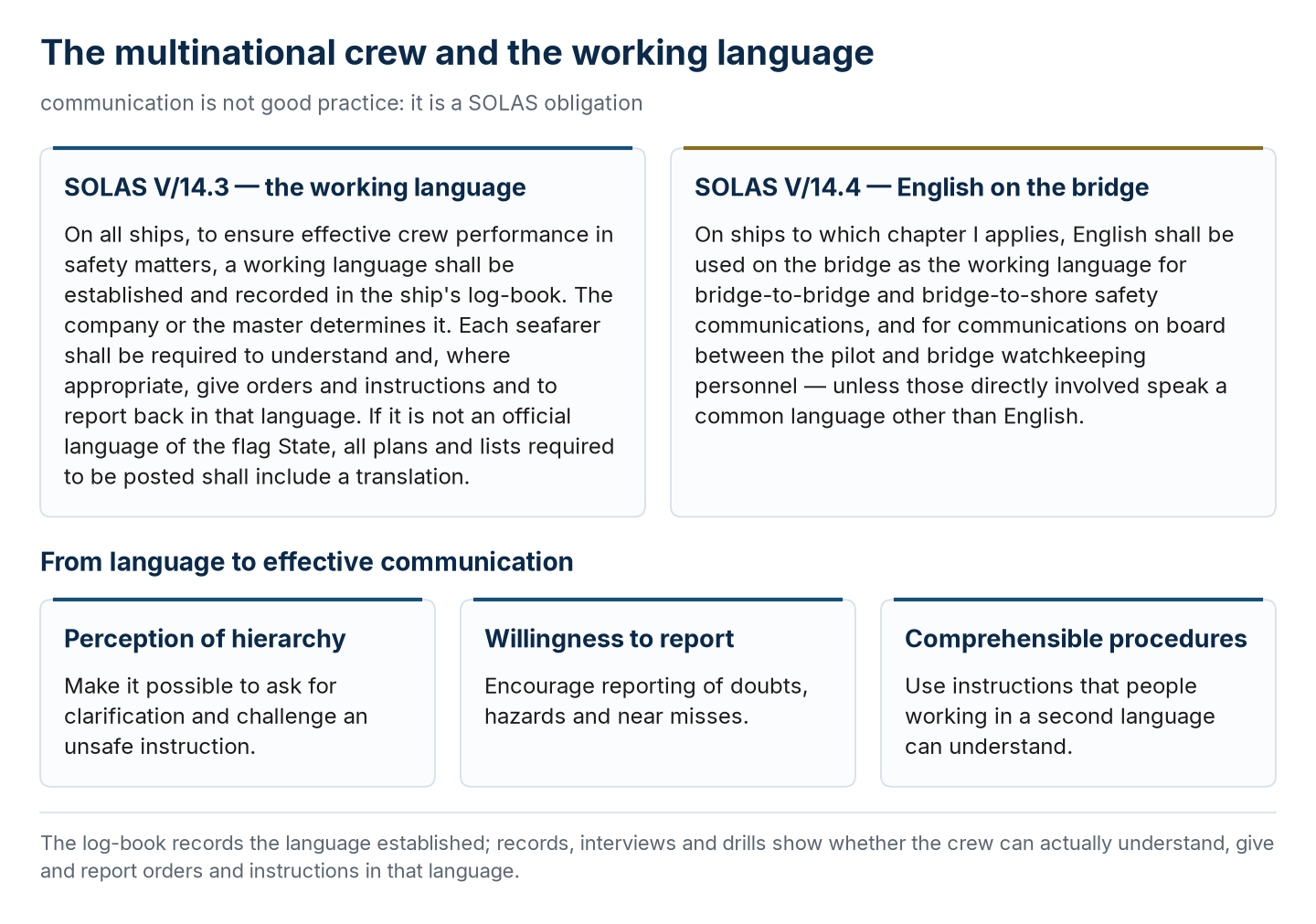
The working language is not good practice: it is a SOLAS obligation
SOLAS Regulation V/14 contains two communication duties with different scope: paragraph 3 establishes the shipboard working language, while paragraph 4 concerns bridge safety communications on ships to which chapter I applies.
| Provision | What it requires |
|---|---|
| SOLAS V/14.3 the working language | On all ships, to ensure effective crew performance in safety matters, a working language shall be established and recorded in the ship’s log-book. The company or the master determines it. Each seafarer shall be required to understand and, where appropriate, give orders and instructions and to report back in that language. If it is not an official language of the flag State, all plans and lists required to be posted shall include a translation |
| SOLAS V/14.4 English on the bridge | On ships to which chapter I applies, English shall be used on the bridge as the working language for bridge-to-bridge and bridge-to-shore safety communications, and for communications on board between the pilot and bridge watchkeeping personnel — unless those directly involved in the communication speak a common language other than English |
Table 6.1 — The two communication obligations of Regulation V/14.
The log-book documents the working language established, while records, interviews and drills can show whether the crew can actually understand, give and report orders and instructions in it. Verification therefore concerns both documentary evidence and operational effectiveness; there is no universal inspection sequence.
The practical challenges
- Language barriers that can compromise communication in critical situations.
- Cultural differences in the perception of hierarchy and the propensity to report problems to a superior.
- Need for procedures and training translated or otherwise understandable to the whole crew.
Even when the common working language on board is formally shared, cultural differences in communication (for example in the propensity to voice disagreement with a superior) can generate dangerous misunderstandings in critical situations. Training on these topics goes beyond a simple language course.
Read the “all ships” requirement within chapter V’s scope and relevant national provisions. Required plans and lists must include translation into the working language. Check understanding through read-back, drills and the ability to ask questions, without inferring individual ability from nationality.
Key takeaways
- The working language shall be established and recorded in the ship's log-book, and the company or the master determines it.
- The log-book documents the working language; mutual understanding requires a separate, substantive check.
- Even with a shared common language, cultural differences in voicing disagreement can generate dangerous misunderstandings.
Sizing the crew: the minimum safe manning document
Module objectiveRecognise who sets a ship's minimum complement, on what criteria, and what the minimum safe manning document contains.
Before planning assignments, the required number and qualifications must be known. The company submits its proposal; the flag Administration assesses and approves the minimum complement and issues the document to be carried on board.
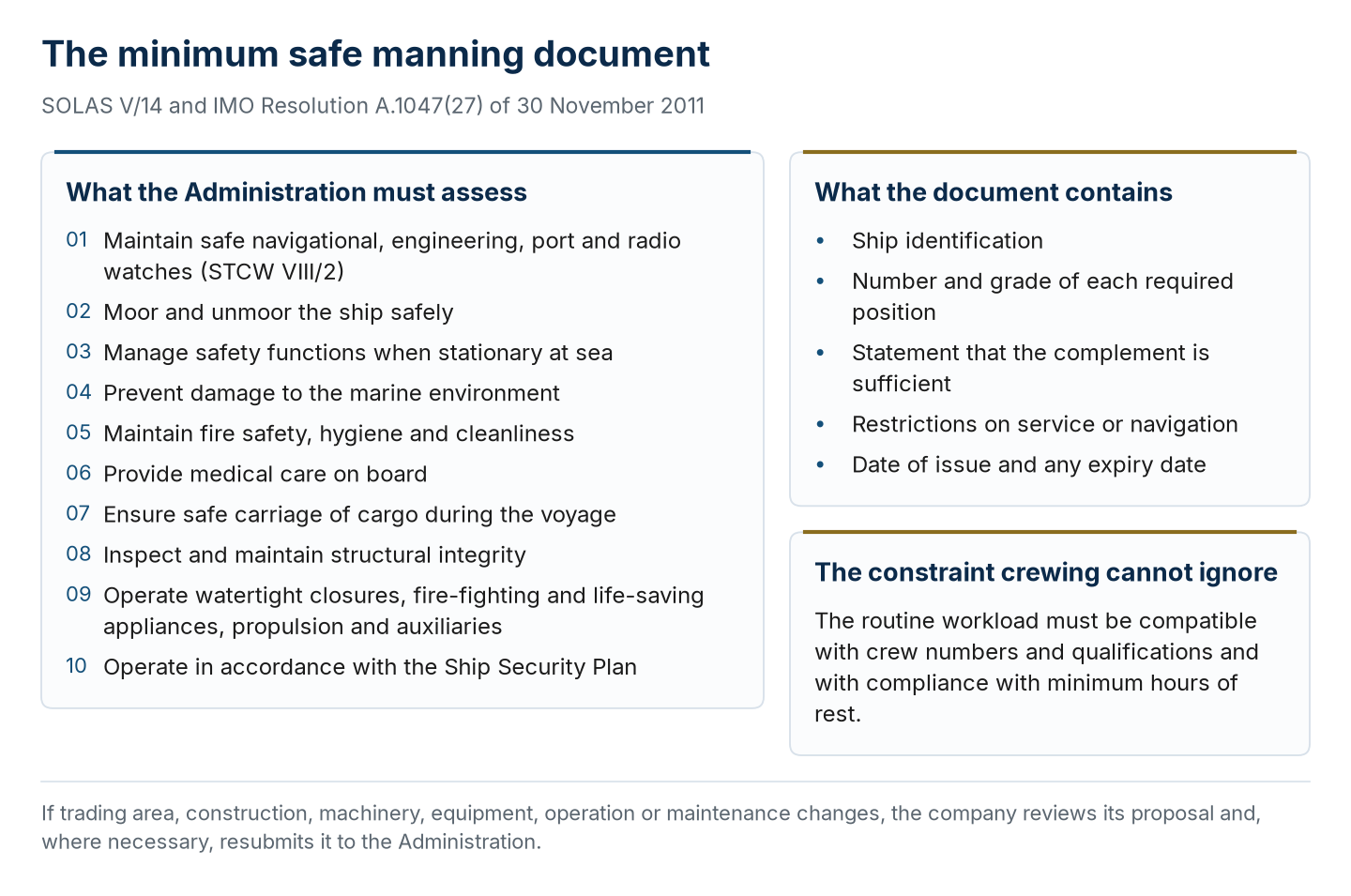
SOLAS V/14 and the Minimum Safe Manning Document
SOLAS V/14.1 requires flag-State ships to be sufficiently and efficiently manned for safety. The minimum safe manning document or equivalent under V/14.2 concerns ships to which chapter I applies; national law may impose additional requirements. IMO resolution A.1047(27), adopted on 30 November 2011, provides principles, recommendations and criteria for proposals and assessment, replacing A.890(21) and A.955(23).
What the Administration must assess
No universal formula is sufficient: estimate workload, simultaneous tasks, qualifications and duty coverage, checking at least the following functions.
- Maintain safe navigational, engineering, port and radio watches, in accordance with STCW Regulation VIII/2.
- Moor and unmoor the ship safely.
- Manage the safety functions when the ship is stationary or nearly stationary at sea.
- Prevent damage to the marine environment.
- Maintain fire safety and conditions of hygiene and cleanliness.
- Provide medical care on board.
- Ensure safe carriage of cargo during the voyage.
- Inspect and maintain the structural integrity of the ship.
- Operate watertight closures, fire-fighting and life-saving appliances, main propulsion and auxiliary machinery.
- Operate in accordance with the Ship Security Plan.
Emergency response must be covered. A.1047(27) requires the proposal to account for non-emergency workload and compliance with hours-of-rest limits. Changes affecting trading area, construction, machinery, equipment, operation or maintenance require the company to review its proposal and, where necessary, resubmit it to the Administration.
What the document contains
- Ship identification: name, IMO number, tonnage and propulsion power, as applicable to the model used.
- The number and grade of each required position.
- The statement that the ship is considered safely manned with that complement.
- Any restrictions on the nature of service or navigation.
- Date of issue and any expiry date, if applicable, with the Administration's authentication.
The MSMD is a minimum requirement and does not authorise ignoring actual workload, rest, qualifications or document conditions. Where actual service needs more people, adjust resources and planning and seek flag review where necessary. An ETO may already be required; it is not inherently an optional resource. Cadets and trainees do not automatically replace a required position; check qualifications and national conditions, including supernumerary arrangements.
Key takeaways
- Manning requires assessment of tasks, workload and qualifications; a universal formula is insufficient.
- The company proposes and the Administration approves the complement; material changes to the ship, area or workload call for review.
- The MSMD alone is insufficient: actual workload, qualifications, rest and operating conditions must remain compliant.
Embarkation planning
Module objectivePlan embarkation rotations balancing operational continuity, crew wellbeing and costs within MLC limits on length of service.
Planning embarkation rotations balances competing needs: the ship's operational continuity, crew wellbeing, travel costs and regulatory constraints on hours of rest and maximum length of service.
Principles of effective planning
- Respect the applicable service-on-board limit. Under MLC Standard A2.5.1.2(b), national laws, regulations or collective agreements must set a maximum period below twelve months; a SEA, CBA or national rule may set a shorter period. Current Standard A2.4.2 also provides at least 2.5 calendar days of leave per month of employment, but this does not automatically make every contract an eleven-month assignment.
- Plan far enough in advance to allow seafarers to organise their personal lives.
- Avoid systematic unplanned extensions, which erode trust in the system.
- Balance ship-specific experience with relief planning and adequate leave.
Repeated extensions call for cause analysis: inadequate relief pools, document delays, travel, port calls and external constraints may contribute. Record the original agreed date, reason, revised plan and safeguards. Individual agreement does not authorise exceeding applicable limits; do not wait until the maximum period to start repatriation planning.
Check rest in rolling windows and travel before joining, availability for handover and recovery from jet lag. Under the normal rest regime: at least ten hours in any twenty-four hours and seventy-seven in seven days; STCW and MLC exceptions need separate checks. Travel does not automatically provide effective rest.
Key takeaways
- Applicable laws, regulations or collective agreements must set maximum service on board before repatriation below twelve months.
- Planning rotations far enough in advance allows seafarers to organise their personal lives.
- Recurring unplanned extensions require analysis of planning, documents, travel and external constraints.
Training and career development
Module objectiveRecognise the elements of a good development path and the link between ongoing training, retention and compliance requirements.
Investing in ongoing training and clear career paths is one of the most effective retention levers, as well as being a compliance requirement in many areas (STCW, TMSA, as seen in the Vetting course).
Elements of a good development path
- Clear advancement paths that are communicated, not left to informality or chance.
- Up-to-date technical training on emerging topics (decarbonisation, digitalisation, new fuels).
- Mentoring programmes between senior and junior officers, transferring tacit knowledge beyond formal training alone.
Mandatory training maintains eligibility for the role; mentoring, technical updating and advancement pathways also pursue development and retention. Their effect should be tested by cohort and rank through participation, promotion and renewal data, not assumed.
From 1 January 2026 MSC.560(108) adds competence in preventing and responding to violence and harassment to PSSR table A-VI/1-4. Check training actually completed, issuing authority and implementation for existing holders; the CoC date alone establishes neither exemption nor a duty to repeat every course. As a national example, MCA MGN 718 of 18 August 2026 updates UK policy; its arrangements and deadlines do not automatically apply to other flags.
Key takeaways
- Advancement paths need to be clear and communicated, not left to informality or chance.
- Technical training has to stay up to date on emerging topics: decarbonisation, digitalisation and new fuels.
- Treating training as career development rather than only compliance can support both competence and retention.
The role of manning agencies
Module objectiveAssess a manning agency against the selection criteria and recognise the obligations MLC 2006 places on recruitment services and on the shipowner.
Many companies rely, wholly or in part, on manning agencies for recruitment and administrative crew management, especially for ratings and for recruitment pools geographically distant from the company's head office.
Criteria for selecting a manning agency
| Criterion | Why it matters |
|---|---|
| Applicable licensing, authorisation and control systems | Provide verifiable process evidence without guaranteeing every individual outcome |
| Track record and reputation | Documented history of complaints, failures, response times and reliability towards seafarers and the shipowner |
| Geographical coverage and recruitment pool | Access to qualified personnel in areas relevant to the company |
| Quality of post-recruitment support | Ongoing assistance during the assignment, not just at selection |
Table 10.1 — Criteria for selecting a manning agency.
Not merely a commercial choice: the MLC imposes precise obligations
Regulation 1.4 and Standard A1.4 of MLC 2006 govern recruitment and placement services. Their obligations are binding, and they are also what an inspection checks.
| Obligation | Content |
|---|---|
| No charge to the seafarer | No recruitment fee or charge may be borne by the seafarer, directly or indirectly. Exceptions cover the national statutory medical certificate, seafarer's book and passport; visas are for the shipowner's account (A1.4.5(b)) |
| System of protection | Insurance or an equivalent measure must cover monetary loss caused by failure of the service or shipowner (A1.4.5(c)(vi)); the 2022 amendments require information before or during engagement |
| No blacklisting | No means, mechanisms or lists intended to prevent or deter seafarers from gaining employment (A1.4.5(a)) |
| Register | An up-to-date register of all seafarers recruited or placed must be maintained (A1.4.5(c)(i)) |
| Non-ratifying countries | A shipowner using a service in a non-ratifying State must ensure, as far as practicable, that it meets Standard A1.4 (Regulation 1.4.3 and Standard A1.4.9) |
Table 10.2 — The MLC obligations on recruitment and placement services.
For a service in a non-ratifying State, the shipowner should be able to show the measures used to ensure compliance as far as practicable: due diligence, contract clauses, risk-based audits and checks on charges and protections communicated to seafarers. Documents and interviews may be used together to test whether the system works.
Recruitment-service protection for monetary loss is distinct from abandonment security under A2.5.2. Also check handling and referral of unresolved complaints to the competent authority, credential verification and the opportunity to read the SEA before signing. Audits and interviews are verification tools, not a universal certification imposed on every agency.
Key takeaways
- Certification, track record, geographical coverage and post-recruitment support are factors to verify alongside other evidence.
- No recruitment fee may fall on the seafarer, apart from the medical certificate, the seafarer's book and the passport.
- For a service in a non-ratifying country, the shipowner must ensure, as far as practicable, that it meets the applicable MLC requirements.
Crewing management KPIs
Module objectiveRead the crewing management KPI dashboard with its calculation formulas and link its indications to vetting and PSC indicators.
Crewing management can use a dashboard of indicators. The formulas below are management definitions proposed by the course, not statutory definitions; comparisons require a stable scope and calculation method.
| KPI | Proposed definition | Interpretation |
|---|---|---|
| Exit turnover | Confirmed exits from the company pool in the period ÷ average size of that same pool. | Define when a person has left; do not treat ordinary sign-off or leave as an exit. |
| Accepted renewal rate | Seafarers accepting a new assignment offer within a defined window ÷ seafarers in the same cohort with a valid offer and observable decision. | Report no offer, unavailability and pending cases separately. This is not the complement of turnover. |
| Time-to-fill to joining | Days from position opening to actual joining; report median and ageing of unfilled positions. | Distinguish selection, acceptance and travel; include open positions in the interpretation. |
| Overdue relief rate | Reliefs due in the period completed late or still pending at observation date ÷ all reliefs due in the period. | Preserve the original agreed date. Distinguish delay, duration and any MLC limit breach. |
| Cadet-to-officer conversion | Cohort cadets obtaining their first CoC within a declared horizon ÷ cadets entering that same cohort. | State observation duration, drop-outs and ongoing pathways; avoid comparing cohorts of different ages. |
Table 11.1 — Proposed management definitions: state period, cohort, unit of observation and exclusions. Express ratios as percentages by multiplying by one hundred. Consistent definitions make indicators comparable.
Compare crewing KPIs with PSC/vetting findings to develop hypotheses, without automatically inferring a common cause. Account for rank, ship, exposure, and inspection number and depth. An operational delay is not automatically an MLC breach; compare it with the SEA, CBA and national limit, which must be below twelve months under A2.5.1.2(b).
Key takeaways
- Each KPI needs an explicit period, cohort, formula and exclusions for reliable comparisons.
- Turnover and non-renewal measure different events; segment by rank and record reasons for leaving.
- Measure overdue reliefs even when not yet completed; assess any MLC breaches separately.
Crewing and operational safety
Module objectiveRecognise crewing management as an operational safety function, not merely an administrative one, in the decisions that concern the crew.
Turnover, training gaps and fatigue can increase risk exposure. Their contribution to an incident must be established from evidence; this course does not provide a universal statistical ranking of causes.
The link with the superintendent's span of control
As seen in the Marine Superintendent course, an excessive span of control reduces the quality of technical supervision; similarly, an excessive crewing management workload for staff reduces the quality of selection, training and embarkation planning, with cascading effects on safety.
Fatigue has dedicated guidelines, and they are addressed ashore too
The Guidelines on Fatigue, MSC.1/Circ.1598 of 24 January 2019, approved by MSC 100, replace the previous 2001 guidance MSC/Circ.1014. The six modules cover fatigue; the company; the seafarer; awareness and training; ship design; and the Administration and port State authorities. Module 2 connects resources, work organisation and shore support. These are risk-management guidelines, not new numerical limits replacing STCW and MLC.
Treating crewing management as a purely administrative function, distinct from operational safety management, ignores how deeply the two areas are actually interconnected: a well-selected, well-trained and stable crew is one of the most effective defences against human error.
Key takeaways
- Turnover, training gaps and fatigue can increase risk; their contribution to incidents requires evidence.
- An excessive crewing management workload can weaken selection, training and embarkation planning.
- The Guidelines on Fatigue MSC.1/Circ.1598 are organised in modules for different audiences, including the company ashore.
Emerging trends
Module objectiveRecognise how the supply and demand for seafarers is changing: an officer shortage alongside a ratings surplus, and the ongoing STCW review.
Crewing management is evolving driven by demographic, technological and regulatory changes in the global maritime labour market.
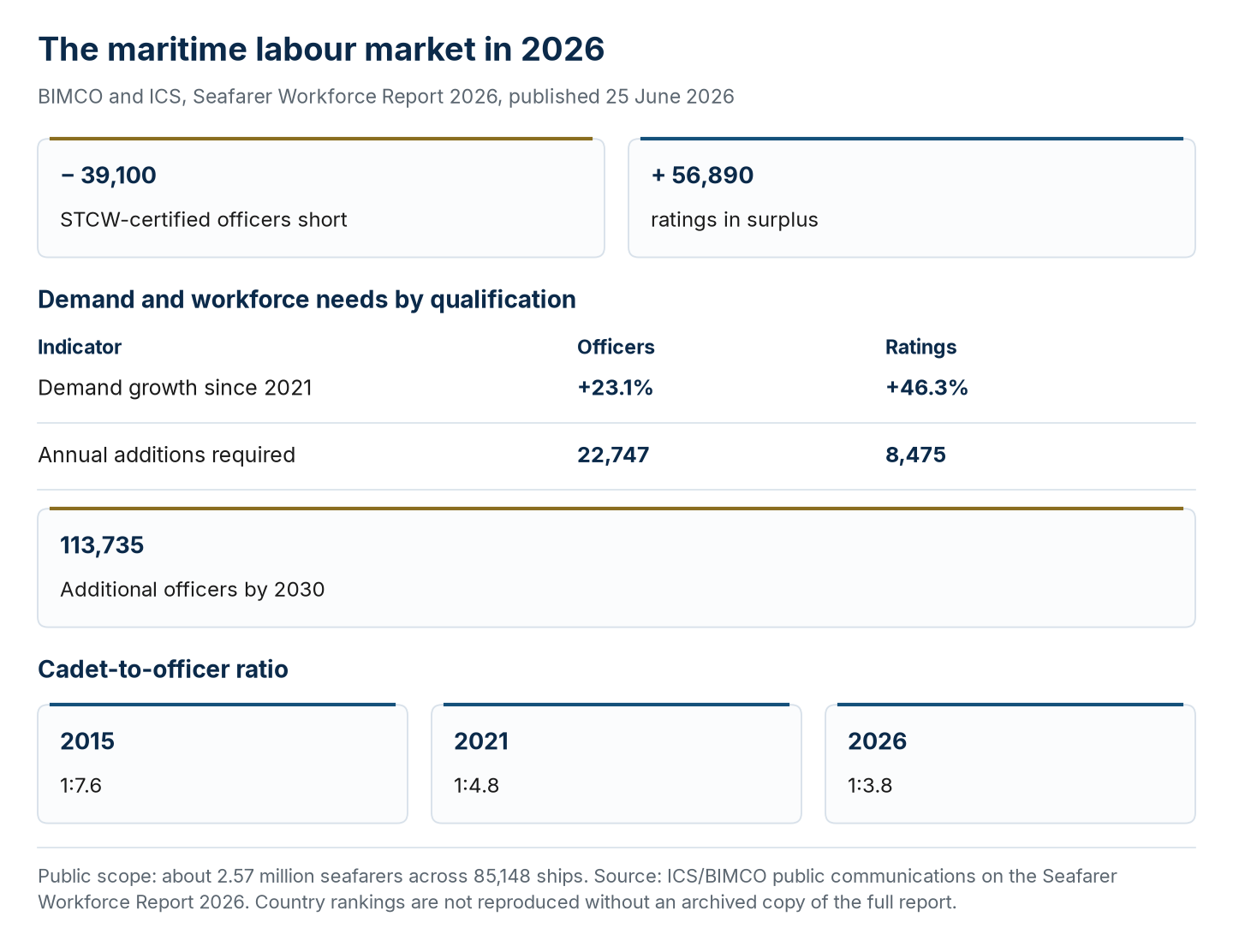
The market, in figures
The Seafarer Workforce Report 2026 from BIMCO and ICS, published on 25 June 2026, measures what the industry usually describes by impression.
| Public indicator | 2026 |
|---|---|
| Report scope | About 2.57 million seafarers across 85,148 ships |
| Shortage of STCW-certified officers | 39,100 |
| Surplus of ratings | 56,890 |
| Annual additions required | 22,747 officers and 8,475 ratings |
| Demand growth since 2021 | +23.1% officers; +46.3% ratings |
| Cadet-to-officer ratio | 1:3.8 (1:4.8 in 2021; 1:7.6 in 2015) |
| Additional officers required by 2030 | 113,735 |
Table 13.1 — Data from public ICS/BIMCO communications on the Seafarer Workforce Report 2026.
ICS/BIMCO global estimates for 2026 indicate a deficit of 39,100 officers and a surplus of 56,890 ratings. They do not establish immediate availability for a particular qualification, flag or route. The cadet/officer ratio moves from 1:7.6 in 2015 to 1:3.8 in 2026, but is not a completion or promotion rate; training berths, mentoring and time are needed to qualify. Projections to 2030 are scenarios, not observed outcomes.
What the figures support
The verifiable operating signal is not a single headcount but an imbalance between qualifications. Forecasting, turnover, time-to-fill and the training pipeline should therefore be segmented by rank, ship and technology. Detailed supply-country rankings are not reproduced because they are not verifiable in the public communications archived for this demo.
Directions to watch
- Growing competition for officers and new competences linked to alternative fuels and technologies.
- The comprehensive STCW review continues at IMO; proposals under discussion must not be presented as adopted requirements.
- IMO work on fatigue and hours of work and rest should be followed alongside STCW and MLC implementation.
- Digitalisation of selection, training and performance evaluation requires data governance.
- The 2025 MLC amendments are approved but not yet in force on 15 September 2026; entry is expected on 23 December 2027, subject to Article XV and the State concerned. The future shore-leave Standard includes visa exemption and reasons for refusal, alongside conditions concerning formalities, health, safety and operations. Recognition of seafarers as key workers is a recommendation in future Guideline B2.5.2.
New technologies and fuels may create specific skill needs. Map fleet requirements against available personnel, training lead times and approved pathways; do not assume every investment automatically produces a competitive advantage.
Key takeaways
- Global 2026 estimates indicate an officer deficit and ratings surplus; they do not measure local availability for every role.
- The cadet-to-officer ratio improved from 1:7.6 in 2015 to 1:3.8 in 2026, but training an officer takes time.
- MLC 2025: entry expected on 23 December 2027; distinguish future Standards from Guideline recommendations.
Building an integrated crewing strategy
Module objectiveRecognise crewing management as a strategic function integrated with technical, HSEQ and commercial functions, and the components of an integrated strategy.
The most effective companies treat crewing management as a strategic function integrated with technical, HSEQ and commercial functions, not as an isolated administrative activity.
The components of an integrated strategy
- Needs forecasting aligned with the fleet development plan, including the competencies required by decarbonisation.
- Retention policies based on real data, not just intuition.
- Ongoing training seen as a strategic investment, not a compliance cost.
- Integrated monitoring of crewing KPIs together with safety, vetting and PSC KPIs.
An integrated strategy connects competence, continuity and resources to fleet needs. Define responsibilities, timing, budget and verification criteria; compare results and operating conditions without promising automatic improvement in every indicator.
Assign data access and retention according to role and applicable law. Health data need particular protection; joining plans need relevant fitness and restrictions without indiscriminate disclosure of diagnoses. Document responsibilities and handovers between crewing, HSEQ, command and administration.
Key takeaways
- Needs forecasting is aligned with the fleet development plan and with the competencies required by decarbonisation.
- Crewing KPIs are monitored together with safety, vetting and PSC KPIs.
- Treating the crew as a strategic asset directs decisions towards competence, continuity and integrated outcomes, not cost alone.
Recurring mistakes
From the Mistake Library of SuperbaKnowledge, filtered to the subjects this course covers. This view selects and organises content published in SuperbaKnowledge; it does not modify or replace it. The linked Knowledge page remains the reference version, while official texts remain authoritative.
| Topic | Mistake | Typical consequence | Topic sheet |
|---|---|---|---|
| Crew familiarisation | Treated as a signature exercise without knowledge transfer | Documented crew unprepared for the specific ship | See topic sheet |
| Crew fatigue | Rest hours recorded without testing the real workload | Apparent compliance that does not control fatigue | See topic sheet |
| MLC complaints | Procedure not explained to the seafarer on joining | A right that is difficult to exercise and a possible MLC deficiency | See topic sheet |
| Violence and harassment | Training renewed without checking the programme actually completed | Gap between certificate, competence and applicable requirements | See topic sheet |
Glossary of acronyms
| Acronym | Definition |
|---|---|
| CBA | Collective Bargaining Agreement |
| CoC | Certificate of Competency, for a role and a level |
| CoP | Certificate of Proficiency, for a specific competence |
| ETO | Electro-Technical Officer |
| GMDSS | Global Maritime Distress and Safety System |
| HTW | Human Element, Training and Watchkeeping: the IMO Sub-Committee conducting the STCW review |
| IGF Code | International Code of Safety for Ships using Gases or other Low-flashpoint Fuels |
| ITF | International Transport Workers’ Federation |
| MLC | Maritime Labour Convention 2006 |
| MSMD | Minimum Safe Manning Document |
| SEA | Seafarer Employment Agreement |
| STCW | Standards of Training, Certification and Watchkeeping for Seafarers |
| TMSA | Tanker Management and Self Assessment |
References and sources
- STCW — revalidation: MCA, national implementation example
- STCW — soprannumero: MIT, circolare 48/2024
- PSSR — MSC.560(108)
- PSSR — MCA MGN 718, UK implementation
- MLC — testo consolidato / consolidated text (2022)
Consolidated source list. Status verified on 15 September 2026.
| Source | Scope and status |
|---|---|
| STCW 1978, as amended | Regulations I/10, I/11, I/14, V/3 and V/4 and Code tables: certification, recognition, company responsibilities and special training |
| SOLAS V/14 and IMO resolution A.1047(27) | Proposal, assessment and review of minimum safe manning |
| IMO resolution A.1206(34) | 2025 PSC Procedures: STCW certificates, recognition, rectification and control criteria |
| MLC 2006 consolidated with 2022 amendments | Current text: recruitment and placement, leave and repatriation; 2022 amendments in force from 23 December 2024 |
| 2025 MLC amendments | Not yet in force; expected 23 December 2027. Standard and Guideline are distinguished |
| MSC.1/Circ.1598 | IMO Guidelines on Fatigue, 24 January 2019 |
| IMO — training for the energy transition | STCW.7/Circ.25 (2025), .26 and .27 (2026), plus continuing work |
| ICS/BIMCO, Seafarer Workforce Report 2026 | Public indicators on population, shortage/surplus, demand and requirements to 2030 |
| ICS — cadet pipeline | Cadet-to-officer ratio in 2015, 2021 and 2026 and distinction between certification and familiarisation |
This course is educational material for training purposes and does not constitute a professional certification or qualifying credential. Read the full disclaimer.