
Cargo Operations, Laytime and Demurrage
Commercial voyage management
Learning objectives
- Distinguish the main types of charter party and the different role of laytime in each.
- Correctly manage the Notice of Readiness, laytime sequence and related exceptions.
- Conceptually calculate demurrage and despatch and understand their economic impact.
- Interpret the most common laytime clauses (WWD SHINC, SHEX, WIBON and similar).
- Prepare a solid, defensible Statement of Facts in the event of a dispute.
- Manage the supercargo's role and the relationship between ship, terminal and charterer during loading operations.
- Recognise the typical path for resolving a demurrage dispute.
Types of charter party and the role of laytime
Module objectiveDistinguish contractual forms and mechanisms for pricing time.
This course addresses the commercial aspects of cargo operations: charter parties, NOR, laytime and demurrage. It is not a complete technical cargo-handling course. Case-law examples concern English law; identify the applicable law and clauses for each contract.
Before addressing the mechanics of laytime and demurrage, it is necessary to place them within the correct type of charter contract: their relevance changes radically depending on the contractual form chosen by the parties.
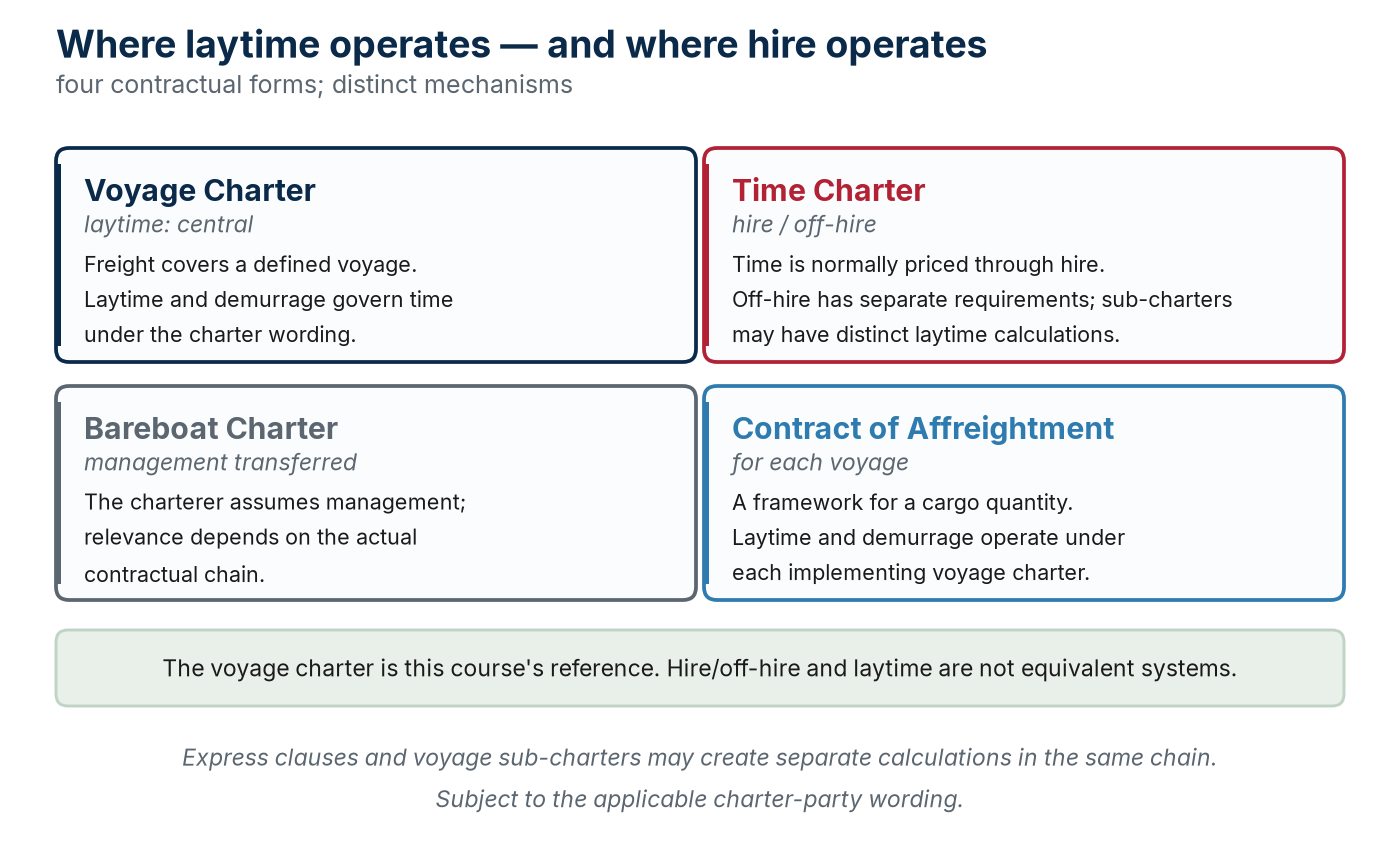
| Contract type | Role of laytime |
|---|---|
| Voyage Charter | Central: the freight covers a specific voyage and laytime/demurrage are key clauses of the contract |
| Time Charter | Laytime and demurrage are not normally the mechanism by which time is priced between the owner and the time charterer: hire runs under the charter and is suspended only when the requirements of the off-hire clause are met. Express provisions and voyage sub-charters may nevertheless create separate laytime and demurrage calculations within the same contractual chain. |
| Bareboat Charter | Not applicable in the typical form: the charterer manages the entire operation, including the commercial aspect of the voyage |
| Contract of Affreightment (CoA) | Relevant for each individual voyage included in the framework agreement |
Table 1.1 — The role of laytime in different forms of charter party.
The Voyage Charter is the ground on which laytime and demurrage produce their most direct and frequent effects: this is why it is the main reference for this course, while also referring to other contractual forms where relevant.
Key takeaways
- The voyage charter is the course’s main reference.
- Hire/off-hire and laytime have separate requirements.
- A CoA is a framework: check the terms of individual voyages.
Notice of Readiness and the start of laytime
Module objectiveCheck NOR validity and the commencement of laytime.
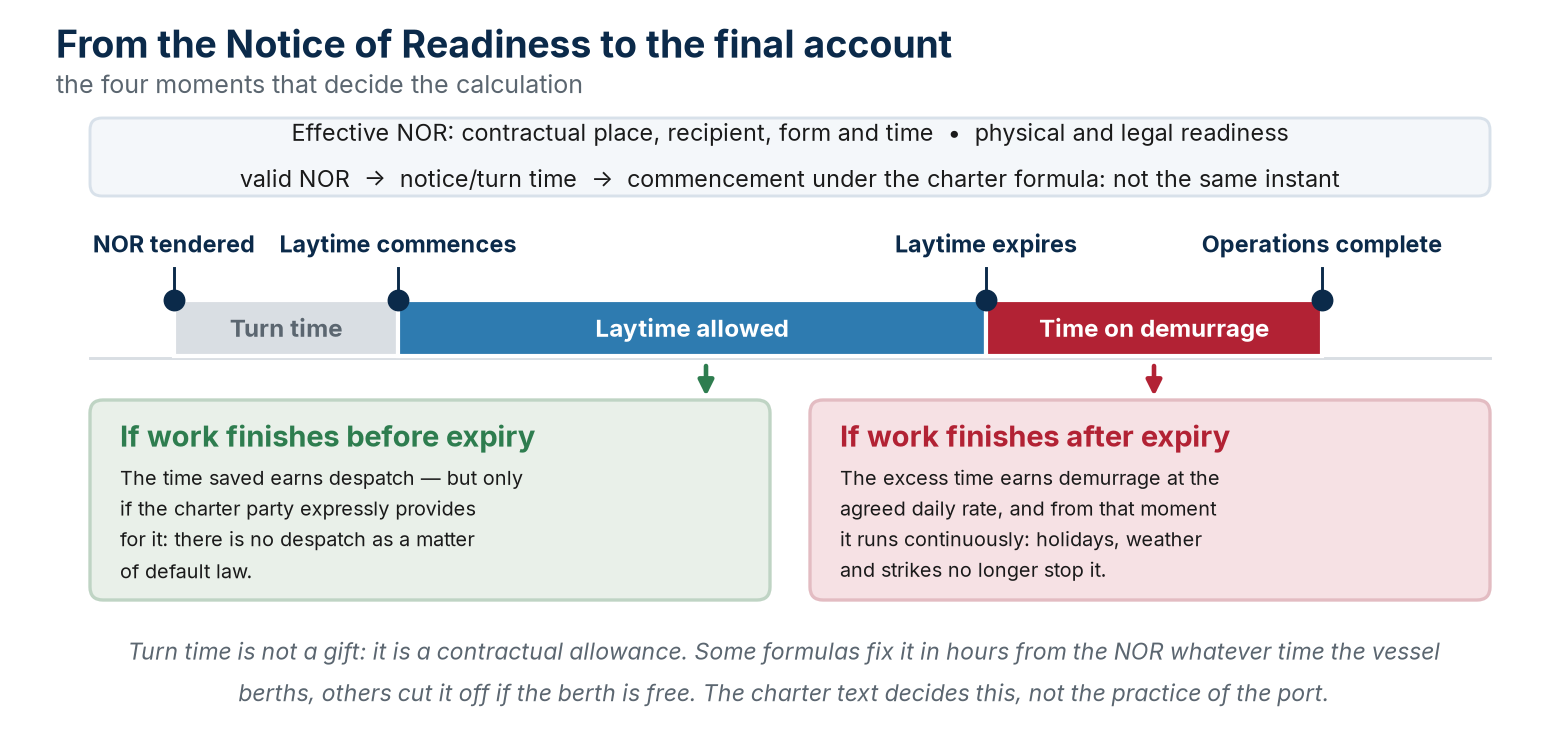
The Notice of Readiness is the notice required by the charter party by which the vessel states that she has arrived at the contractual destination and is ready to load or discharge. To be effective, it must be tendered to the required recipient, at the required place, time and in the required form, while the vessel is physically and legally ready. A valid NOR does not necessarily start laytime at that instant: time begins in accordance with the contractual notice period and commencement formula.
NOR validity requirements
- The ship must have arrived at the place specified by the charter party (port, anchorage area, berth, depending on the agreed clause).
- The vessel must be physically ready (suitable holds and necessary equipment operational) and legally ready under the charter and applicable formalities. Check any free-pratique and customs-clearance clauses.
- The NOR must be delivered according to the manner and timing set out in the contract (often subject to office hours constraints).
Waiting time: turn time
Between delivery of the NOR and the actual start of the laytime count, a waiting period (turn time) may elapse, whose duration depends on the contractual clauses: some formulas provide that laytime begins a fixed number of hours after the NOR, regardless of when the ship actually manages to berth.
Record time, method, recipient and proof of receipt. An objection alone does not invalidate a NOR, nor does the master’s silence automatically decide commencement. Check the objection and clause; re-tender when necessary while preserving the earlier position.
Key takeaways
- Check location, readiness, recipient, form and timing together.
- A valid NOR does not necessarily start the clock immediately.
- Record receipt and objections; consider a fresh NOR where necessary.
The arrived ship: who pays for congestion
Module objectiveAssess arrival location and allocation of waiting risk under the contract.
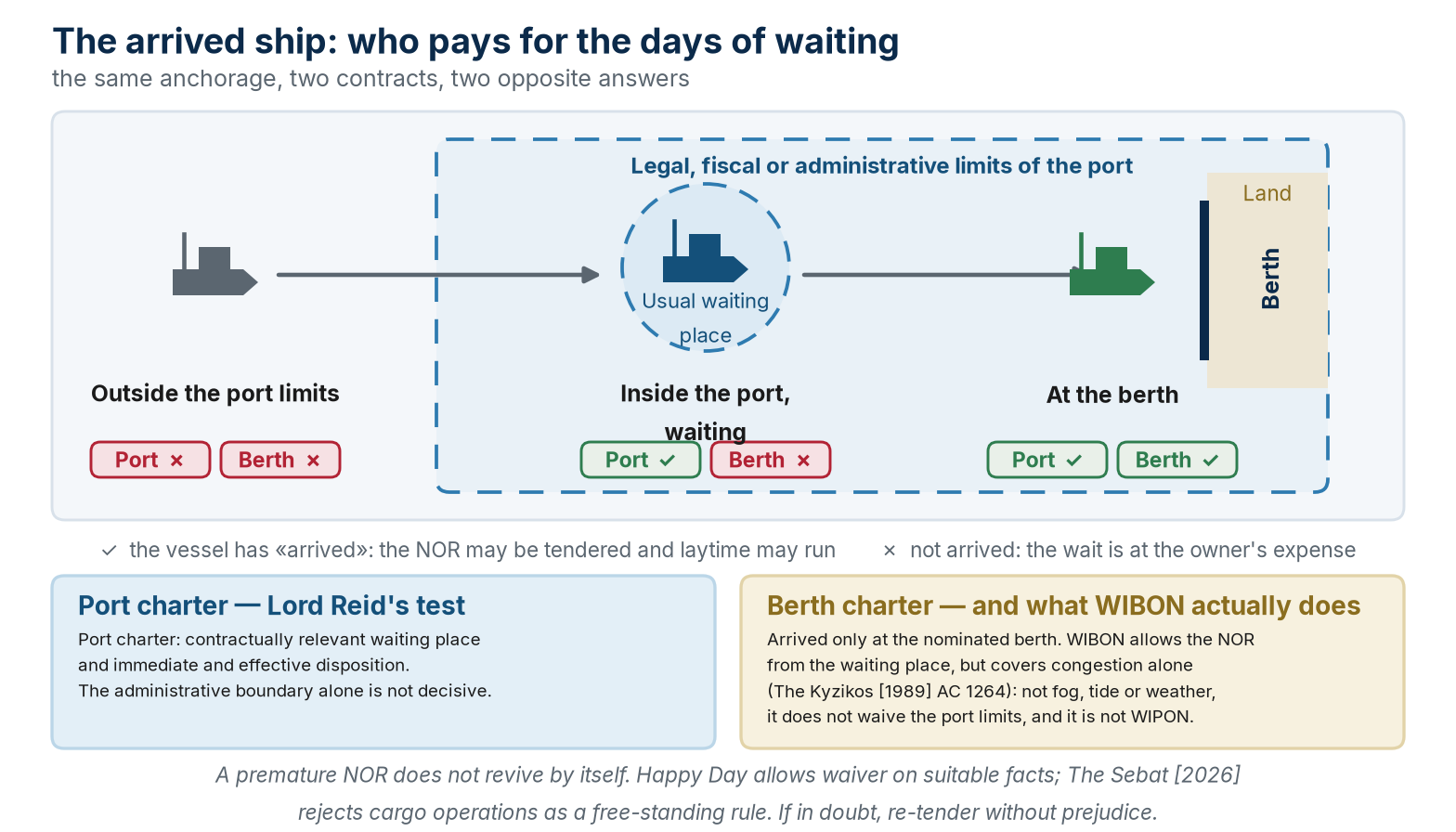
This section uses English-law examples. The contractual destination and additional clauses determine when the vessel is an arrived ship and how waiting is treated. Congestion alone does not automatically start laytime.
Port and berth charters
In a berth charter the destination is the specified loading/discharging place: normally it must be reached, subject to clauses allowing earlier NOR or counting. A port charter may allow the relevant waiting place within the port, with the vessel at the charterer’s immediate and effective disposition. Readiness, NOR and notice time still require checking.
The Johanna Oldendorff [1974] AC 479 establishes the disposition test; The Maratha Envoy [1978] AC 1 and The Arundel Castle [2017] EWHC 116 (Comm) address port limits. These interpret the contracts concerned: an expressly incorporated PORT definition, such as the 2013 Definitions, may have a different scope.
WIBON is not WIPON
WIBON allows, on its agreed terms, NOR from the usual waiting place when the berth is unavailable. It does not remove readiness requirements. The Kyzikos [1989] AC 1264 distinguishes berth unavailability from inability to reach an available berth because of fog or access conditions. WIPON also addresses waiting outside port in the circumstances covered by its wording. Check any “time lost waiting for berth” provision separately: it is not synonymous with WIBON.
Premature NOR
The Mexico 1 [1990] 1 Lloyd’s Rep 507 rejects automatic maturation of a premature NOR. The Happy Day [2002] EWCA Civ 1068 and The Sebat [2026] EWHC 950 (Comm) require examination of facts supporting agreement, waiver or estoppel: cargo operations are not a free-standing commencement rule. Where necessary re-tender a valid NOR while preserving the position on earlier notices.
Key takeaways
- Port and berth charters remain subject to their actual clauses.
- WIBON and WIPON differ and do not dispense with readiness.
- Starting cargo operations does not automatically cure an invalid NOR.
The most common laytime clauses
Module objectiveRead definitions, abbreviations and contractual amendments together.
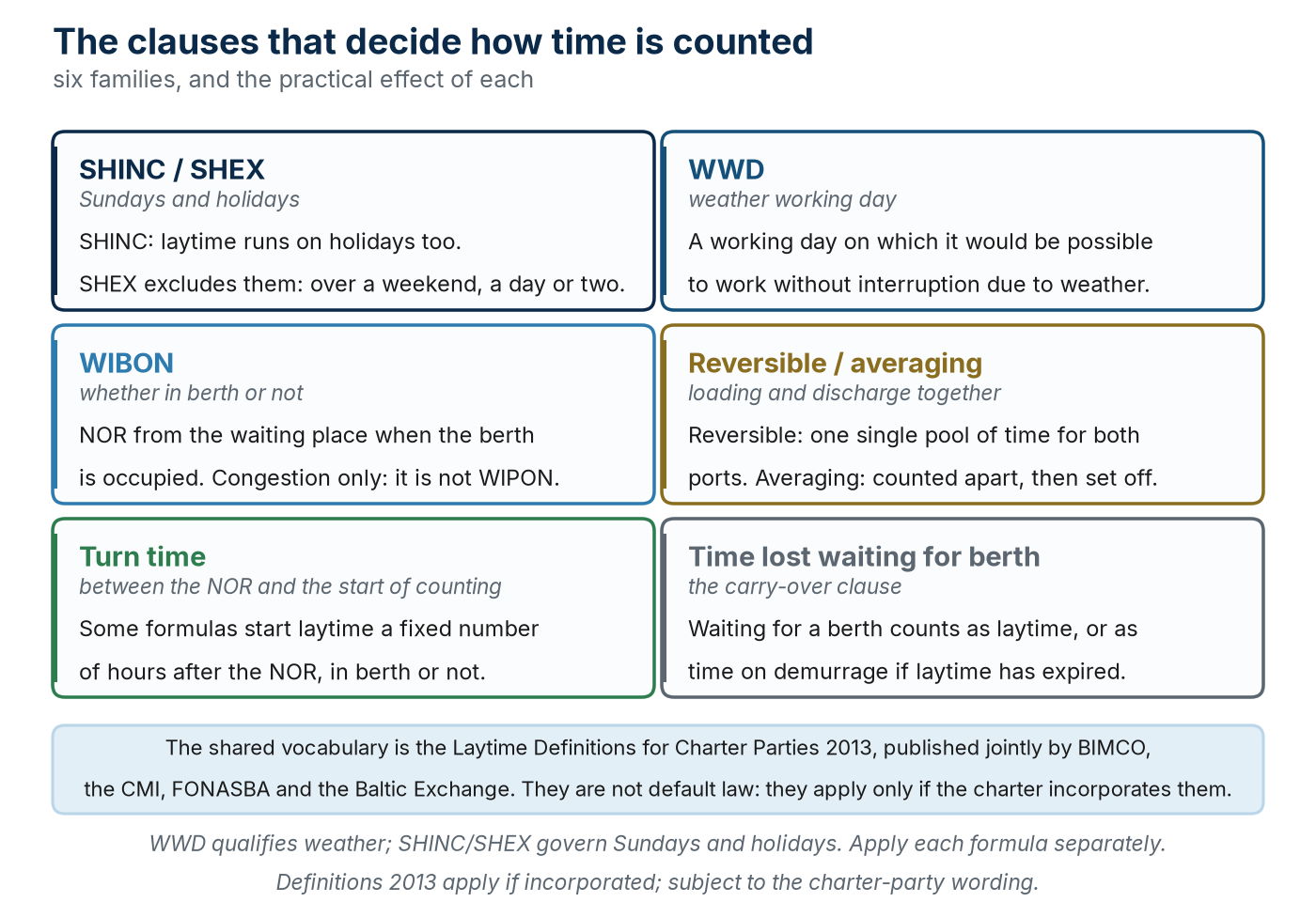
How laytime is counted depends largely on the specific clauses negotiated in the charter party. Understanding the most widespread formulas is essential to anticipate the practical impact of every event on the count.
The authoritative definitions: the Laytime Definitions 2013
Before discussing clauses it helps to know a shared vocabulary exists. The Laytime Definitions for Charter Parties 2013, published jointly by BIMCO, the CMI, FONASBA and the Baltic Exchange, are the reference in this field: they replaced the Voylayrules 1993, which in turn followed the 1980 Definitions.
| Term | 2013 definition |
|---|---|
| Weather working day | A working day or part of a working day during which it is or, if the vessel is still waiting for her turn, it would be possible to load/discharge the cargo without interruption due to the weather |
| Whether in berth or not | If the designated loading or discharging berth is not available on arrival, the vessel on reaching any usual waiting place at the port shall be entitled to tender notice of readiness from it and laytime shall commence in accordance with the charter party |
| Demurrage | An agreed amount payable to the owner in respect of delay to the vessel once the laytime has expired, for which the owner is not responsible |
| Despatch money | An agreed amount payable by the owner if the vessel completes loading or discharging before the laytime has expired |
Table 4.1 — Four key definitions from the Laytime Definitions 2013.
This is the warning the Definitions give about themselves, and it is the first thing to check: they apply «for the purposes of laytime when any or all such definitions are expressly incorporated into the charter party». They are not default law: if the contract does not incorporate them, a term such as weather working day falls to be interpreted from the contract text and the case law, not from the 2013 document.
Abbreviations should not be read in isolation. A period may be excluded because it falls on a SHEX Sunday and, separately, be affected by a weather qualification. Each qualification must be applied in the order and with the effect provided by the charter party.
Why the choice of clause changes everything
SHINC includes Sundays and holidays; SHEX excludes them subject to qualifications such as unless used. These abbreviations do not by themselves exclude Saturday. Check hours, local holidays and all further exceptions.
A common mistake is to estimate operation times based on general experience, without checking the specific clause of the current contract. The same ship, in the same port, with SHINC rather than SHEX clauses, can have a radically different commercial outcome for the same physical operations.
WWD variants need not use the same deduction method: the 2013 Definitions distinguish WWD, WWD of 24 consecutive hours and WWD of 24 hours. The short table definition does not replace the complete formula.
Key takeaways
- The 2013 Definitions are contractual provisions, not universal law.
- SHINC/SHEX concern Sundays and holidays; WWD concerns weather.
- Check WWD variants, unless used and expressly excluded periods.
Exceptions to laytime: what counts and what does not
Module objectiveSeparate laytime exceptions from those applicable to demurrage.
Not all time spent in port counts for laytime purposes: the charter party defines which events interrupt the count (exceptions) and which continue to let it run.
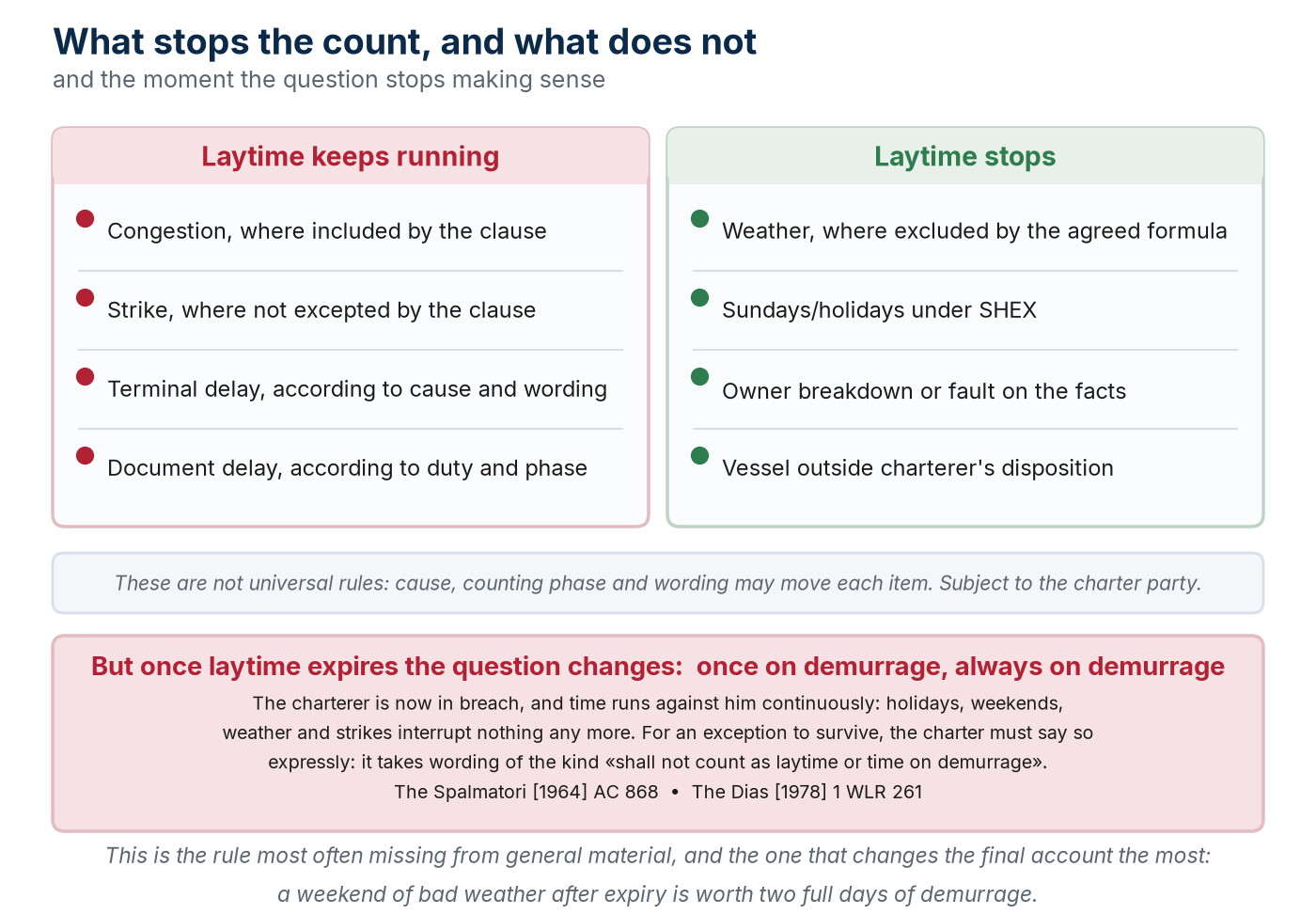
The most delicate areas
| Situation | Why it is delicate |
|---|---|
| Bad weather | Its effect depends on the specific weather qualification of laytime, such as weather working day, weather permitting or another agreed formula. SHINC and SHEX instead determine whether Sundays and holidays are included or excluded; they do not, by themselves, determine the effect of weather. |
| Port congestion | With a WIBON clause the NOR may be tendered from the usual waiting place when the berth is occupied. But WIBON covers congestion only, not an inability to berth because of fog, tide or weather (Module 03) |
| Ship breakdown | Check delay causation, breach and vessel availability. A breakdown does not automatically produce a deduction. Owner-responsible delay and withdrawal of the vessel from the charterer’s disposition require separate assessment, including on demurrage (The Stolt Spur [2002] 1 Lloyd’s Rep 786). |
| Strike | Depends on the specific clause; some formulas distinguish general strikes from strikes attributable to one of the parties |
Table 5.1 — Typical situations and their interpretive complexity.
The definition of «weather working day» — whether a day with a few hours of rain counts as a working day or not — is one of the most common sources of disagreement between the parties. Accurately recording actual times and weather conditions during operations is the best defence in the event of a dispute.
Key takeaways
- Record the cause, duration and counting phase of each stoppage.
- A breakdown alone does not determine an automatic exclusion.
- After laytime expires, check demurrage provisions and owner-responsible delay.
The supercargo's role
Module objectiveDefine the supercargo’s mandate and coordination with the master.
The supercargo is the figure, often sent by the charterer, who follows loading and discharging operations on behalf of commercial interests, in a role distinct from but complementary to that of the Master and crew.
What a supercargo actually does
- Supervises loading/discharging operations to verify compliance with commercial instructions.
- Verifies the quantity and quality of the cargo, often in coordination with independent surveyors.
- Documents any delays or inefficiencies attributable to the terminal, useful in the event of a demurrage dispute.
- Acts as a communication channel between ship, terminal and the charterer's office during operations.
The relationship with the Master
The supercargo acts within a mandate from the owner, charterer or other commercial interest. Specific commercial authority does not replace the master’s safety authority. Clarify who may issue instructions, sign documents or bind the principal; company and crew responsibilities remain.
A Master who actively cooperates with the supercargo, promptly sharing observations on terminal delays or anomalies, builds stronger documentation for their company in the event of a dispute, instead of treating the supercargo's presence as interference to be tolerated.
Key takeaways
- The supercargo acts within the appointed mandate.
- Distinguish commercial instructions from safety authority.
- Record all delays and disagreements without assuming fault before investigation.
The Statement of Facts
Module objectiveBuild a verifiable SOF that distinguishes facts from contractual interpretation.
The Statement of Facts (SOF) is the document that chronologically records every relevant event during the ship's stay in port: arrival, NOR, start and end of operations, interruptions, causes of delays. It is the factual basis on which the laytime calculation, and in the event of disagreement the entire dispute, is built.
What a good SOF must contain
- The exact date and time of every event, indicating the source (deck log, agent's communication, direct observation).
- Specific, not generic, causes for every interruption (not «bad weather» but «heavy rain from 14:20 to 16:45, operations suspended to protect the cargo»).
- Signature or countersignature of the parties present (agent, terminal, supercargo), with an explicit note if a party refuses to sign or signs with reservations.
- Consistency with other onboard documents (deck log, cargo operations record).
If the terminal or agent refuses to sign the SOF or signs it with reservations on certain points, the Master must explicitly note the disagreement at the time, not simply hope the matter does not resurface later. A timely annotation is worth enormously more than a reconstruction after the fact.
The SOF is evidence of facts, not automatic agreement on counting. State time zone and UTC offset, clock changes, record authors and disputed entries. A signature may have effects depending on wording and circumstances: read reservations. Preserve the original and correction history; do not erase disagreements to obtain a signature.
Key takeaways
- The SOF records facts; it does not alone decide time counting.
- State time zone, sources, reservations and signatures.
- Keep originals and a correction trail, including for digital records.
Demurrage and despatch: the economic mechanics
Module objectiveCalculate demurrage and despatch using the agreed formulas.
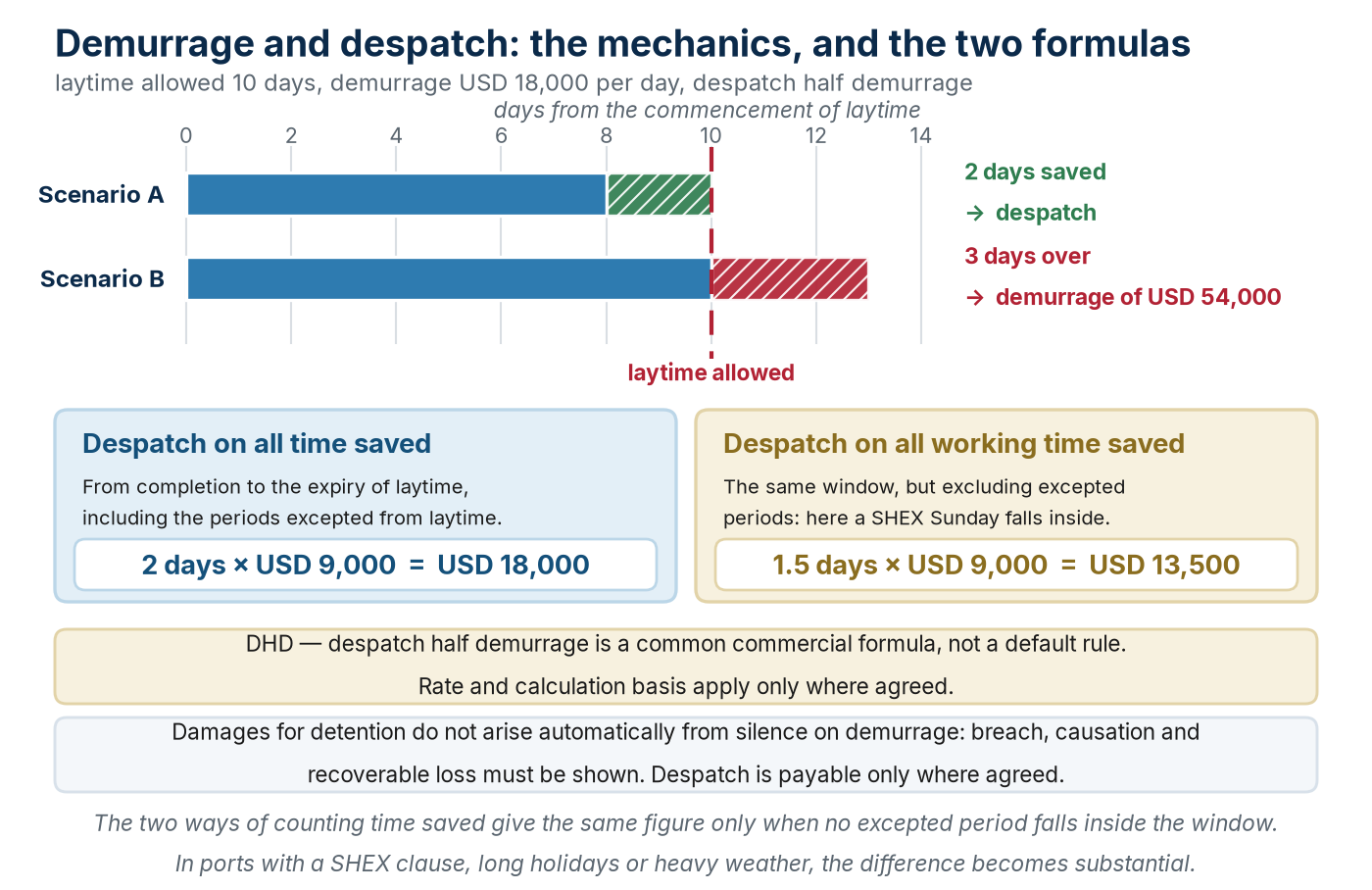
Demurrage and despatch have opposite economic effects, but they are not symmetrical remedies. Demurrage is normally the agreed amount payable to the owner for delay after laytime has expired, where the delay is not for the owner’s account. Despatch is payable only if the charter party provides for it and rewards time saved under the agreed formula.
| Term | Definition |
|---|---|
| Demurrage | Compensation owed to the shipowner when loading/discharging time exceeds the allowed laytime, at a daily rate set in the charter party |
| Despatch | An amount owed by the owner to the charterer when operations finish before the laytime expires. It is payable only if the contract provides for it: unlike demurrage it has no common-law counterpart |
Table 8.1 — Definitions of demurrage and despatch.
The half: a convention, not a rule
DHD — despatch half demurrage is a common commercial formula, not a default rule: the rate and calculation basis apply only if provided by the charter party.
Damages for detention are not the automatic consequence of the absence of a demurrage clause. They may arise from culpable delay falling outside the period or remedy covered by laytime and demurrage, but the claimant must identify the breached obligation, causation and recoverable loss under the contract and applicable law. Despatch, by contrast, is payable only where agreed.
«All time saved» or «working time saved»: the same ship, two different invoices
Despatch is paid on time saved, but «time saved» has two distinct contractual meanings, both defined in the Laytime Definitions 2013 — and the choice between them changes the invoice substantially.
| Formula | What is counted |
|---|---|
| Despatch on all working time saved or on all laytime saved | From completion of operations to the expiry of laytime, excluding any periods excepted from laytime |
| Despatch on all time saved | From completion of operations to the expiry of laytime, including the excepted periods |
Table 8.2 — The two despatch formulas of the Laytime Definitions 2013.
Separate example from the upper diagram: operations finish Saturday 12:00; 48 allowed working hours remain; Sunday 00:00–24:00 is excluded with no other exception. The hypothetical expiry is Tuesday 12:00. At USD 9,000/day, all time saved pays 72 hours = USD 27,000; working time saved pays 48 hours = USD 18,000. Rate and entitlement to despatch are express contractual assumptions.
While laytime is still running, an apparent delay generates no demurrage if it falls within a recognised exception: a holiday under a SHEX clause, for instance, simply does not count. The demurrage calculation begins only once the allowed laytime, net of exceptions, is exhausted.
Under English law, laytime exceptions normally do not interrupt demurrage unless made specifically applicable to it by the contract. Interpret the actual wording: no unique mandatory phrase is required. Owner-responsible delay is a separate issue. The Spalmatori [1964] AC 868 and The Dias [1978] 1 WLR 261 support the principle, not disregard of the actual clauses.
Key takeaways
- DHD applies only if agreed; despatch requires agreement.
- Distinguish all time saved from working time saved.
- Laytime exceptions do not automatically carry over to demurrage.
The practical calculation of laytime
Module objectiveBuild a calculation timeline and verify allowance, exceptions and rates.
From contract to timeline
- Identify allowance and units: fixed time or quantity divided by a handling rate, with any per-hatch rules.
- Check NOR and the commencement formula, including early work.
- Build intervals with source, cause, elapsed time and counted time.
- Locate the instant laytime expires. Apply demurrage rules thereafter rather than indiscriminately deducting earlier exceptions.
- Apply the agreed rate and pro rata, or despatch where provided.
Reproducible example
Assume commencement Monday 00:00; 72 hours allowed; no exclusions before expiry; completion Thursday 18:00; demurrage USD 18,000 per 24-hour day pro rata. Laytime expires Thursday 00:00. The following 18 hours give 18 ÷ 24 × 18,000 = USD 13,500. Six hours of rain during that period still count unless a demurrage exception or another legally relevant ground excludes them. All times use the same time zone.
Reversible and averaging
Reversible laytime permits the charterer, where agreed, to combine loading and discharging allowances. Averaging calculates each operation separately and offsets saved time against excess time. This does not automatically mean adding two independent demurrage and despatch invoices: settlement, rates and the meaning of time saved depend on the contract.
Have a second person check each interval against the contract and evidence. Identify disputed items instead of hiding them in a single “net time” figure.
Key takeaways
- Separate counting before and after laytime expires.
- Reversible combines allowances; averaging offsets separately calculated time.
- State assumptions, evidence and calculation units.
How a good demurrage claim is lost
Module objectivePreserve a claim by checking its scope, deadlines and contractual documents.
Scope of the claim: The Eternal Bliss
In K Line v Priminds (The Eternal Bliss) [2021] EWCA Civ 1712 the English Court of Appeal held that, absent contrary agreement, demurrage liquidates losses arising from failure to complete within laytime. Additional loss is not recoverable merely because it is of a different kind: a separate breach must be identified. The 2021 decision reversed the 2020 decision; read the judgment with the applicable charter.
Contractual deadlines
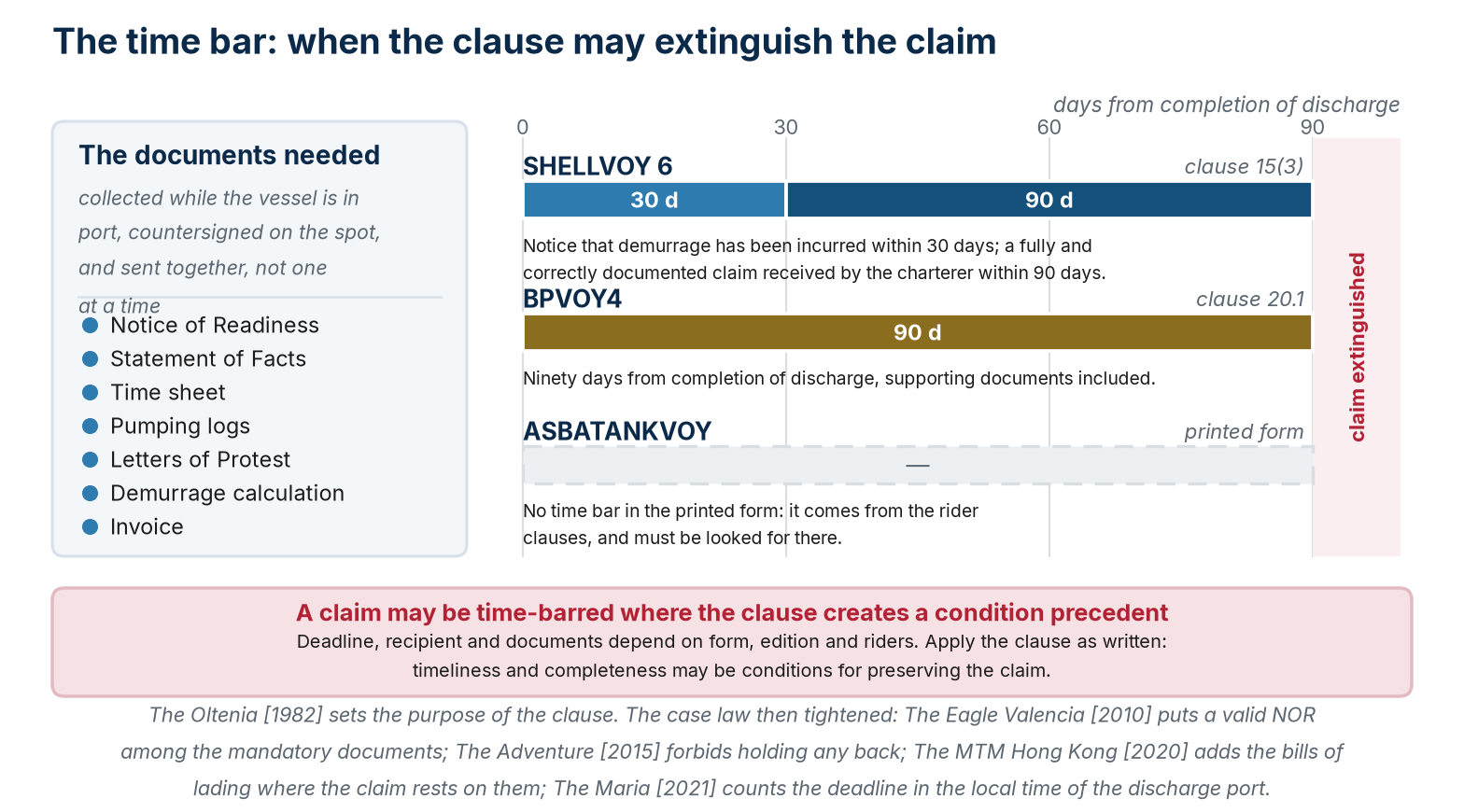
A claim valid on its merits may be barred by a contractual deadline. There is no universal 90-day period. Distinguish initial notification, documented submission and the deadline for commencing arbitration or litigation.
- SHELLVOY 6, cl. 15(3): notification within 30 days after discharge completion and receipt of the documented claim within 90 days, under the applicable wording.
- BPVOY4, cl. 20.1: 90 days after discharge completion for the claim and required documents.
- ASBATANKVOY: check the 1977/2025 edition, recap and riders; do not import SHELLVOY or BPVOY deadlines.
These examples do not replace the signed clause. The effect of omissions, total or partial preclusion, extensions, waiver and estoppel depends on wording, facts and applicable law. Do not assume every missed deadline automatically extinguishes every right.
Documents, recipients and receipt
Build a contractual checklist: NORs, SOFs, time sheets, pumping records where relevant, protests, calculation and invoice. The Eagle Valencia [2010] EWCA Civ 713, The Adventure [2015] EWHC 318 (Comm) and The MTM Hong Kong [2020] EWHC 700 (Comm) illustrate the importance of documents required by the actual contract; they do not create one list for every claim. The Maria [2021] EWHC 2565 (Comm) also highlights time-zone issues for the notification deadline.
Collect evidence on board and assign a shore owner for the deadline diary. Submit promptly, supplement missing items within the deadline and by permitted methods, retaining proof of receipt by the correct recipient. Do not wait until the last day to send everything together. A Letter of Protest is not necessarily contractual notification of the claim.
Key takeaways
- The Eternal Bliss concerns loss from a particular breach under English law.
- Deadlines and documents depend on the contract, not a universal 90-day rule.
- Submit promptly, complete within the deadline and retain proof of receipt.
Standard forms and typical clauses
Module objectiveIdentify the agreed form, edition, recap and riders.
The maritime chartering market relies largely on standard charter party forms, developed by industry associations, which are then modified with specific clauses (rider clauses) negotiated case by case.
| Form | Edition discussed | Segment and notes |
|---|---|---|
| GENCON BIMCO | GENCON 2022 approved 18 May 2022, published 25 October | General dry cargo. Replaces GENCON 94 with a full revision, not a touch-up |
| ASBATANKVOY BIMCO and ASBA | ASBATANKVOY 2025 published 23 April 2025 | Tanker. Four arbitration venues with New York as the default. The 1977 form may still be incorporated: always check which of the two editions has been incorporated |
| NYPE BIMCO, ASBA and the Singapore Maritime Foundation | NYPE 2015 | Time charter. Predecessors: NYPE 1946 and NYPE 93, both still encountered |
| SHELLVOY Shell | SHELLVOY 6, March 2005 | Tanker: check the form and additional clauses actually incorporated. |
| BPVOY BP | BPVOY5, March 2016 | Tanker. BPVOY4 is used in the cases discussed: verify the agreed version |
Table 11.1 — The most widespread standard forms, with the editions discussed.
Writing «Gencon» without the year does not identify a contract. Between GENCON 94 and GENCON 2022 the structure and clause numbering change, and a cross-reference such as «clause 6» in a rider clause can point at two different things. The same goes for ASBATANKVOY: since 23 April 2025 two editions are in circulation, and the 1977 form has not been withdrawn. The first check on a fixture is which edition was incorporated; the second is which rider clauses amended it.
The importance of rider clauses
The standard form text is rarely used unmodified: the parties negotiate additional clauses (rider clauses) that can significantly alter how the standard clauses, including laytime clauses, operate. A common mistake is reasoning on the basis of the standard form while ignoring that a specific rider clause has modified it.
Knowing that a contract is «a Gencon» says little about the conditions actually applicable if the full set of rider clauses negotiated for that particular fixture has not also been read. The correct practice is to treat every charter party as a specific document to be read in full.
Key takeaways
- The form’s name without its edition is insufficient.
- A new form does not automatically replace existing contracts.
- Check priority between recap, printed form, addenda and riders.
Letters of Protest and dispute management
Module objectiveDraft factual protests without assuming automatic legal effects.
The Letter of Protest is the formal instrument by which the Master, or the company, communicates a disagreement to the counterparty over a specific event during operations, preserving its position for a possible subsequent dispute.
When to issue a Letter of Protest
- Delays attributable to the terminal or receiver that the Master considers unjustified.
- Refusal by the counterparty to countersign the Statement of Facts or certain entries in it.
- Damage to the cargo or the ship attributable to operations conducted incorrectly by the terminal.
- Discrepancies between declared cargo quantities and quantities actually loaded/discharged.
How to write an effective Letter of Protest
The document must be specific, factual and timely: generic and late is almost useless in a subsequent dispute. It must state the date, time, facts directly observed (not assumptions), and be formally delivered to the counterparty with a request for receipt, even in the event of refusal to sign.
A protest records a position but alone proves neither liability nor quantum. It does not guarantee compliance with every deadline or automatically suspend a time bar or limitation period. Keep proof of delivery and separately submit the notices and claim required by the contract.
Key takeaways
- Describe verifiable events, times, recipients and reservations.
- A protest alone establishes neither liability nor entitlement to damages.
- A protest does not replace the claim or automatically suspend deadlines.
Dispute resolution
Module objectiveIdentify the seat, law and procedure for the dispute.
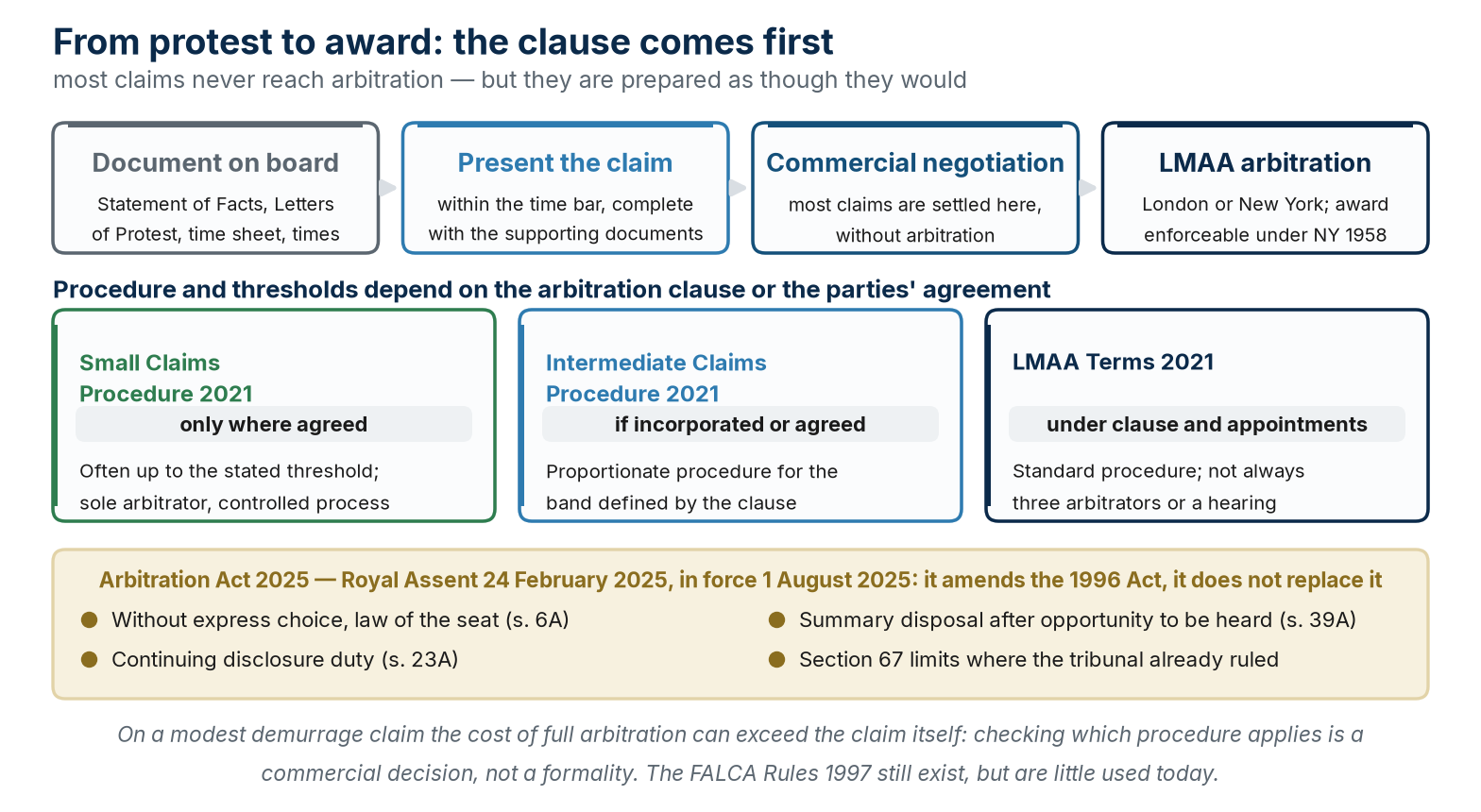
When the parties fail to reach agreement on the laytime or demurrage calculation, the charter party typically provides for a resolution path that culminates, in most cases, in maritime commercial arbitration rather than ordinary court litigation.
Why arbitration is the preferred route in the industry
- Check the agreed seat and rules: London/LMAA and New York/SMA are distinct examples, not interchangeable procedures.
- Arbitrators specialising in maritime matters understand industry commercial practice better than a generalist ordinary court.
- Duration and cost depend on the dispute and procedure. The 1958 New York Convention facilitates recognition and enforcement of awards, subject to conditions and grounds for refusal.
LMAA procedures depend on agreement
The applicable procedure depends first on the arbitration clause and the parties’ agreement, not on the value of the claim in isolation. The LMAA Terms 2021 govern the standard procedure; the parties may incorporate the Small Claims Procedure 2021 or Intermediate Claims Procedure 2021 and agree the relevant thresholds. USD 100,000 is a commonly used SCP threshold and USD 400,000 is often used as the upper ICP limit, but the contractual wording remains decisive.
| Procedure | When it applies | Key features |
|---|---|---|
| LMAA Small Claims Procedure 2021 | Only where agreed; often where neither claim nor counterclaim exceeds the threshold stated in the clause | Sole arbitrator, restricted timetable, normally documents-only, controlled costs |
| LMAA Intermediate Claims Procedure 2021 | Only where incorporated or agreed; for the band defined by the clause | Proportionate procedure for intermediate disputes |
| LMAA Terms 2021 | Where applicable to the reference under the appointments and arbitration clause | Standard procedure; it does not automatically require three arbitrators or an oral hearing |
Table 13.1 — LMAA 2021 procedures: application and thresholds depend on the clause or the parties’ agreement.
The Arbitration Act 2025, in force from 1 August 2025, amends the 1996 Act. In the absence of an express choice of law for the arbitration agreement, new section 6A applies the law of the seat; choosing the law of the charter party alone does not amount to an express choice for the arbitration agreement. Section 39A permits summary disposal of claims or defences with no real prospect of success, subject to a reasonable opportunity to make representations. Section 23A codifies the arbitrator’s continuing duty of disclosure. Where the tribunal has already ruled on jurisdiction, section 67 restricts new grounds, new evidence and rehearing subject to the statute and rules of court.
The role of documentation in the dispute
The quality of the documentation gathered during operations — Statement of Facts, Letters of Protest, correspondence with the agent — largely determines the outcome of an arbitration dispute. A technically correct position that is not documented promptly is difficult to sustain months or years later.
The moment that truly shapes the outcome of a future demurrage dispute is not when arbitration is initiated, months later, but the hours the ship is in port, when every event must be documented precisely. A Master aware of this treats operational documentation as a commercial investment, not merely a bureaucratic obligation.
The 2025 Act amends the arbitration framework for England, Wales and Northern Ireland. Sections 1–14 do not apply to arbitrations commenced before entry into force or related court proceedings; check the remaining transitional provisions. Where SCP or ICP is incorporated without different thresholds, also check that procedure’s default limits, treating claims and counterclaims separately.
Key takeaways
- Seat, law and arbitration rules require separate checks.
- SCP and ICP require agreement; thresholds alone are insufficient.
- Check the transitional regime for the 2025 Act.
Emerging trends in commercial voyage management
Module objectiveConnect digital evidence and environmental clauses with voyage management.
The management of laytime and demurrage is also evolving, driven by digitalisation and greater standardisation of documentary processes.
Digitalisation of the Statement of Facts
An electronic SOF can improve access to events but does not guarantee accuracy. Record author, source, time zone, changes, acceptances and disputes; retain verifiable exports and data access under the agreements.
Greater contractual standardisation
Industry associations continue to update standard forms to reduce interpretive ambiguity in the most contentious clauses (particularly those relating to bad weather and port congestion), in an effort to reduce the volume of arbitration disputes.
Interaction with decarbonisation
Speed and consumption warranties, already present in charter parties, have gained new relevance in light of CII and FuelEU Maritime obligations (seen in the dedicated decarbonisation course): managing speed for environmental compliance can conflict with contractual obligations towards the charterer.
What has changed in the last few years is that the market is no longer waiting: BIMCO has already produced the clauses by which the parties divide these obligations, and anyone negotiating a fixture today finds them on the table.
| BIMCO clause | What it does |
|---|---|
| CII Operations Clause for Time Charter Parties | Allocates operational duties and contractual cooperation on CII; it does not automatically transfer statutory responsibility. |
| ETS Allowances Clauses | Who buys and transfers EU Emissions Trading System allowances. Adopted for voyage charters and SHIPMAN in December 2023, for contracts of affreightment in June 2024 |
| FuelEU Maritime Clause for Time Charter Parties 2024 | The 2024 FuelEU clause addresses cooperation, data, surcharges and settlement. Pooling, banking and borrowing rights depend on the covered period, conditions and required instructions. Contractual allocation does not change the identity of the company responsible under the Regulation. |
| EEXI Transition Clause for Time Charter Parties | Governs the transition period for compliance with the EEXI |
Table 14.1 — The BIMCO clauses that allocate environmental obligations between the parties.
A Master who reduces speed to contain the ship's CII may, without realising it, breach a speed clause in the charter party. Commercial voyage management today requires an explicit dialogue between the technical office and the commercial office on these trade-offs, before they emerge as post-voyage disputes.
Key takeaways
- A digital SOF needs provenance and traceability.
- Clauses allocate contractual duties and costs.
- Responsibility to authorities remains governed by the applicable legislation.
Recurring mistakes
From the Mistake Library of SuperbaKnowledge, filtered to the subjects this course covers. This view selects and organises content published in SuperbaKnowledge; it does not modify or replace it. The linked Knowledge page remains the reference version, while official texts remain authoritative.
| Topic | Mistake | Typical consequence | Topic sheet |
|---|---|---|---|
| Charter Party and Cargo Clauses | Port or berth nominated by the charterer accepted without verification against the safe port/safe berth clause | Exposure of the ship to a port or berth that is unsafe under the contractual terms | See the topic sheet |
| Cargo Claim Handling | No reservation noted on the bill of lading despite non-compliant conditions at loading | Evidential exposure concerning apparent cargo condition; legal effect depends on the bill and applicable law | See the topic sheet |
Glossary of terms
| Term | Definition |
|---|---|
| CoA | Contract of Affreightment |
| Demurrage | Compensation for exceeded laytime |
| Despatch | Contractually agreed payment for time saved |
| Fixture | The charter contract concluded for a given voyage or period |
| Laytime | Time allowed by the charter party for loading/discharging operations |
| NOR | Notice of Readiness |
| Rider clauses | Additional clauses negotiated in addition to the standard form |
| SHEX | Sundays and Holidays Excluded |
| SHINC | Sundays and Holidays Included |
| SOF | Statement of Facts |
| Supercargo | Commercial representative acting within the appointed cargo-operations mandate |
| Turn time | Waiting time between the NOR and the actual start of the laytime count |
| WIBON | Whether In Berth Or Not |
| WWD | Weather Working Day(s) |
References and sources
Direct sources for the review:
- BIMCO — testo Definitions 2013
- Court of Appeal — The Eternal Bliss (2021)
- LMAA — Terms and Procedures 2021
- Arbitration Act 2025 — testo
- Commencement Regulations 2025
- BIMCO — ASBATANKVOY 2025
- BIMCO — FuelEU Maritime Clause 2024
Consolidated list of the sources cited, reviewed on 15 September 2026; access limitations are recorded in the review report. For the interpretation of a specific contract always refer to the full text and to qualified legal advice: what follows is educational material, not an opinion.
| Category | Sources |
|---|---|
| Definitions and standard forms | Laytime Definitions 2013; GENCON 2022; ASBATANKVOY 2025 and 1977; NYPE 2015; SHELLVOY 6 (2005); BPVOY4/BPVOY5 according to the incorporated edition. |
| Arbitration and legislation | LMAA Terms, SCP and ICP 2021; Arbitration Act 2025; Commencement Regulations 2025. |
| Leading authorities | The Johanna Oldendorff; The Maratha Envoy; The Kyzikos; The Mexico 1; The Happy Day; The Sebat [2026] EWHC 950 (Comm); The Eternal Bliss. |
| Market forms and practice | Always identify edition, recap, addenda and riders; commercial guidance does not replace the judgment or contractual text. |
This course is educational material for training purposes and does not constitute a professional certification or qualifying credential. Read the full disclaimer.