
Fleet Decarbonisation
EEXI · CII · IMO Net-Zero Framework · EU ETS · FuelEU Maritime
Full course overview
For shore and shipboard technical and operational personnel. Fourteen modules connecting decarbonisation rules, decisions, technologies and data.
Regulatory framework
IMO strategy, EEXI, CII and Net-Zero Framework status.
Compliance instruments
EU ETS, FuelEU and OPS application to a port call.
Technology and operations
Fuels, operational measures and structural investments.
Planning and data
Multi-year planning, trends and reporting.
OPS demo: module 08 and two questions · Start with the first module
- The strategic framework: the IMO GHG Strategy
- EEXI: the one-off technical requirement
- CII: the annual operational indicator
- The IMO Net-Zero Framework: architecture
- The Net-Zero Framework: timeline and current status
- EU ETS: shipping in the European carbon market
- FuelEU Maritime: intensity and flexibility
- OPS: duties and port-call preparation
- Alternative fuels: a comparative overview
- Short-term operational levers
- Structural investments and newbuildings
- Building a multi-year compliance plan
- Emerging trends
- Reporting and regional carbon pricing: MRV, DCS and the UK ETS
Learning objectives
- Place EEXI, CII, the IMO Net-Zero Framework, EU ETS and FuelEU Maritime within the overall framework of the IMO GHG strategy.
- Explain the difference between a one-off technical requirement (EEXI) and an annual operational one (CII).
- Describe the progress and timeline of the IMO Net-Zero Framework, including the delays that have occurred.
- Distinguish the scope of application of EU ETS and FuelEU Maritime from the global IMO instruments.
- Comparatively assess the main available alternative fuels.
- Identify short-term operational levers and long-term structural investments for fleet decarbonisation.
- Set up a multi-year compliance plan that integrates the various regulatory instruments.
- Govern the data chain (MRV, DCS) and the reporting calendar on which allowances, penalties and ratings depend.
The strategic framework: the IMO GHG Strategy
Module objectivePlace global and regional instruments within the 2023 IMO Strategy checkpoints, distinguishing strategic ambitions, requirements in force and measures not yet adopted.
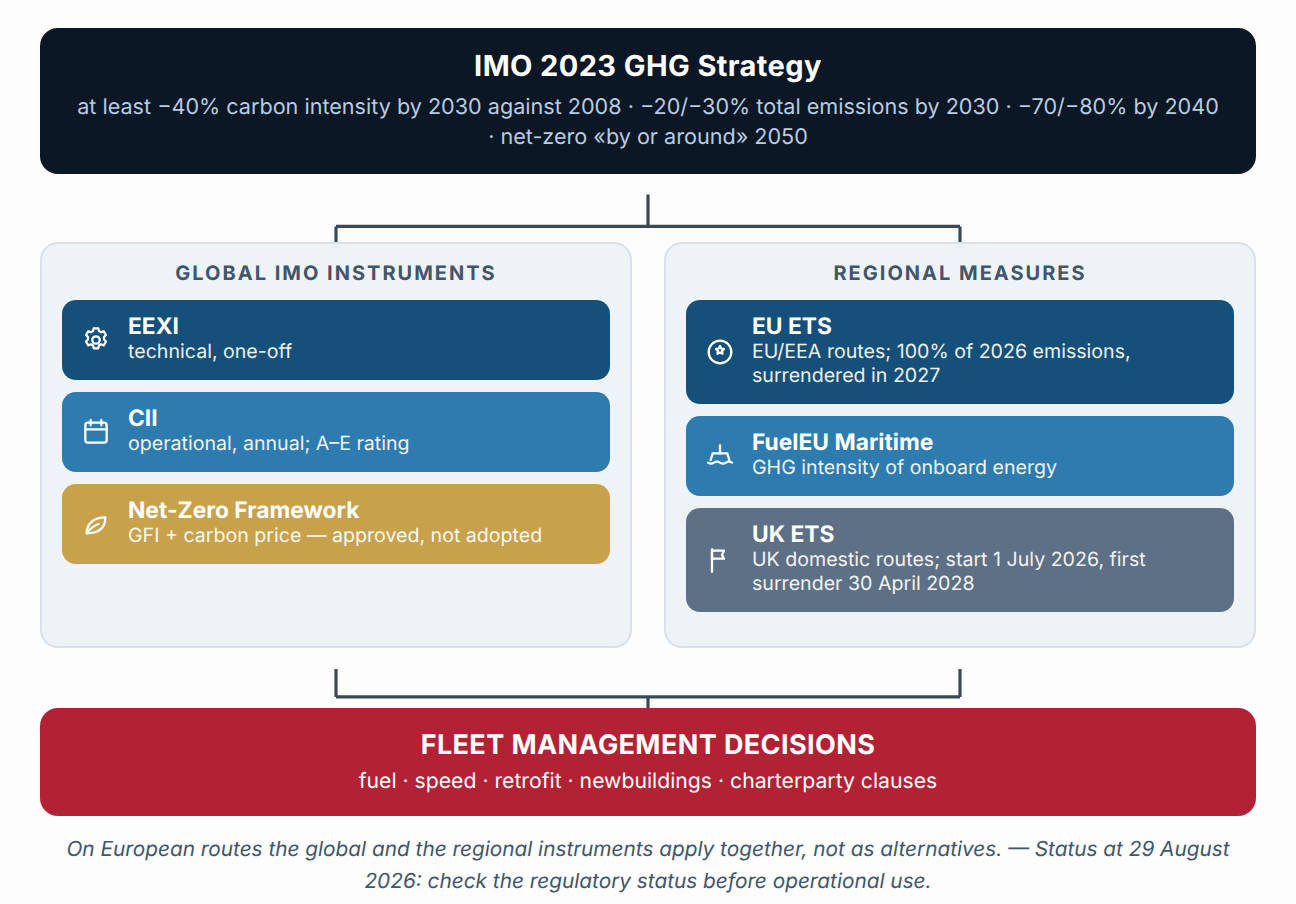
The decarbonisation of international shipping stems from the 2023 IMO Strategy on Reduction of GHG Emissions from Ships, which raised the ambition of the initial 2018 strategy. The text sets a target of reducing the carbon intensity of international shipping by at least 40% by 2030 compared with 2008, with the ambition of reaching net-zero emissions «by or around, i.e. close to» 2050. Alongside intensity, the Strategy sets checkpoints on total emissions: at least −20%, striving for −30%, by 2030, and at least −70%, striving for −80%, by 2040, both compared with 2008. And it sets a third level of ambition that is often forgotten: by 2030, zero- or near-zero-GHG technologies, fuels and energy sources should represent at least 5%, striving for 10%, of the energy used by the sector.
The resulting instruments
The Strategy imposes nothing on a ship: it sets the ambition and the checkpoints, and leaves it to the instruments that follow from it to turn those into obligations verifiable ship by ship. This is the distinction to hold on to throughout the course — looking in the text of the Strategy for the requirement that applies to one ship means looking where it is not.
| Instrument | Nature | Status as of 15 September 2026 |
|---|---|---|
| EEXI | Technical, one-off | In force |
| CII | Operational, annual | In force, with annual rating |
| IMO Net-Zero Framework | Global, standard + pricing | Approved at MEPC 83; not adopted: no adoption at MEPC 84, next attempt on 4 December 2026, subject to confirmation by MEPC 85 |
| EU ETS (shipping) | Regional, cap-and-trade | In force for EU/EEA routes; 100% applies to 2026 emissions, surrendered by 30 September 2027; CH4 and N2O from 2026 |
| FuelEU Maritime | Regional, onboard energy intensity | In force since 2025; Article 2 scope and EEA incorporation to check (Module 7) |
| UK ETS (shipping) | Regional, cap-and-trade | UK domestic routes from 1 July 2026 |
Instruments may overlap but do not automatically apply to every ship on European routes. Check ship type, tonnage, activity and voyages separately: EEXI/CII and regional measures have distinct scopes; the Net-Zero Framework remains an unadopted scenario.
Key takeaways
- The IMO Strategy sets ambitions and checkpoints, not ship-level obligations.
- EEXI and CII are in force; the Net-Zero Framework is not adopted.
- EU ETS, FuelEU and UK ETS add distinct regional scopes.
EEXI: the one-off technical requirement
Module objectiveDetermine when EEXI applies, how it is verified and the operational consequences of EPL, ShaPoLi and hull or propeller work.
The Energy Efficiency Existing Ship Index (EEXI), introduced through an amendment to MARPOL Annex VI, extends to existing ships a design efficiency logic similar to that already required for newbuildings (EEDI). It applies to ships of 400 GT and above in the categories subject to EEDI. Unlike the CII, the EEXI is a technical requirement normally verified once, not an indicator that is updated every year.
How it works
- The ship's theoretical EEXI index is calculated, based on technical design characteristics (engine power, hull type, speed).
- It is compared against a reference value (required EEXI) set for the ship's type and size.
- If the calculated value exceeds the reference, the ship must adopt measures to come within the limits: the most common are limiting installed engine power (Engine Power Limitation, EPL) or technical interventions on the hull.
- EEXI is verified at the first applicable annual, intermediate, renewal or initial survey from 1 January 2023 (regulation 5.4.7). Evidence includes the verified technical file and IEE certification; a major conversion can require renewed verification under regulation 5.4.8.
| Compliance measure | Operational impact |
|---|---|
| Engine Power Limitation (EPL) | Reduces the maximum available power; affects the maximum achievable speed |
| Shaft Power Limitation (ShaPoLi) | Alternative to EPL, limits power at the shaft rather than the engine |
| Hull or propeller interventions | Improve hydrodynamic efficiency, reducing power requirements for the same speed |
A power limitation reduces the maximum available speed. The first consequence is one of safety — the power that remains must be enough to handle the ship in heavy weather, which is why the IMO guidelines require a power reserve and the ability to reinstate it — and only then commercial, for the ship's flexibility when time has to be made up. The choice of compliance measure must therefore be assessed on safety, operability and the commercial plan together, not decided on purely technical grounds.
Check categories and exclusions in MARPOL Annex VI regulations 19, 23 and 25 and the survey cycle in regulation 5. Compare attained with required EEXI; a major conversion can require renewed verification. For EPL/ShaPoLi, reserve use, records and reactivation follow the approved Onboard Management Manual and applicable guidelines.
Key takeaways
- EEXI is a technical design index, not an annual performance figure.
- Verification occurs at the first applicable survey, including an initial survey; major conversions require review.
- A power limitation must also be assessed for safety and operability.
CII: the annual operational indicator
Module objectiveCalculate and interpret the annual CII cycle, recognising Z factors, ratings and the conditions requiring a corrective-action plan in SEEMP part III.
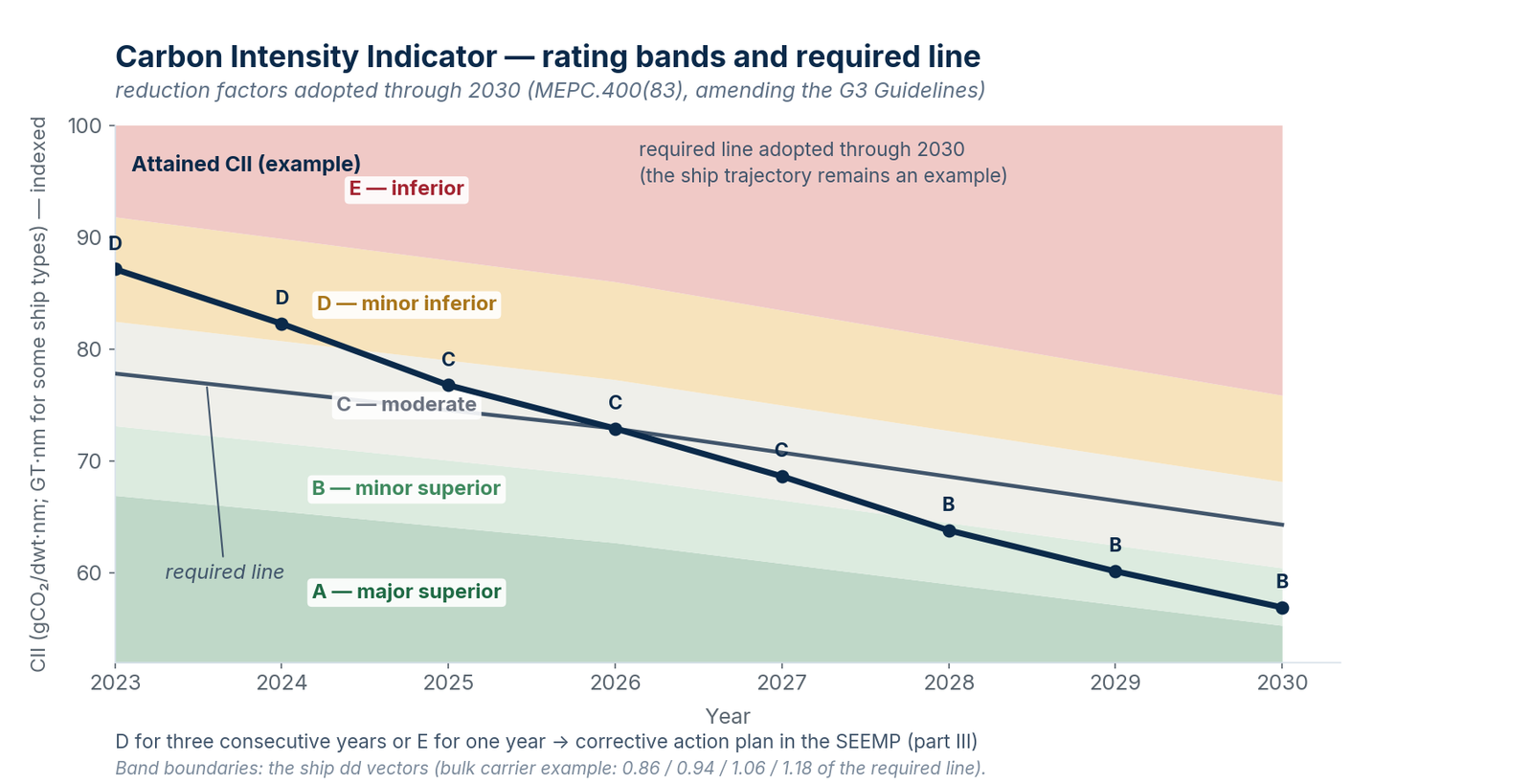
The Carbon Intensity Indicator (CII) measures the carbon intensity actually generated by the ship's operation over the course of the year, expressed in grams of CO2 per deadweight tonne per nautical mile travelled (or an equivalent unit for the ship type). Unlike the EEXI, the CII is recalculated every year based on actual consumption.
The consequences of the rating
| Rating | Implication |
|---|---|
| A / B | Superior performance (major and minor superior); no corrective plan triggered by the rating; other duties remain |
| C | Moderate performance (moderate in IMO terminology); no corrective plan triggered by the rating; other duties remain |
| D (for 3 consecutive years) or E (even a single year) | Inferior performance (minor inferior and inferior): obligation to submit a corrective action plan in the SEEMP (Ship Energy Efficiency Management Plan), part III |
The Z reduction factors applied to the required line are set up to 2030 against the 2019 reference line: −5% in 2023, −7% in 2024, −9% in 2025, −11% in 2026, −13.625% in 2027, −16.250% in 2028, −18.875% in 2029 and −21.500% in 2030. The 2027–2030 values were adopted by MEPC 83 through resolution MEPC.400(83), amending the G3 Guidelines in MEPC.338(76). Phase 2 of the review, running to 2028, may still develop metrics, the SEEMP framework and enforcement: it does not make the adopted factors «undecided».
Levers to improve the rating
Since the CII depends on actual consumption and not only on the ship's technical characteristics, acting on the rating is largely a matter of operational management: speed, route planning, hull cleaning, cargo and trim optimisation all directly affect the current year's indicator.
A longer route may increase both fuel use and denominator distance: its CII effect cannot be inferred from distance alone. Compare total consumption, service delivered, rating and cost; an improved ratio alone does not demonstrate lower absolute emissions.
For CII ship categories of 5,000 GT and above, the denominator remains capacity × total annual distance reported under IMO DCS, both under way and not under way. MEPC.412(84) retains DWT for the listed cargo categories and GT for cruise, ro-ro and ro-pax ships: actual cargo does not automatically replace capacity. An A–C rating does not remove monitoring or SEEMP duties; three consecutive D ratings or one E rating trigger corrective planning.
Example without G5 corrections: 3,000 t CO₂ = 3 billion grams; with 20,000 DWT and 10,000 nautical miles, CII = 15 gCO₂/(DWT·nm). The rating then needs the category reference line, Z factor and G4 boundaries. Submit the revised SEEMP corrective plan for repeated D or E within one month of CII reporting (regulation 28.8).
Key takeaways
- The Z factors from 2027 to 2030 are already adopted through MEPC.400(83).
- D for three consecutive years or E for one year requires corrective action.
- The rating should be forecast during the year, not discovered at year-end.
The IMO Net-Zero Framework: architecture
Module objectiveExplain the architecture of the approved Net-Zero Framework text without presenting targets, prices or remedial units as obligations in force.
The Net-Zero Framework represents the IMO's attempt to introduce, for the first time at the level of an entire global sector, a mandatory limit on emissions intensity combined with a carbon pricing mechanism. The text, in the form of a new chapter of MARPOL Annex VI, was preliminarily approved during the MEPC 83 session in April 2025.
The two pillars
| Pillar | Function |
|---|---|
| GHG Fuel Intensity standard (GFI) | A limit on the emissions intensity of the fuel used, decreasing over time, in the draft for ships from 5,000 GT, subject to regulation 30 exclusions |
| Pricing and reward mechanism | The draft combines remedial and surplus units; potential ZNZ rewards have separate eligibility criteria |
Structure of the pricing mechanism (draft)
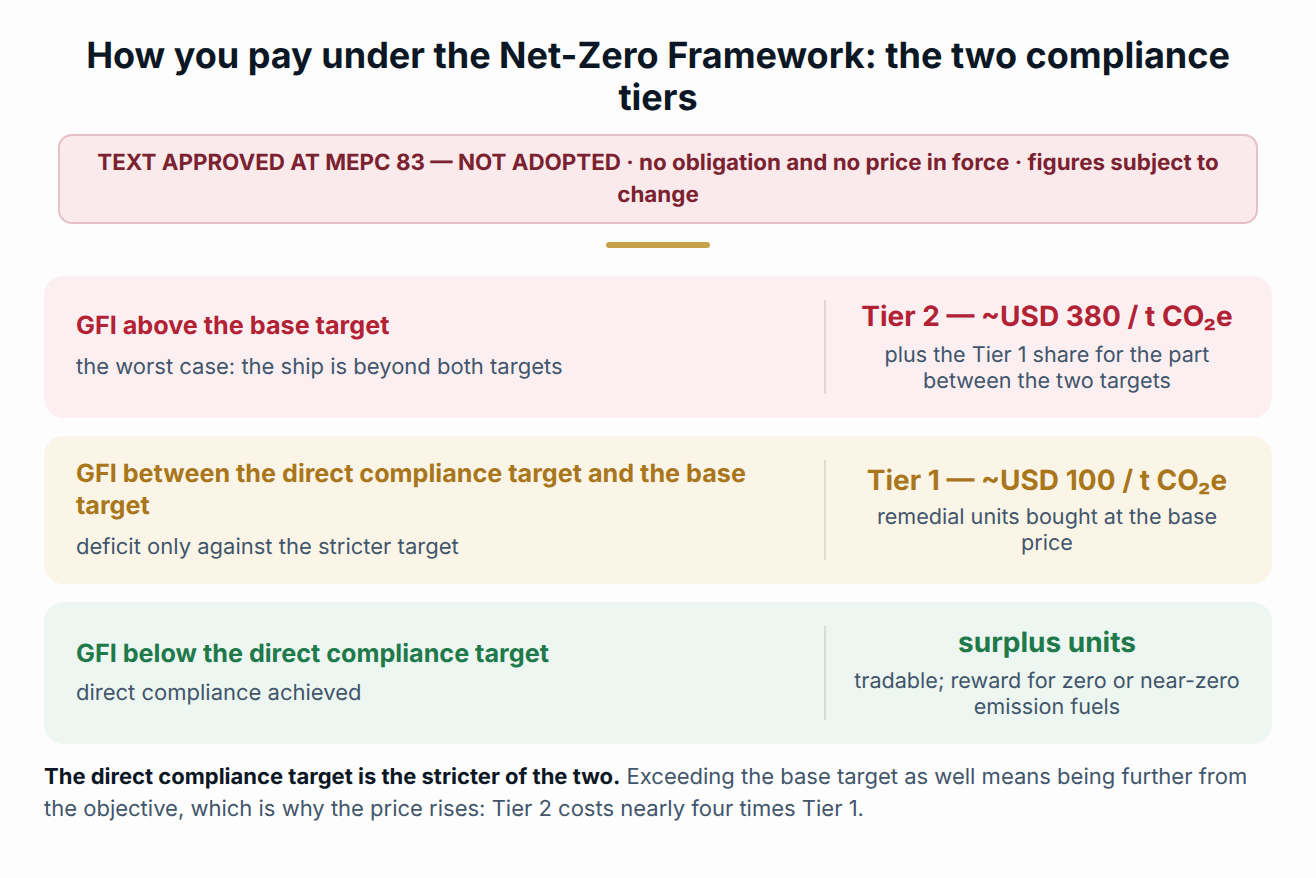
In the approved text, the direct compliance target is stricter than the base target. Between them, Tier 1 deficit would be covered by USD 100/tCO₂e remedial units. Above the base target, an additional Tier 2 deficit could be covered by transferred or banked surplus units, or USD 380/tCO₂e remedial units. These are 2025-text prices for 2028–2030, not current prices or confirmed deadlines.
Below the direct compliance target, a positive balance can generate surplus. Surplus units and any ZNZ rewards are distinct instruments; reward eligibility requires a separate assessment.
Key takeaways
- The text combines the GFI standard with a pricing and reward mechanism.
- Approval is neither adoption nor entry into force.
- Prices and targets remain part of a text that can still be amended.
The Net-Zero Framework: timeline and current status
Module objectiveReconstruct the Net-Zero Framework process and translate procedural uncertainty into auditable decision scenarios.
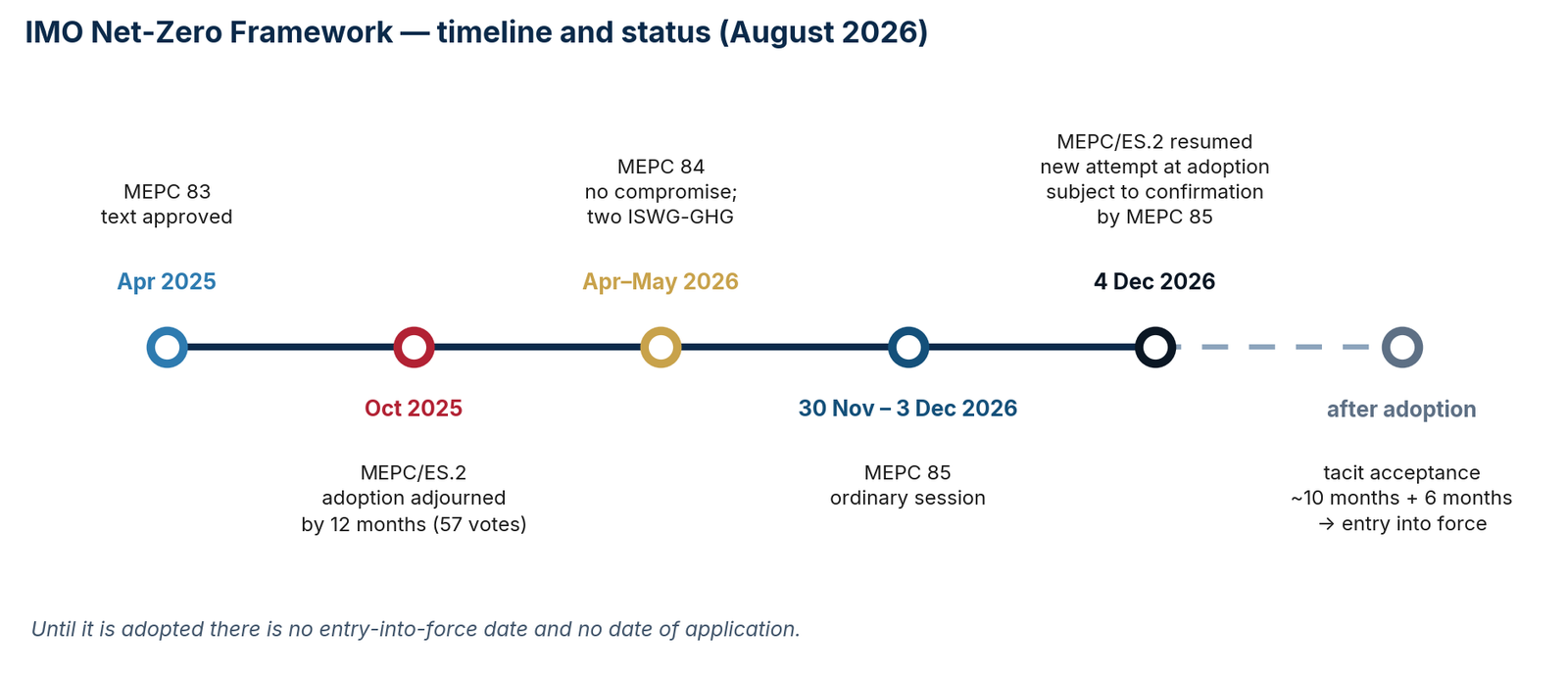
Understanding the recent timeline of the Net-Zero Framework is essential to avoid confusing «approved in draft» with «in force»: these are two very different states with different practical implications for fleet planning.
The key steps
- April 2025 (MEPC 83): the text is approved, with a large majority of member States in favour. Approval is not adoption.
- October 2025 (MEPC/ES.2, extraordinary session): the formal adoption vote expected at this session is adjourned by twelve months, with 57 votes in favour of adjournment and 49 against.
- 27 April–1 May 2026 (MEPC 84): no adoption. The Committee arranged further intersessional work to address differences, allowing new proposals to amend the text. Resumption of the extraordinary session on 4 December remains subject to MEPC 85 confirmation.
- 30 November – 3 December 2026 (MEPC 85), followed by the resumption of the second extraordinary session on Friday 4 December 2026: this is where the next attempt at adoption will be played out. The date is not settled, however — the IMO gives it as subject to confirmation by MEPC 85 itself — and the intersessional work preceding it is set for 1–4 September and 23–27 November 2026.
- Any adoption must establish the text and applicable procedure. Under the ordinary MARPOL tacit-acceptance route, acceptance takes at least ten months and entry into force follows six months later, subject to treaty conditions. This sequence is not a confirmed Framework date: negotiation status, acceptance and application must be checked against the adopted instrument.
The negotiation calendar is not a compliance deadline. Separate current duties, proposed text and scenarios in the fleet plan; update decisions after Committee action.
ISWG-GHG 22 met on 1–4 September. Discussions on proposals continued; implementation guidelines and LCA documents were deferred to ISWG-GHG 23 (23–27 November). This is not adoption of the Framework. MEPC 85 is scheduled for 30 November–3 December; the extraordinary resumption on 4 December remains subject to Committee discussions.
Key takeaways
- The 2025 extraordinary session was adjourned without adoption.
- 4 December 2026 is a scheduled step but subject to confirmation.
- No entry-into-force date exists before adoption.
EU ETS: shipping in the European carbon market
Module objectiveMap EU ETS scope, responsible entity, gases, phase-in and surrender deadline for a ship and for a shipping company.
The European Union has extended its Emissions Trading System (ETS) to maritime transport: it covers ships of 5,000 GT and above calling at ports in the Union and the European Economic Area. The share to be covered is counted on the emissions year, not the surrender year: 40% of verified 2024 emissions, 70% of 2025 emissions and 100% of 2026 emissions, each surrendered by 30 September of the following year. 2026 emissions are therefore surrendered in September 2027. From 2026 the scope is no longer CO2 alone: it also covers methane and nitrous oxide. Offshore ships of 5,000 GT and above enter the EU ETS in 2027: a narrower scope than MRV's, and not to be confused with it.
Ordinary scope concerns commercial cargo or passenger transport; check exclusions and derogations for the service, port and route. The 100% and 50% shares describe ordinary geographical scope, not a substitute for that assessment.
How it works in practice
- 100% of emissions on voyages between EU/EEA ports and during port stays is covered, and 50% of emissions on voyages entering or leaving the area.
- The responsible entity is the shipping company: the registered owner, or the ISM company that has assumed operational responsibility and received a documented mandate from the registered owner for ETS and MRV. Without that mandate, the registered owner is responsible. Tasks such as data collection or allowance purchasing may be outsourced — and often are — but outsourcing a task does not transfer regulatory responsibility: before the authority, the designated company always answers.
- Allowances are surrendered by 30 September of the following year, on the basis of the verified MRV report.
- The price of allowances is determined by the European ETS market, exposing the company to that market's volatility.
Unlike a fixed duty, the ETS cost varies with the market price of CO2 allowances, which can fluctuate significantly. The most structured companies incorporate financial hedging and contractual clauses that allow this cost to be passed on, in whole or in part, to charterers.
Separate geographical share and phase-in: 1,000 verified tCO₂e on an extra-EEA voyage in 2026, without derogations, give 1,000 × 50% × 100% = 500 allowances to surrender in 2027. Do not apply the 50% twice to an aggregate already limited to ETS scope.
Key takeaways
- The 100% applies to 2026 emissions, surrendered in September 2027.
- From 2026 the scope also covers methane and nitrous oxide.
- Outsourcing tasks does not transfer regulatory responsibility.
FuelEU Maritime: intensity and flexibility
Module objectiveApply well-to-wake limits, pooling, banking, borrowing to a fleet, keeping FuelEU distinct from EU ETS.
FuelEU Maritime has applied since 1 January 2025 to ships above 5,000 GT carrying cargo or passengers commercially, irrespective of flag, within Article 2 and subject to its exclusions. This differs from the inclusive EU ETS threshold. The limit concerns the annual average well-to-wake GHG intensity of energy. Check geographical scope separately: the Commission reports delayed incorporation into the EEA Agreement; until incorporation, Norwegian and Icelandic ports are third-country ports for FuelEU.
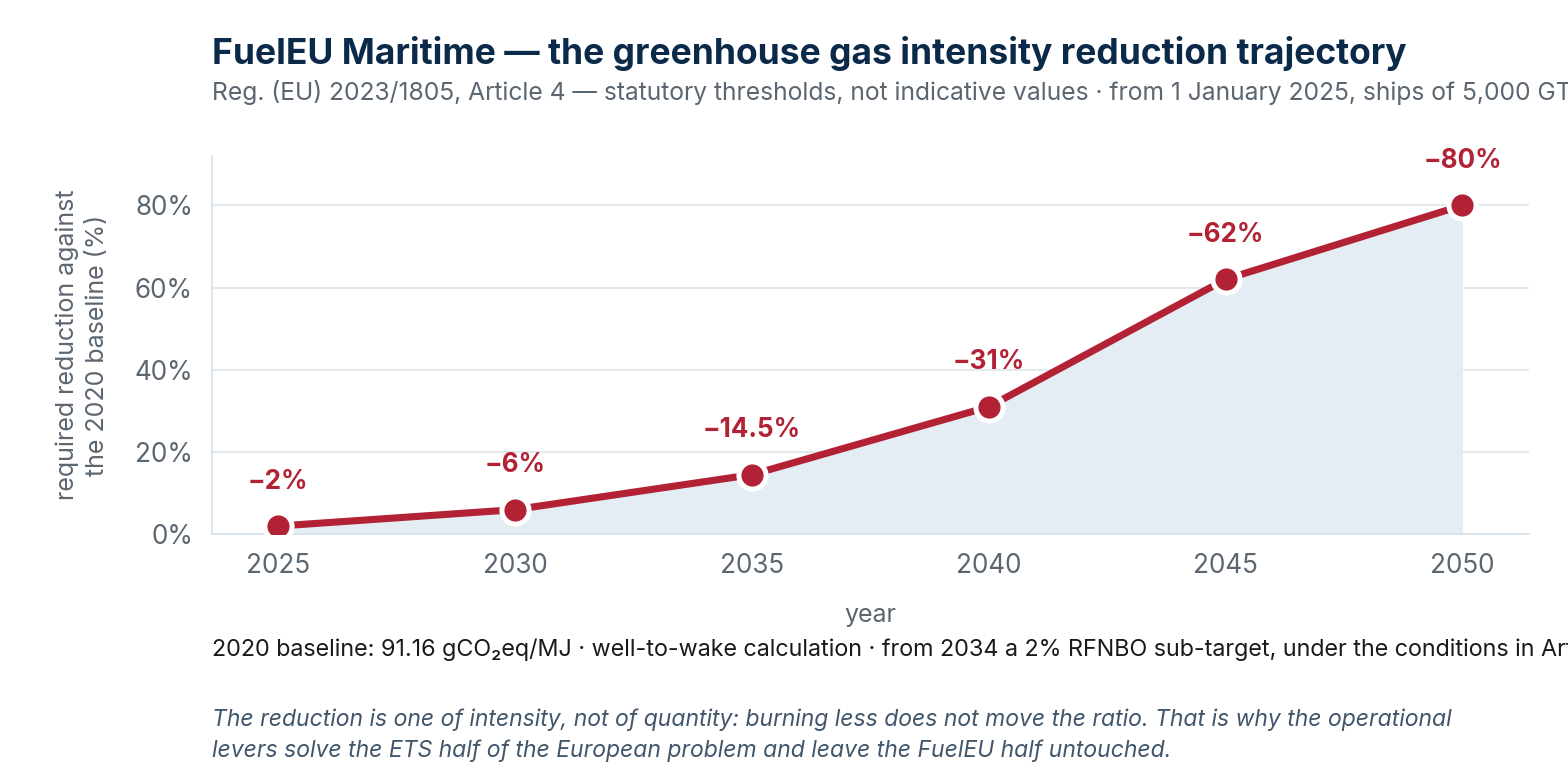
The trajectory starts from the 2020 fleet average of 91.16 gCO2e/MJ and tightens in steps: −2% from 2025, −6% from 2030, −14.5% from 2035, −31% from 2040, −62% from 2045 and −80% from 2050. OPS is a distinct duty covered in the next module: port-call preparation.
Flexibility mechanisms
| Mechanism | Function |
|---|---|
| Pooling | Multiple ships of the same company (or different companies) can aggregate their compliance balances, offsetting deviations between ships |
| Banking | A compliance surplus in one year can be carried forward to subsequent years |
| Borrowing | An advance surplus is borrowed from the next period, with repayment uplift and defined limits |
| Penalties | Non-compliance not offset by the preceding mechanisms results in financial penalties |
Pooling can allocate surplus among ships with different balances. Compare surplus, fuel, verification and contractual costs: an economic benefit is not automatic. Define responsibilities, allocation and the consequences of corrected data.
Pooling requires a positive total balance; a deficit ship must not worsen its deficit and a surplus ship must not become deficient. Borrowing has the 2% limit defined in Article 20(2), a 10% repayment uplift and cannot be used in two consecutive periods. Record decisions within Articles 20–21 deadlines; pooling does not offset an OPS connection failure.
A ship cannot use borrowing and pooling in the same period (Article 21(6)). Article 5 RFNBO rewards and the Annex I wind factor have specific conditions: distinguish these incentives from the general limit.
Key takeaways
- FuelEU regulates the GHG intensity of onboard energy, not an ETS allowance.
- The thresholds from 2025 to 2050 are statutory, not indicative values.
- Pooling can support several ships’ compliance within balance, verification and deadline constraints.
OPS: duties and port-call preparation
Module objectiveAssess the OPS duty for a ro-pax case, identify the evidence to record and distinguish the port-stay duration from non-compliant hours.
This module applies the shore-power topic explored in Carbon. It belongs to the decarbonisation course: OPS remains linked to FuelEU Article 6 and AFIR infrastructure, but requires a port-call decision. The case is illustrative and does not describe an actual GNV ship or call.
First check a passenger or container ship above 5,000 GT, commercial use and Article 2 scope; then the year, port and stay at the quayside. Equipment availability alone does not determine the duty.
OPS: applicability and evidence
The reference is FuelEU Article 6: from 2030 at AFIR Article 9 ports; from 2035 at other Member-State ports with available OPS at the quay. In 2030, unavailability may support an exception; it does not remove the port from scope. The eight Article 6(5) exceptions have specific conditions: a stay must actually last less than two hours; batteries must cover all demand and meet Article 6(5)(b) and Annex III. Determination and recording follow Article 6(9). From 2035, the Article 6(10) limit concerns only exceptions (d), (e) and (f) at AFIR ports.
30,000 GT, four hours at an AFIR port, compatible installations and available OPS: check the duty and supply the entire electrical demand unless an exception applies. For established demand of 1,000 kW and 1.2 non-compliant hours, Article 23(5) gives an estimate of 1.5 × 1,000 × 2 = EUR 3,000. Round up the non-compliant hours, not the entire stay.
Explore OPS and its calculator in Carbon · Operational preparation in Knowledge
Article 6(3) allows earlier national OPS requirements in 2030–2034 at other ports; check them.
Evidence to organise before the call
- Ship, GT, service, year and port: document why the case falls within scope.
- Actual stay and connection times, electrical demand and equipment availability.
- Ship–shore compatibility and relevant technical records.
- Any exception: the specific condition and recording under Article 6(9), not a generic assertion.
- Any non-compliant hours: keep them separate from the total port stay.
In summary
- OPS concerns electrical demand at the quayside: check scope and exceptions.
- Pooling and borrowing do not offset a failure to connect to OPS.
- The penalty estimate uses established demand and non-compliant hours rounded up.
After the two questions, discover how this topic connects to the other decarbonisation instruments.
Explore the 14-module course overview · Start the full course
Alternative fuels: a comparative overview
Module objectiveCompare energy carriers by pathway, well-to-wake performance, ship compatibility, availability and HSE risk.
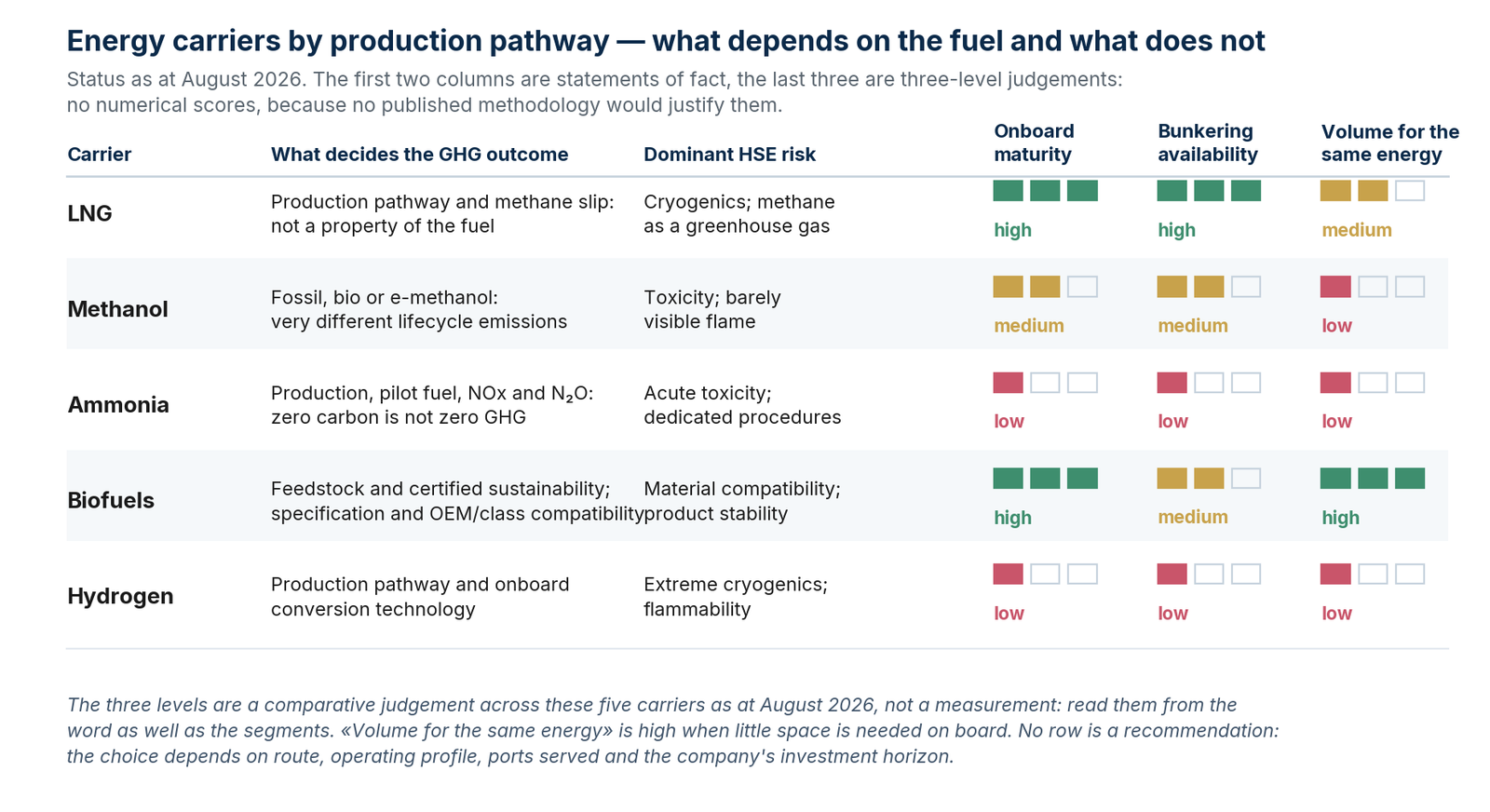
The choice of fuel is the most significant structural decision, and the hardest to reverse, in a company's decarbonisation strategy, with impacts on newbuildings, retrofits, bunkering infrastructure and crew training.
| Fuel | Main advantages | Main challenges |
|---|---|---|
| LNG | Relatively mature technology and infrastructure; reduces SOx and particulate matter | Well-to-wake GHG performance depends on the production pathway and methane slip: it is not a property of the fuel, it is a property of the supply chain and the engine |
| Methanol | Liquid at ambient conditions, simpler handling than LNG | Lifecycle emissions differ radically between fossil, bio- and e-methanol. Low energy density and toxicity require dedicated design and procedures |
| Ammonia | Contains no carbon and produces no fuel-carbon CO2 | Production, pilot fuel, NOx and N2O, toxicity and safety determine the actual outcome: «zero carbon» is not «zero GHG» |
| Biofuels | Some products and blends can be used with limited modifications | Subject to specification, compatibility, OEM/class and certified-sustainability checks: drop-in does not apply indiscriminately |
| Hydrogen | No fuel-carbon CO2 at the point of use | Well-to-wake performance, storage, range, safety and conversion technology depend on the pathway and the application |
The optimal choice depends on the route profile, bunkering availability on the routes served and the company's investment horizon. Many companies are opting for dual-fuel solutions that preserve optionality, deferring definitive commitment to a single fuel until there is greater regulatory and market clarity.
For hydrogen distinguish compressed and liquid storage: high pressure and cryogenics do not apply in the same way. The matrix summarises design checks; it does not certify suitability or assign universal availability scores.
Key takeaways
- A fuel name alone does not determine climate performance.
- Zero carbon at the point of use does not mean zero well-to-wake emissions.
- Ship, port and crew readiness must be checked together.
Short-term operational levers
Module objectiveSelect measurable operational levers and define baselines, owners and commercial limits for each ship.
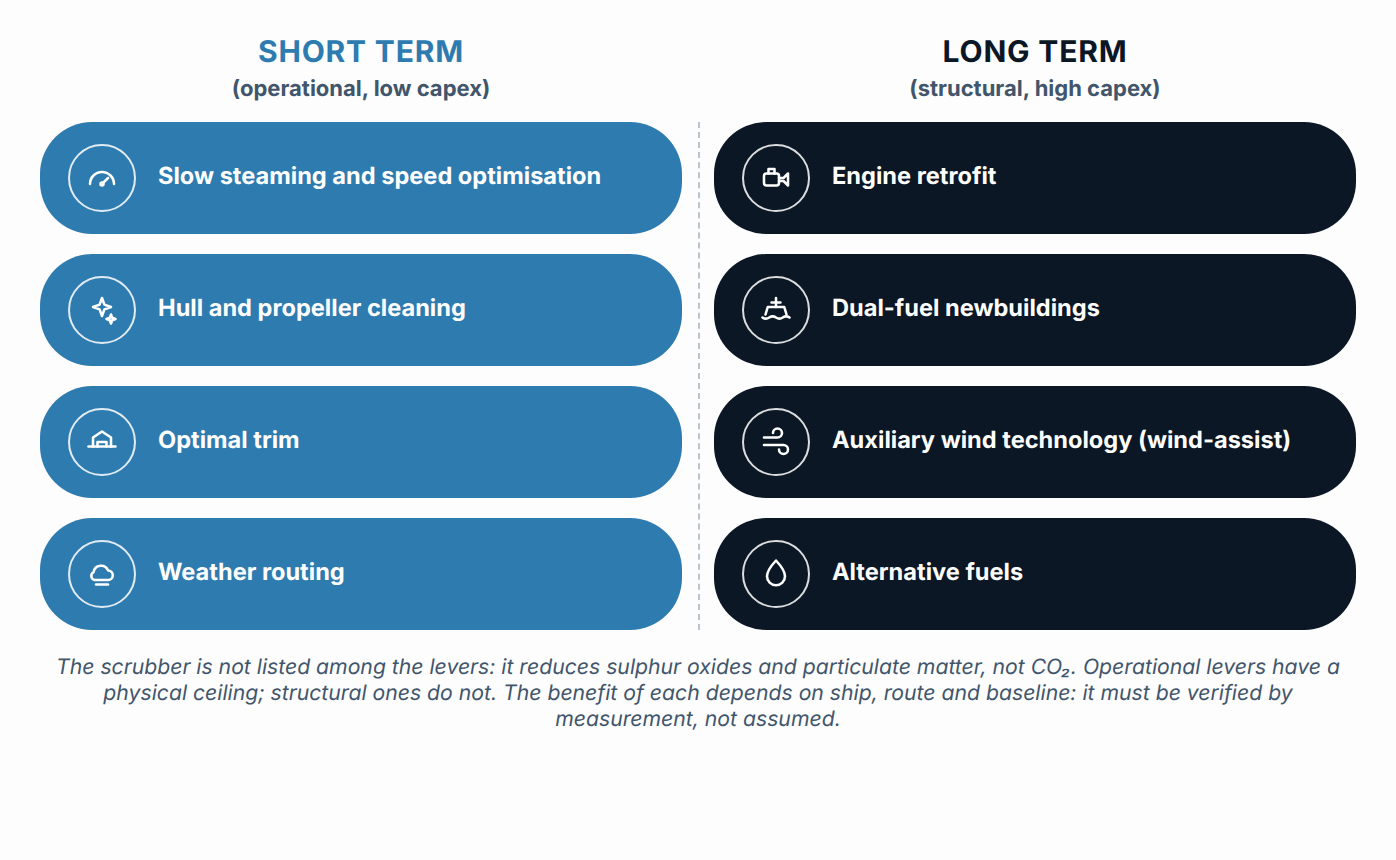
Speed, hull condition, trim and routing offer efficiency opportunities to assess for each ship. Before acting, define the baseline, safety limits, approvals, responsibilities and service constraints. Effects on CII, ETS and FuelEU are not identical.
Short-term levers in detail
| Lever | Typical impact |
|---|---|
| Slow steaming and speed optimisation | Significant reduction in fuel consumption per unit of distance travelled |
| Hull and propeller cleaning | Reduction in hydrodynamic resistance and therefore consumption for the same speed |
| Optimal trim and stability | Better propulsive efficiency for the same load |
| Weather routing | Avoids adverse weather conditions that increase consumption |
Measure before and after under comparable speed, draught, load, weather and hull conditions. Assess voyage and annual consumption, auxiliary hours and service delivered. Lower speed may extend voyages and change fleet requirements; do not apply universal savings percentages.
Reducing energy use does not automatically reduce FuelEU intensity in gCO2e/MJ: with unchanged mix and factors, the ratio stays the same. The balance may change through in-scope energy. Measure total consumption, CII, FuelEU intensity and ETS cost separately; structural investments also have limits and costs.
Key takeaways
- Speed, hull condition, trim and routing can reduce consumption within safety and service constraints.
- The benefit varies by ship and route and must be measured, not assumed.
- Operational measures and investments have limits: measure their contribution.
Structural investments and newbuildings
Module objectiveEvaluate retrofits and newbuildings through technical, regulatory and financial scenarios, separating GHG reduction from pollutant control.
Long-term decisions — retrofits, newbuildings, auxiliary technologies — require significant capital and long amortisation horizons, which makes them particularly sensitive to the regulatory uncertainty described in Module 5.
The main structural options
- Efficiency and propulsion retrofits: engine and propeller modifications, hydrodynamic devices, air lubrication, waste-heat recovery, batteries or wind-assist may reduce fuel consumption or replace part of the fossil energy demand, but the benefit must be measured against the ship's actual operating profile. Scrubbers are not a CO2-reduction measure: they address SOx and particulate limits depending on configuration, may in fact increase energy consumption, and must not be counted as a decarbonisation lever.
- Dual-fuel newbuildings: maintain fuel flexibility, at a higher construction cost.
- Auxiliary wind technologies (wind-assist): rigid sails, Flettner rotors and similar systems can reduce primary fuel consumption under specific route conditions.
The investment dilemma under regulatory uncertainty
Optionality can reduce some investment risks but does not remove technical constraints or irreversible choices. Dual-fuel and fuel-ready do not mean compatibility with any fuel: specify conversions, space, approvals, fuel supply and costs before valuing flexibility.
Postponing every investment while waiting for full regulatory certainty is not a neutral strategy: it risks having to rush to meet obligations within tight timeframes once the framework stabilises, at a stage when shipyard capacity and the alternative fuel supply chain will likely be more contested and expensive.
Key takeaways
- Scrubbers are not a CO2 reduction measure at all.
- Assess optionality against costs and technical limits; it does not remove every irreversible choice.
- Cost and benefit must be tested against the ship's actual operating profile.
Building a multi-year compliance plan
Module objectiveBuild a ship-by-ship multi-year plan integrating applicable obligations, data, contracts, operational levers and investments.
The complexity and overlap of the instruments seen in previous modules make an integrated compliance plan necessary, one that coordinates EEXI, CII, EU ETS and FuelEU while keeping obligations, records and responsibilities distinct; the Net-Zero Framework remains a scenario until adoption.
The components of a good plan
- Mapping of applicable obligations for each ship in the fleet, based on routes, flag and size.
- Continuous monitoring of CII and consumption, with a projection of the expected year-end rating.
- Periodic assessment of the short-term operational levers still available for each ship.
- Multi-year structural investment plan, with alternative scenarios based on regulatory developments.
- Contractual clauses with charterers that clearly allocate compliance costs: for time charters there are industry standard clauses — BIMCO's ETS Emissions Trading Scheme Allowances Clause, CII Operations Clause and FuelEU Maritime Clause for Time Charter Parties 2024 — to assess and adapt to the actual contract, without automatically transferring regulatory responsibility.
- Regular updating of the plan based on regulatory developments, particularly on the outcome of the next attempt at adopting the Net-Zero Framework, with extraordinary resumption scheduled for 4 December 2026, subject to MEPC 85 discussions.
No single role — technical, commercial, HSEQ — can manage fleet decarbonisation alone. The most mature companies set up a permanent cross-functional group that integrates technical, commercial and financial decisions, preventing each function from optimising only its own part of the problem.
Key takeaways
- A ship-by-ship mapping coordinates applicable obligations, data and responsibilities.
- Contractual cost and responsibility must be allocated explicitly.
- The plan must be updated with regulatory developments, not left static.
Emerging trends
Module objectiveDefine a regulatory-watch process that separates adopted facts, negotiated texts and assumptions, updating scenarios.
The maritime decarbonisation framework will continue to evolve rapidly in the coming years, and some directions already appear to be taking shape.
What to watch in the coming months
- The outcome of the next attempt at adopting the Net-Zero Framework, at the resumed extraordinary session on 4 December 2026, immediately after MEPC 85, including the debate on the acceptance procedure (tacit or explicit) that will affect its entry-into-force timing.
- The development of detailed guidelines on fuel lifecycle analysis methodologies and the GFI registry, under discussion at the Intersessional Working Group during 2026.
- The evolution of the availability of zero/near-zero emission fuels at commercial scale, which will determine the real effectiveness of the reward mechanism envisaged by the Net-Zero Framework.
- The possible convergence, or conversely the growing fragmentation, between the global IMO framework and the regional European measures already in force.
Given the uncertainty still present around the outcome of the Net-Zero Framework's adoption, the soundest planning does not bet on a single regulatory scenario, but builds enough flexibility to operate reasonably under several plausible scenarios, updating the plan as the framework becomes clearer.
Key takeaways
- The outcome of the next adoption attempt must be tracked, not assumed.
- Fuel availability and lifecycle rules are decisive variables.
- Scenario planning supports decisions while regulatory developments remain uncertain.
Reporting and regional carbon pricing: MRV, DCS and the UK ETS
Module objectiveGovern DCS, MRV, EU ETS, FuelEU and UK ETS as separate but reconciled data chains, with verified scopes and deadlines.
Consumption is a starting point, not the only determinant. Emission factors, energy, distance, capacity, fuel certification, scopes and exceptions also matter. DCS, MRV, FuelEU and ETS require reconciled but distinct data chains.
The two data chains: DCS and MRV
The IMO DCS collects, for ships of 5,000 GT and above, annual consumption by fuel type, distance travelled and hours under way; the data go to the flag or the RO, which issues the Statement of Compliance to be kept on board. The EU MRV requires, for EU/EEA voyages, per-voyage and per-ship data based on an approved monitoring plan, with the verified report uploaded to THETIS-MRV and the document of compliance carried on board. Its scope is no longer the DCS scope: since 1 January 2025 MRV also covers general cargo and offshore ships from 400 to below 5,000 GT (Article 2(1a)), as well as offshore ships of 5,000 GT and above (Article 2(1b)), and it covers CO2, CH4 and N2O for emissions from 2024. The resulting offshore scope therefore starts at 400 GT; this does not automatically extend EU ETS to the same ships. Ship type, tonnage, activity and voyage must therefore be checked separately: MRV applicability cannot be inferred from DCS applicability.
| Deadline | Obligation |
|---|---|
| 31 January | FuelEU: ship report to the verifier |
| 31 March | DCS: previous year's data to the Administration or RO · MRV/EU ETS: verified ship and company-level reports · FuelEU: the verifier notifies the compliance balance and records the report (Art. 16) · UK ETS: verified annual report |
| 30 April | FuelEU: borrowing and pool composition/allocation recorded (Articles 20–21); banking must be recorded before the document of compliance is issued · UK ETS: ordinary surrender for scheme years from 2028 (first ordinary deadline: 30 April 2029); for scheme years 2026 and 2027, allowances are surrendered together on 30 April 2028 |
| 31 May | DCS: issue of the Statement of Compliance |
| 30 June | DCS: data to the IMO database within one month of SoC issue · MRV: document of compliance on board · FuelEU: issue of the document of compliance and payment of any penalties (Arts. 22-23) |
| 30 September | EU ETS: surrender of the previous year's allowances |
UK ETS: scope and deadlines
From 1 July 2026 the United Kingdom has extended its ETS to shipping: it covers cargo and passenger ships of 5,000 GT and above on UK domestic routes and during stays at UK ports. The gases covered are CO2, methane and nitrous oxide, measured on a tank-to-wake basis. The monitoring plan is per company, not per ship. The verified annual report is due by 31 March of the following year, and that already applies to 2026 and 2027. Surrender follows two different rules: ordinary from the 2028 scheme year, on 30 April of the following year; and transitional for the first two years, because 2026 and 2027 allowances are both surrendered on 30 April 2028. The first cycle, moreover, is not a full year but the half-year 1 July – 31 December 2026. Offshore units come in from January 2027.
A ship trading in UK cabotage and on European routes may fall under both UK ETS and EU ETS. Voyage and in-port activity definitions must be assessed under both regimes: no rule guarantees in the abstract that there is no overlap, so each itinerary has to be mapped. What certainly doubles is the administration: separate compliance flows, plans and registries — and it is worth checking whether the same provider holds both of the required accreditations, because that cannot be assumed.
What changes for management
With multiple carbon-pricing and reporting instruments, consumption data stop being a technical figure and become an accounting figure: bunker delivery notes, flowmeter readings and engine-room records must reconcile with each other. A discrepancy found at verification costs more — in time, in credibility and sometimes in allowances — than a whole year of careful recording.
Treat reporting as an administrative chore and you discover late that you are paying on the worst figure available. The work starts on board: uniform reading procedures, fuel sampling, monthly reconciliation between declared and accounted consumption. Better data make the CII rating more reliable; they do not guarantee a better rating.
UK ETS: also check excluded activities and qualifying Scottish ferry services; in-port activities include port movements. Apply for the monitoring plan within 42 days of the first in-scope activity. Under MRV, the authority may require reports before 31 March, but not before 28 February. The table does not replace competent-authority instructions.
DCS: MEPC.385(81) entered into force on 1 August 2025. MEPC.1/Circ.913 distinguishes early application, existing ships retaining prior granularity throughout 2025 and moving to enhanced data from 2026, and ships delivered from 1 August 2025 collecting enhanced data from delivery. Verify SEEMP Part II for the case and flag instructions. More detailed consumer and transport-work data are also required; they do not automatically replace the CII denominator.
Key takeaways
- DCS and MRV no longer share the same tonnage threshold.
- Unreconciled bunker data become a financial and compliance risk.
- The 2026 and 2027 UK ETS years share one surrender date, 30 April 2028.
Recurring mistakes
From the Mistake Library of SuperbaKnowledge, filtered to the subjects this course covers. This learning selection draws on SuperbaKnowledge topics, with wording reviewed for this course. The linked Knowledge page remains the reference version, while official texts remain authoritative.
| Topic | Mistake | Typical consequence | Topic sheet |
|---|---|---|---|
| Methanol/Ammonia Bunkering | Planning based on theoretical technical compatibility, without checking actual bunkering availability along the routes | Practically unable to refuel the ship according to the original voyage plan | See the topic sheet |
| CII (Carbon Intensity Indicator) | CII rating monitored only at year-end, without intra-year projections | Late discovery of an insufficient rating, with no time for corrective action within the current year | See the topic sheet |
| CII Reduction Factors | SEEMP Part III not reviewed against the adopted 2027–2030 CII reduction factors | Documentary non-compliance with the new CII requirements | See the topic sheet |
| EEXI/EPL | Exclusive reliance on EPL without considering the operational impact on maximum available speed | Reduced commercial flexibility of the ship not fully assessed in advance | See the topic sheet |
| EU ETS and FuelEU Maritime | EU ETS and FuelEU Maritime treated as a single obligation, without distinguishing their logic | Confusion in managing the obligations, which are actually distinct mechanisms with their own deadlines and logic | See the topic sheet |
| IMO Net-Zero Framework | Fleet planning based on the original entry-into-force date without monitoring slippages in the adoption process (the October 2025 session closed without agreement) | Fuel/compliance credit investments calibrated to a regulatory timeline that is no longer current | See the topic sheet |
| EU MRV Review | Scope of the MRV Regulation checked only once and never updated over time | A ship that falls into a recently included category without the Company noticing | See the topic sheet |
| SEEMP Part II and Part III | SEEMP Part II not updated for the applicable granularity timetable and flag instructions | Data collected not compliant with the new requirements, CII reporting at risk of inaccuracy | See the topic sheet |
| Alternative Fuels and Operational Readiness | Crew trained generically on 'alternative fuels' instead of specifically on the fuel actually used | Personnel not adequately prepared for the specific risks of the actual fuel on board | See the topic sheet |
| Just Transition and Decarbonization | Crew training on alternative fuels planned only right before the new ship's delivery | Crew unprepared for the ship entering service, with real operational risk | See the topic sheet |
Frequently asked questions
Do EU ETS and FuelEU have the same scope?
No: check thresholds, activities and geography separately. FuelEU uses above 5,000 GT; EU ETS uses an inclusive threshold. Do not automatically transfer EEA treatment between regimes.
Does consuming less always improve FuelEU intensity?
No. With unchanged mix and factors, gCO2e/MJ may remain the same. Assess energy reduction, balance, CII and ETS exposure separately.
Does pooling avoid a penalty for failure to use OPS?
No. Intensity flexibility does not replace the Article 6 connection duty; the Article 23(5) OPS penalty has separate conditions.
Is a small offshore ship always outside MRV?
No. From 2025 Article 2(1a) also includes offshore ships from 400 to below 5,000 GT, for in-scope activities and voyages. Check EU ETS separately.
Does completing this demo certify compliance?
No. Checks are educational and progress is local to the browser. Results are not a professional certificate, flag verification or a ship compliance determination.
Glossary of acronyms
| Acronym | Definition |
|---|---|
| CII | Carbon Intensity Indicator |
| DCS | IMO Data Collection System (fuel oil consumption) |
| EEDI | Energy Efficiency Design Index (newbuildings) |
| EEXI | Energy Efficiency Existing Ship Index |
| EPL | Engine Power Limitation |
| ETS | Emissions Trading System |
| GFI | GHG Fuel Intensity |
| GHG | Greenhouse Gas |
| GT | Gross Tonnage |
| ISWG-GHG | Intersessional Working Group on GHG (IMO) |
| LCA | Life Cycle Assessment (of the fuel) |
| MEPC | Marine Environment Protection Committee (IMO) |
| MRV | Monitoring, Reporting and Verification (EU emissions regime) |
| NZF | Net-Zero Framework (IMO) |
| OPS | Onshore Power Supply (shore power at berth) |
| RFNBO | Renewable Fuels of Non-Biological Origin |
| SEEMP | Ship Energy Efficiency Management Plan |
| ShaPoLi | Shaft Power Limitation |
| SoC | Statement of Compliance (DCS) |
| tank-to-wake | Emissions from the onboard tank to the exhaust, excluding production |
| well-to-wake | Analysis of emissions across the fuel's entire lifecycle |
| ZNZ | Zero or Near-Zero GHG emission fuels |
References and sources
- IMO — EEXI/CII FAQ
- IMO — MEPC/ES.2/2 (draft, 2025)
- IMO — MARPOL Annex VI: resolutions and guidance
- EMSA — Safety of alternative fuels
Provisions and updates checked for this revision, 15 September 2026. Legal instruments and institutional summaries have distinct roles.
- FuelEU — Articles 2, 4, 6, 20–23
- AFIR — Article 9, consolidated 8 January 2026
- MRV — Article 2(1a) and (1b), consolidated 1 January 2025
- European Commission — FuelEU status and EEA incorporation
- IMO — ISWG-GHG 22 outcome, September 2026
- GOV.UK — maritime UK ETS: application and deadlines
- BIMCO — FuelEU Maritime Clause for Time Charter Parties 2024
Consolidated list of the sources cited. Reference date: 15 September 2026. Regulatory status must be checked before operational use. The decarbonisation framework is evolving rapidly: always consult the latest official version in force.
| Source | Scope |
|---|---|
| IMO — 2023 IMO Strategy on Reduction of GHG Emissions from Ships | 2030/2050 strategic targets |
| MARPOL Annex VI and subsequent amendments (Res. MEPC.328(76) and following) | EEXI, CII, basis of the Net-Zero Framework |
| IMO MEPC 83 (April 2025) and MEPC ES.2 (October 2025) | Draft approval and postponement of the Net-Zero Framework |
| Regulation (EU) 2023/1804 (AFIR), Art. 9 — alternative fuels infrastructure | The ports where the FuelEU OPS obligation starts in 2030 |
| Regulation (EU) 2023/1805 — FuelEU Maritime, Art. 4 (thresholds), Art. 6 (OPS), Arts. 20-23 (banking, borrowing, pooling, document of compliance and penalties) | GHG intensity of onboard energy and the compliance calendar |
| IMO MEPC 84 (27 April – 1 May 2026) | Net-Zero Framework status; start of phase 2 of the CII review |
| IMO Res. MEPC.352(78), as amended by MEPC.412(84); MEPC.353(78); MEPC.338(76), as amended by MEPC.400(83); MEPC.354(78); MEPC.355(78) | CII Guidelines G1–G5, respectively: indicators and calculation methods, reference lines, reduction factors, rating, correction factors and voyage adjustments |
| IMO Res. MEPC.395(82), as amended by MEPC.401(83) and MEPC.413(84); revokes MEPC.346(78) (2022 SEEMP Guidelines), previously amended by MEPC.388(81) | 2024 Guidelines for the development of the SEEMP, including Part III |
| MARPOL Annex VI, chapter 4 (DCS) | Collection and transmission of consumption data |
| Regulation (EU) 2015/757, as amended by Reg. (EU) 2023/957 — consolidated version of 1 January 2025, Arts. 2(1), 2(1a), 2(1b) and 2(1c) | MRV: scope by ship type and tonnage, gases covered, monitoring, reporting and verification |
| Directive 2003/87/EC, as amended by Directive (EU) 2023/959 | EU ETS: establishment of the system and extension to maritime transport |
| The Greenhouse Gas Emissions Trading Scheme (Amendment) (Extension to Maritime Activities) Order 2026 — and, distinct from it, the GOV.UK operational guidance «UK ETS for maritime: how to comply» | Extension of the UK ETS to maritime activities: the instrument sets the obligations, the guidance describes their application and can change without the instrument changing |
| BIMCO — ETS Allowances Clause, CII Operations Clause, FuelEU Maritime Clause for Time Charter Parties 2024 | Contractual allocation of compliance costs |
IMO — MEPC press releases and documents on the Net-Zero Framework's adoption status.
European Commission — updates on EU ETS and FuelEU Maritime.
Classification societies and Flag Administrations for technical application on board.
This course is educational material for training purposes and does not constitute a professional certification or qualifying credential. Read the full disclaimer.