
MLC 2006
Crew welfare and maritime labour compliance
Learning objectives
- Describe the structure of the five titles of MLC 2006 and the four levels of the text, distinguishing binding Standards from Guidelines.
- Identify which ships and which people the Convention covers, and what a substantial equivalence is.
- Understand the function of the Declaration of Maritime Labour Compliance (DMLC), Parts I and II.
- Correctly manage a complaint according to the procedure set out in the Convention.
- Apply the minimum hours of rest requirements and understand their relationship with STCW.
- Recognise the typical areas checked in an MLC inspection, including within PSC.
- Reconstruct the five rounds of amendments to the Code and the tacit acceptance mechanism that governs them.
- Contribute to a welfare culture that goes beyond mere formal compliance.
Genesis and structure of MLC 2006
Module objectiveUnderstand why MLC 2006 consolidates maritime labour instruments, recognise its five Titles and connect substantive rights with compliance and enforcement.
The Maritime Labour Convention 2006 was adopted by the International Labour Organization (ILO) on 23 February 2006, at the 94th (Maritime) Session of the International Labour Conference, and entered into force on 20 August 2013, twelve months after the double threshold was met: thirty ratifications representing at least 33 per cent of world gross tonnage. It consolidates and updates 68 earlier instruments — 37 Conventions and 31 Recommendations adopted from 1920 onwards — into a single text, which is why it is described as the «fourth pillar» of international maritime regulation alongside SOLAS, MARPOL and STCW. As checked on 15 September 2026, it is ratified by 113 Member States, representing 96.6 per cent of world gross tonnage.
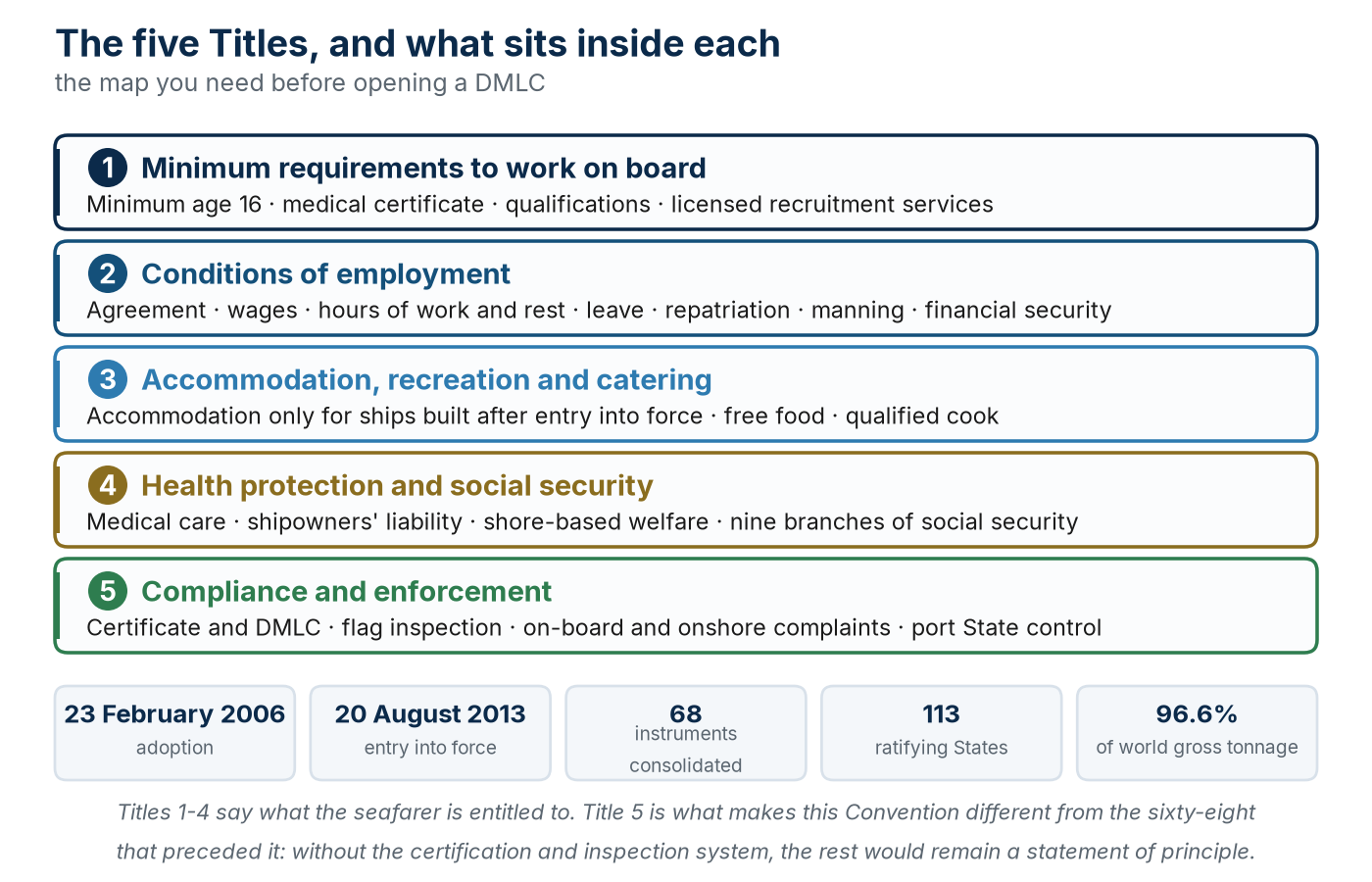
| Title | Content |
|---|---|
| 1 | Minimum requirements to work on board (minimum age, medical certificate, training, recruitment) |
| 2 | Conditions of employment (contract, pay, leave, repatriation, minimum manning) |
| 3 | Accommodation, recreational facilities, food and catering |
| 4 | Health protection, medical care, welfare and social security |
| 5 | Compliance and enforcement (inspections, certification, complaints) |
Table 1.1 — The five titles of MLC 2006.
MLC 2006 does not only introduce substantive rights for seafarers, but also a verification and enforcement system (Title 5) that makes it, in practice, an instrument with obligations and checks under the applicable regime, not merely a declaration of principles.
Key takeaways
- MLC 2006 combines maritime labour rights and mechanisms for verifying them.
- The five Titles move from individual eligibility to compliance and enforcement.
- Ratification and tonnage coverage show global reach but do not replace flag-State implementation checks.
How the Convention is built, and which ships it covers
Module objectiveDistinguish Articles, Regulations, Standards and Guidelines and determine the persons, ships, responsible shipowner and permitted flexibility.
Read MLC by Title and legal level. Articles, Regulations and Part A contain obligations; Part B guides implementation and must receive due consideration. This distinction helps interpret the DMLC and national provisions.
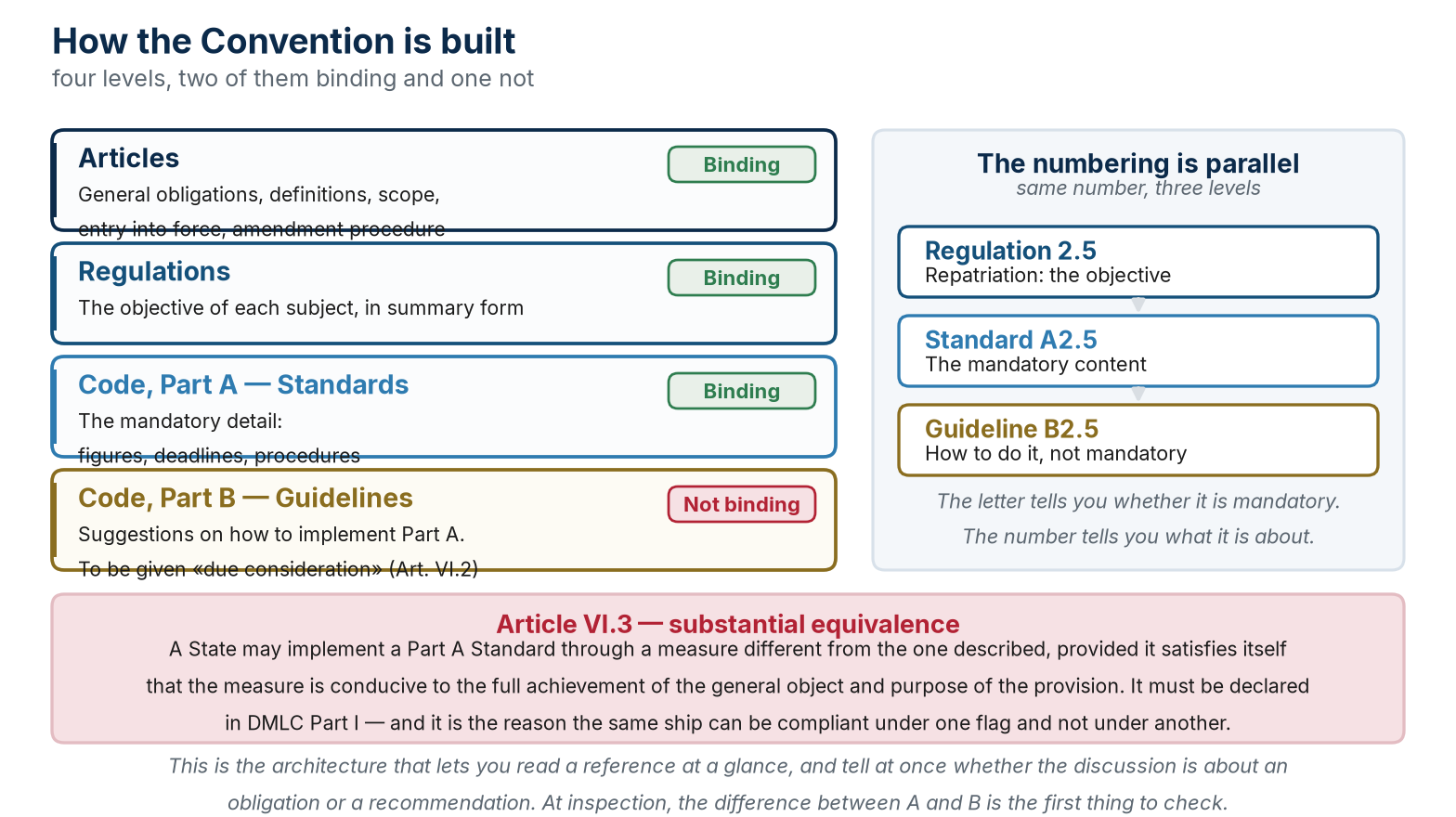
The four levels of the text
| Level | What it contains | Legal force |
|---|---|---|
| Articles | General obligations, definitions, scope, entry into force, amendment procedure | Binding. Amendable only by a new Conference |
| Regulations | The objective of each subject, in summary form | Binding |
| Code, Part A Standards | The mandatory detail: figures, deadlines, procedures | Binding. Implementation through the means permitted by Article IV.5 |
| Code, Part B Guidelines | Suggestions on how to implement Part A | Not binding, but to be given «due consideration» (Art. VI.2) |
Table 2.1 — The four levels of the text and their legal force.
Numbering connects Regulations and the Code: Regulation 2.5 on repatriation now corresponds to Standards A2.5.1 (repatriation) and A2.5.2 (financial security), as well as Guideline B2.5. The letter distinguishes Standards and Guidelines; also check the subparagraph and amended version.
Substantial equivalence, and why it must be read before every inspection
Article VI.3 permits substantial equivalences where a State cannot implement rights and principles in the manner required by Part A, unless otherwise provided. The measure must fully achieve the general object and purpose and give effect to the provision (VI.4). Adopted equivalences belong in DMLC Part I. This flexibility does not apply to Title 5 Part A: it is not general permission to replace any requirement with a company solution.
Who is a seafarer
Article II.1(f) covers people employed, engaged or working in any capacity on a ship subject to the Convention. This includes hotel and catering roles and does not require an STCW qualification. For doubtful categories, such as some temporarily embarked technicians, the competent authority decides after consultation with shipowners’ and seafarers’ organisations (II.3); presence on board alone does not resolve every case.
Who is the shipowner
Article II.1(j) defines the shipowner as the owner or another organisation or person — the manager, the agent, the bareboat charterer — who has assumed responsibility for the operation of the ship and who, on assuming it, has agreed to take over the duties and responsibilities imposed on shipowners by the Convention, regardless of whether any other organisation or person fulfils certain of them on their behalf. This is the central point for ship management: MLC responsibility follows whoever assumed the operation, and is not removed when others perform tasks on their behalf.
Which ships it covers
| It applies to | Exclusions (Art. II.1(i) and II.4) |
|---|---|
| All ships, public or private, ordinarily engaged in commercial activities, of any tonnage | Ships engaged in fishing or similar pursuits |
| Ships on international voyages and ships in domestic trade, subject to the exclusions opposite | Ships of traditional build, such as dhows and junks |
| Ships navigating exclusively in inland waters or within or closely adjacent to sheltered waters or areas where port regulations apply | |
| Warships and naval auxiliaries |
Table 2.2 — The scope of application of the Convention.
The 500 GT threshold determines, in the cases specified by Regulation 5.1.3, whether a Maritime Labour Certificate and DMLC are mandatory; it is not the Convention’s general application threshold. A 400 GT ship engaged on international voyages must therefore comply with the applicable MLC requirements even though mandatory certification is not required, unless the shipowner requests voluntary certification. For ships below 200 GT not engaged on international voyages, Article II.6 permits the flag State, after consultation, limited flexibility regarding certain details of the Code where application would not be reasonable or practicable and the matter is otherwise regulated. Flag-State law and the applicable national implementation must therefore always be checked.
Title 1 requires a minimum age of sixteen; hazardous work and, subject to specific authorised training exceptions, night work are prohibited under eighteen. Medical certificates last at most two years, or one under eighteen; colour-vision certification lasts at most six. Check qualifications and safety familiarisation. Recruitment entails no seafarer fees except the national medical certificate, seafarer’s book and passport; visas are the shipowner’s cost (A1.1, A1.2, A1.4.5(b)).
Key takeaways
- Part A Standards are binding; Part B Guidelines must be given due consideration.
- The seafarer definition is broad, but doubtful cases are determined by the competent authority after consultation.
- Application and certification are different; Article II.6 provides only limited flexibility below 200 GT.
Certification: MLC Certificate and DMLC
Module objectiveExplain when the certificate and DMLC are required, distinguish Parts I and II and verify the five-year certification cycle.
Ships of 500 GT or over engaged in international voyages, or flying the flag of one country and operating from a port or between ports in another country, must hold a Maritime Labour Certificate and a Declaration of Maritime Labour Compliance (DMLC), the latter structured in two parts with distinct functions (Regulation 5.1.3.1). Below 500 GT certification is not mandatory — but the applicable MLC requirements continue to apply, subject to the limited flexibility under Article II.6, and that is the distinction most often misunderstood.
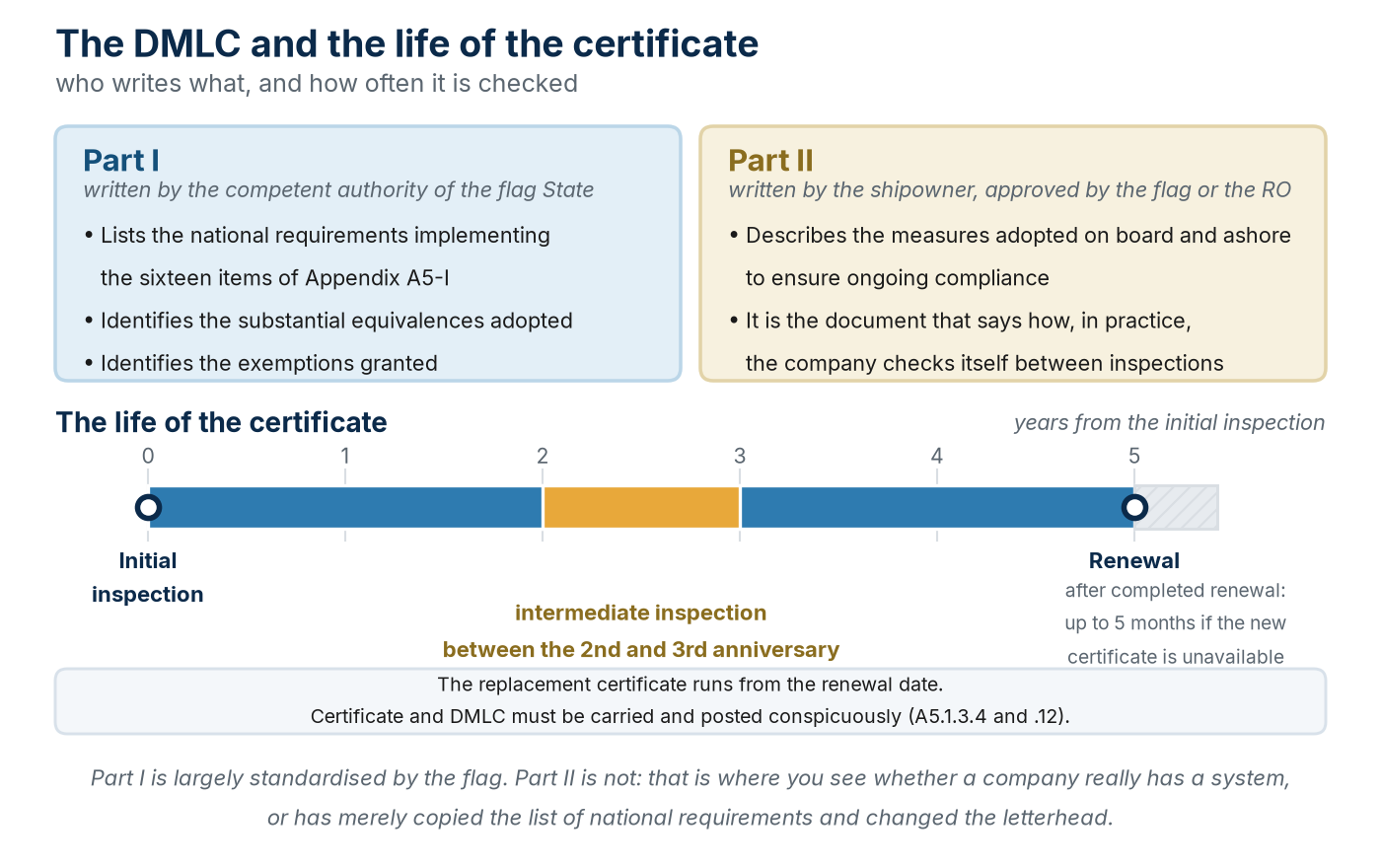
| Part | Content and responsible party |
|---|---|
| Part I | Drawn up by the competent authority of the flag State. It lists the national requirements implementing the sixteen items of Appendix A5-I, and identifies any substantial equivalences adopted and exemptions granted |
| Part II | Drawn up by the shipowner and approved by the competent authority or the recognised organisation. It describes the measures adopted to ensure ongoing compliance between inspections |
Table 3.1 — The two parts of the DMLC.
Validity, intermediate inspection and extension
The certificate lasts at most five years (A5.1.3.1). Where there is only one intermediate inspection and a five-year validity, it takes place between the second and third anniversaries and leads to endorsement (.2). If renewal is completed within three months before expiry, the new certificate runs from completion and expires no later than five years after the previous expiry; if completed earlier, the maximum runs from completion (.3). An authorised endorsement may extend validity up to five months from the old expiry where renewal was satisfactorily completed before expiry but the new document cannot immediately be issued and available on board (.4). Extension does not restart the five-year cycle. Keep the certificate and DMLC on board and post accessible copies; an English translation is required if they are not in English, except on ships not engaged on international voyages (.12).
While Part I is largely standardised on a national basis, Part II reflects the real commitment of the individual company: it describes how, in concrete terms, the shipowner verifies that MLC conditions continue to be met in daily practice, not only at the time of initial certification.
An interim certificate may last at most six months for new delivery, flag change or a new shipowner assuming the ship, after the prescribed checks. No further interim certificate follows the initial six months; full inspection must precede expiry. A DMLC is not required for this interim period (A5.1.3.5-8).
Key takeaways
- Part I records national requirements, equivalences and exemptions; Part II describes the shipowner’s continuing measures.
- The certificate lasts at most five years and requires at least one intermediate inspection during its validity.
- The five-month extension is conditional on a completed renewal inspection and is not an ordinary extension.
Conditions of employment: contract and pay
Module objectiveIdentify SEA content, apply pay, leave and repatriation rules and distinguish a recommended wage from a binding obligation.
Title 2 of the Convention governs the contractual and financial aspects of the maritime employment relationship, with minimum requirements that every seafarer employment agreement must meet.
Essential elements of the Seafarer Employment Agreement (SEA)
- Duration of employment and terms of early termination.
- Remuneration, payable at no greater than monthly intervals (Standard A2.2.1), with a monthly account and the possibility of an allotment, that is a periodic transfer of part of the pay to family members (A2.2.2-4).
- Entitlement to paid annual leave: the minimum is 2.5 calendar days per month of employment, that is thirty days a year (Standard A2.4.2). Any agreement to forgo it is prohibited, save in cases expressly provided for by the competent authority (A2.4.3).
- Entitlement to repatriation at the shipowner's expense (expiry of the agreement, illness or injury, shipwreck, insolvency or cessation of the shipowner's business, deviation of the ship to a war zone). The maximum period of continuous service on board after which the entitlement arises is less than twelve months (Standard A2.5.1.2(b)), and the shipowner may not recover the cost from wages save where the seafarer is found in serious default of employment obligations under national law (A2.5.1.3).
The ILO wage benchmark
The Convention sets no mandatory minimum wage: it is recommended by Guideline B2.2.4, and the figure is negotiated by the Subcommittee on Wages of Seafarers of the ILO Joint Maritime Commission. The benchmark for the able seafarer rises to USD 690 from 1 January 2026, 704 from 1 January 2027 and 715 from 1 January 2028, up from 673. It is not binding in itself — it applies where the flag State adopts it or the collective agreement incorporates it — but it is the figure around which bargaining in fact revolves.
The right to repatriation, including the circumstances in which the shipowner remains liable regardless (for example in the event of ship abandonment), is one of the most practically significant aspects of MLC, and has been strengthened through amendments subsequent to the original 2006 text, precisely in response to cases of crews left without assistance.
The SEA also identifies the parties, the seafarer’s birth details, place and date of signature, capacity, health and social benefits, termination and notice, and applicable collective agreement. Seafarer and shipowner hold a signed original; examination and advice must be possible before signing (A2.1). Repatriation circumstances follow A2.5.1 and national implementation; more detailed examples including shipwreck, insolvency and war zones appear in Guideline B2.5.1. The ILO wage reference concerns monthly basic pay for an able seafarer, not every rank’s total remuneration.
Key takeaways
- Pay, monthly accounts, leave and repatriation are Title 2 rights implemented through applicable law.
- The maximum service period after which repatriation entitlement arises must be less than twelve months.
- The ILO able-seafarer minimum is a recommendation unless implemented by law or agreement.
Hours of work and rest
Module objectiveApply MLC limits, recognise rest-splitting constraints and assess MLC and STCW exceptions separately.
Management of working and rest hours is one of the most heavily checked areas in MLC and PSC inspections, and one of the most delicate to manage realistically on board, especially on ships with reduced manning.
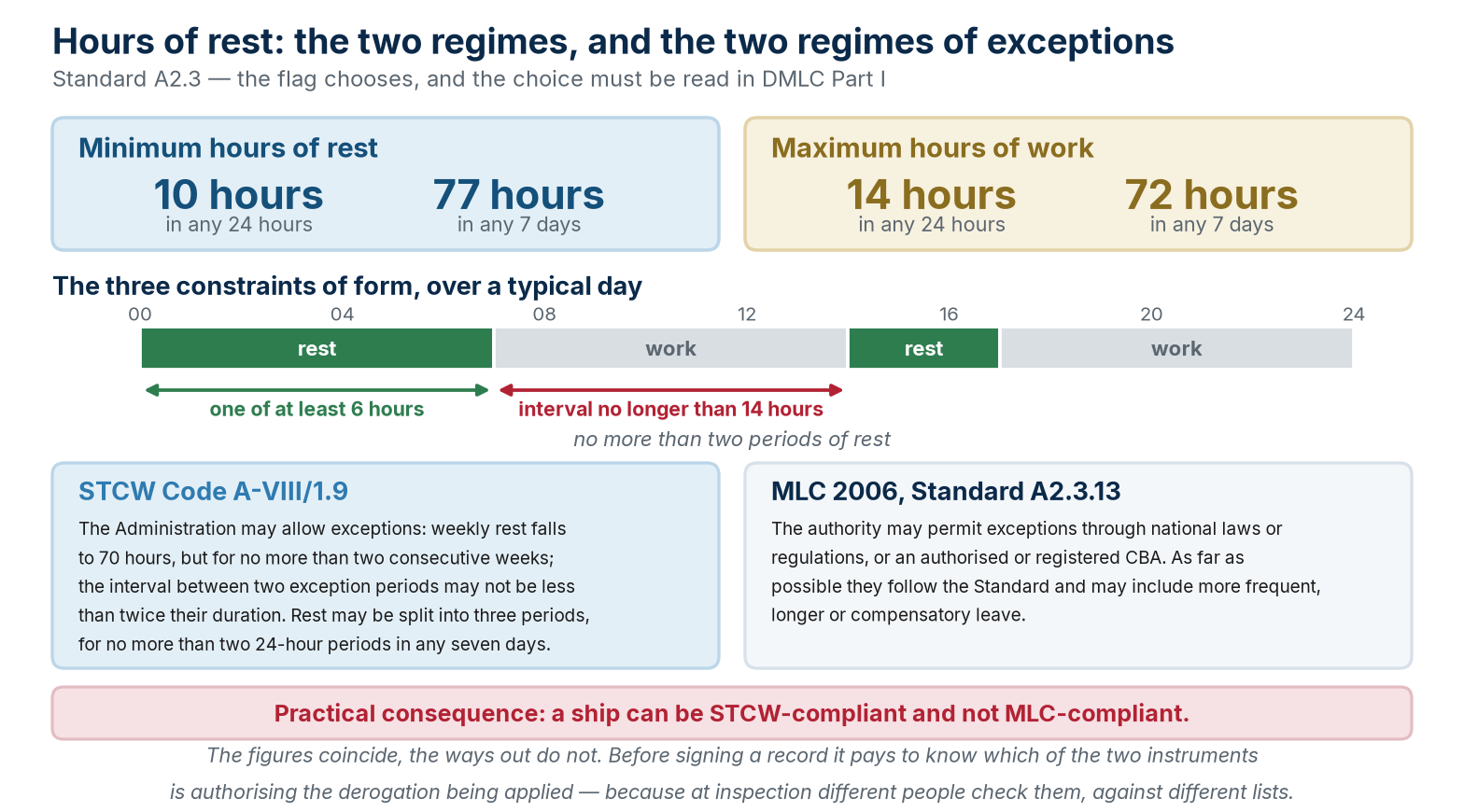
The two regimes, and the figures that define them
Standard A2.3 leaves the flag State to choose between two alternative regimes. Which one applies must be checked in DMLC Part I, because the two are not equivalent.
| Regime | Limits |
|---|---|
| Minimum hours of rest | No less than 10 hours in any 24-hour period and 77 hours in any seven-day period |
| Maximum hours of work | No more than 14 hours in any 24-hour period and 72 hours in any seven-day period |
Table 5.1 — The two alternative regimes of Standard A2.3.5.
Within the hours-of-rest regime three further constraints of form apply, and it is on these that deficiencies concentrate: rest may be divided into no more than two periods, one of which of at least six hours, and the interval between consecutive periods of rest may not exceed fourteen hours.
Why «aligned with STCW» is only half true
The figures do coincide: the STCW Code, section A-VIII/1, also requires ten hours in twenty-four and seventy-seven in seven days, with the same constraints of form. What differs is the exceptions — and that is where the disputes arise.
| Instrument | How exceptions work |
|---|---|
| STCW Code section A-VIII/1.9 | The Administration may allow exceptions: weekly rest may fall to 70 hours, but for no more than two consecutive weeks, and the interval between two exception periods may not be less than twice the duration of the exception. Rest may be divided into three periods — one of at least six hours, the others of at least one hour — for no more than two 24-hour periods in any seven days |
| MLC 2006 Standard A2.3.13 | A2.3.13 provides for laws, regulations or a procedure to authorise or register collective agreements permitting exceptions. These follow the Standard as far as possible and may consider more frequent, longer or compensatory leave. Check the agreement and flag implementation: an STCW exception alone is insufficient. |
Table 5.2 — The two regimes of exceptions.
An officer working under an authorised STCW exception may comply with that regime without automatically complying with MLC. Also check the applicable MLC regime and the basis for its exception, including the authorised or registered collective agreement. The same PSC officer may check both instruments.
Recording of hours
The Convention requires accurate records to be kept of each seafarer's working or rest hours, verifiable at inspection. A systematic discrepancy between the records and actual practice (so-called «fictitious hours») is one of the most frequent and most serious deficiencies found by PSC inspectors in this area.
Rest-hour records that are formally correct but do not correspond to actual operational practice expose the company to a double risk: on one hand detention if discovered, and on the other, above all, unmanaged real crew fatigue, with direct consequences for operational safety.
Assess limits in any rolling 24-hour and seven-day window. The chart’s example provides ten hours of rest: repeated for seven days, it gives seventy hours and fails the normal seventy-seven-hour minimum. STCW covers watchkeepers and personnel with designated safety, security and pollution-prevention duties; MLC protects all relevant seafarers. Drills and call-outs must minimise disturbance and provide applicable compensatory rest; after an emergency the master ensures adequate rest for seafarers who worked during scheduled rest (A2.3.7-9, .14). Provide the seafarer with a record copy endorsed by them and the master or authorised person.
Key takeaways
- The flag chooses a maximum-work or minimum-rest regime; the applicable regime must be identified.
- The rest regime uses 10 hours in 24 and 77 in seven days, with specified splitting constraints.
- An STCW exception does not automatically establish MLC compliance: the applicable flag-State basis and collective regime must also be verified.
Accommodation, recreation and catering
Module objectiveDistinguish transitional accommodation construction requirements from operational duties for food, water, hygiene and cooks.
Title 3 of the Convention sets detailed requirements on accommodation, recreational spaces and catering on board, recognising that the crew's daily quality of life directly affects wellbeing and, indirectly, operational safety.
Typical regulated areas
| Area | Typical requirements |
|---|---|
| Accommodation | Minimum cabin dimensions, lighting, ventilation, sound insulation |
| Recreational spaces | Common areas for leisure time, access to personal communications |
| Catering | Quality and variety of food, hygiene requirements for the galley, qualification of catering staff |
Table 6.1 — Typical areas regulated by Title 3 of MLC 2006.
Accommodation construction requirements: which date matters
Regulation 3.1.2 provides that Code requirements relating to the ship’s construction and equipment apply to ships constructed on or after the date on which the Convention enters into force for the flag State. Earlier ships remain subject, where relevant, to ILO Conventions Nos 92 and 133 or applicable national law. This transitional rule does not disapply the other Title 3 obligations: food, drinking water, hygiene, cook qualifications and inspections of supplies must still be verified. Before assessing a construction-related measurement, check the construction date, the Convention’s entry into force for the flag and any national requirements.
Food, water and the ship’s cook
- Food and drinking water are supplied free of charge for the whole period of engagement, of appropriate quantity, nutritional value, quality and variety, having regard to the number of seafarers on board, their religious requirements and their cultural practices (Standard A3.2.2).
- The ship’s cook must be trained and qualified for the post (A3.2.3). On ships with a prescribed manning of fewer than ten, the competent authority may not require a fully qualified cook, but whoever cooks must still have received training in food and personal hygiene and food handling and storage (A3.2.5).
- No seafarer under the age of eighteen may be employed as ship’s cook (A3.2.8).
- Food stores and drinking water must be inspected at frequent and documented intervals, by or under the authority of the master (A3.2.7). Documented inspections were already required before the 2022 amendments.
The quality and variety of food on board is often underestimated as a wellbeing factor, but it directly affects crew morale and retention, as well as being a frequently checked inspection area. Investing in this area often produces a return disproportionate to its relatively modest cost.
Key takeaways
- Construction date matters for Code requirements relating to accommodation construction and equipment.
- The transitional rule does not suspend food, water, hygiene or supply-inspection duties.
- Crew numbers, religious requirements and cultural practices affect catering adequacy.
Medical care and social security
Module objectiveAssess medical care, shipowner liability, doctor carriage requirements and minimum social-security protection.
Title 4 requires every seafarer to have access to adequate medical care on board and ashore, and governs the shipowner's liability in the event of illness or injury, as well as setting minimum social security coverage requirements.
Shipowner's liability in the event of illness or injury
- Medical treatment, medicines, board and lodging are covered until recovery or declaration of permanent sickness or incapacity. Any national time limit for these costs cannot be less than sixteen weeks from injury or onset of sickness (A4.2.1.2). Also check permitted exclusions and public authorities assuming costs under A4.2.1.5-6.
- For incapacity due to sickness or injury, the shipowner pays full wages while the seafarer remains on board or until repatriation (A4.2.1.3(a)). After repatriation or landing, full or partial wages follow national law or collective agreement until recovery or earlier entitlement to cash benefits (.3(b)). Any national time limit for wages off board must be at least sixteen weeks from injury or onset of sickness (.4).
- Repatriation at the shipowner's expense if unable to continue serving on board for health reasons.
The ship’s doctor
A qualified doctor is required with at least one hundred persons on international voyages ordinarily exceeding three days (A4.1.4(b)). Other ships need at least one seafarer in charge of medical care and medicines or competent in medical first aid; STCW qualifications, voyage duration and nature, and persons on board determine the required level (A4.1.4(c)).
The nine branches of social security
Standard A4.5.1 lists nine branches: medical care, sickness benefit, unemployment benefit, old-age benefit, employment injury benefit, family benefit, maternity benefit, invalidity benefit and survivors’ benefit. At the time of ratification each State must provide at least three of them (A4.5.2), and Guideline B4.5 recommends that these include medical care, sickness benefit and employment injury benefit. This is why the effective coverage of a multinational crew depends on each seafarer’s State of residence more than on the flag of the ship.
Growing attention to crew psychological wellbeing, driven also by the prolonged isolation typical of life on board, is broadening the practical interpretation of medical care obligations beyond the purely physical component, an area of growing attention in more recent inspections.
The nine branches do not mean automatic flag-State coverage for every seafarer. A4.5.3 places primary responsibility on the State of ordinary residence, alongside bilateral or multilateral agreements and other relevant provisions. Verify the individual’s covered branches, contributions, benefits and access.
Key takeaways
- National limits for medical costs and wages off board must respect the thresholds and conditions in A4.2.1.
- A doctor is required when the ship carries one hundred or more persons on international voyages normally exceeding three days.
- The Convention lists nine social-security branches and requires at least three on ratification.
The onboard complaint-handling system
Module objectiveHandle MLC complaints while ensuring accessibility, representation, non-retaliation and direct access to external authorities.
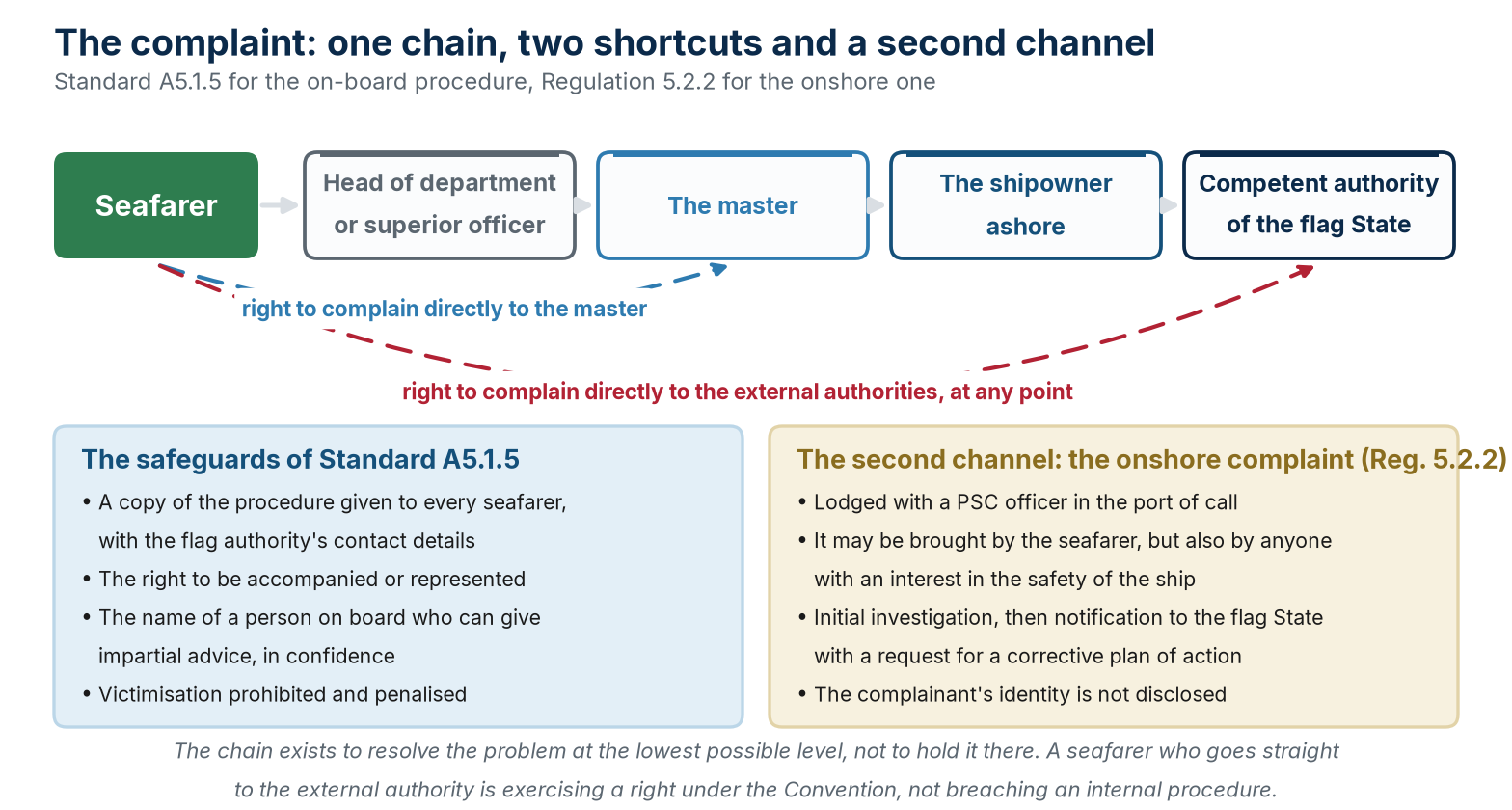
Every ship subject to MLC must have a fair, effective and expeditious complaint procedure. The internal route does not restrict direct access to the master or appropriate external authorities.
The principles of an effective procedure
- Accessibility: the seafarer must know the procedure and how to invoke it, in a language they understand.
- Non-retaliation: no negative consequences for anyone filing a complaint in good faith.
- Clear escalation: the Convention sets out a defined path — head of department or superior officer → the master, who deals with the matter personally → the shipowner ashore → the competent authority of the flag State (Guideline B5.1.5).
Standard A5.1.5 protects direct access to the master and appropriate external authorities, including flag and port States; a union may assist or represent the seafarer but is not a public authority. Accompaniment or representation and protection from victimisation are required. Each seafarer’s procedure copy must identify flag-authority contacts, the authority in the State of residence if different, and an onboard person able to give impartial confidential advice. The DPA derives from the ISM Code; the company may use that contact, but MLC does not require it.
As already seen for safety reporting, a consistently zero number of MLC complaints may genuinely reflect an excellent working environment, or a widespread fear of reporting problems. Distinguishing between the two situations requires direct attention, not just reading the aggregate figure.
Key takeaways
- The internal chain is an organisational route, not a mandatory exhaustion requirement.
- A seafarer may complain directly to the master or appropriate external authorities.
- Procedure copies, correct contacts, confidential advice and protection from victimisation are inspectable elements.
MLC inspections and their relationship with PSC
Module objectiveConnect flag certification, the sixteen MLC areas, PSC inspection and onshore complaint handling.
The flag State must ensure MLC inspections at intervals not exceeding three years (A5.1.4.4), including where mandatory certification does not apply. Port State control complements rather than replaces flag supervision. Article V.7 prevents more favourable treatment of ships from non-ratifying States.
The sixteen areas and the scope of inspection
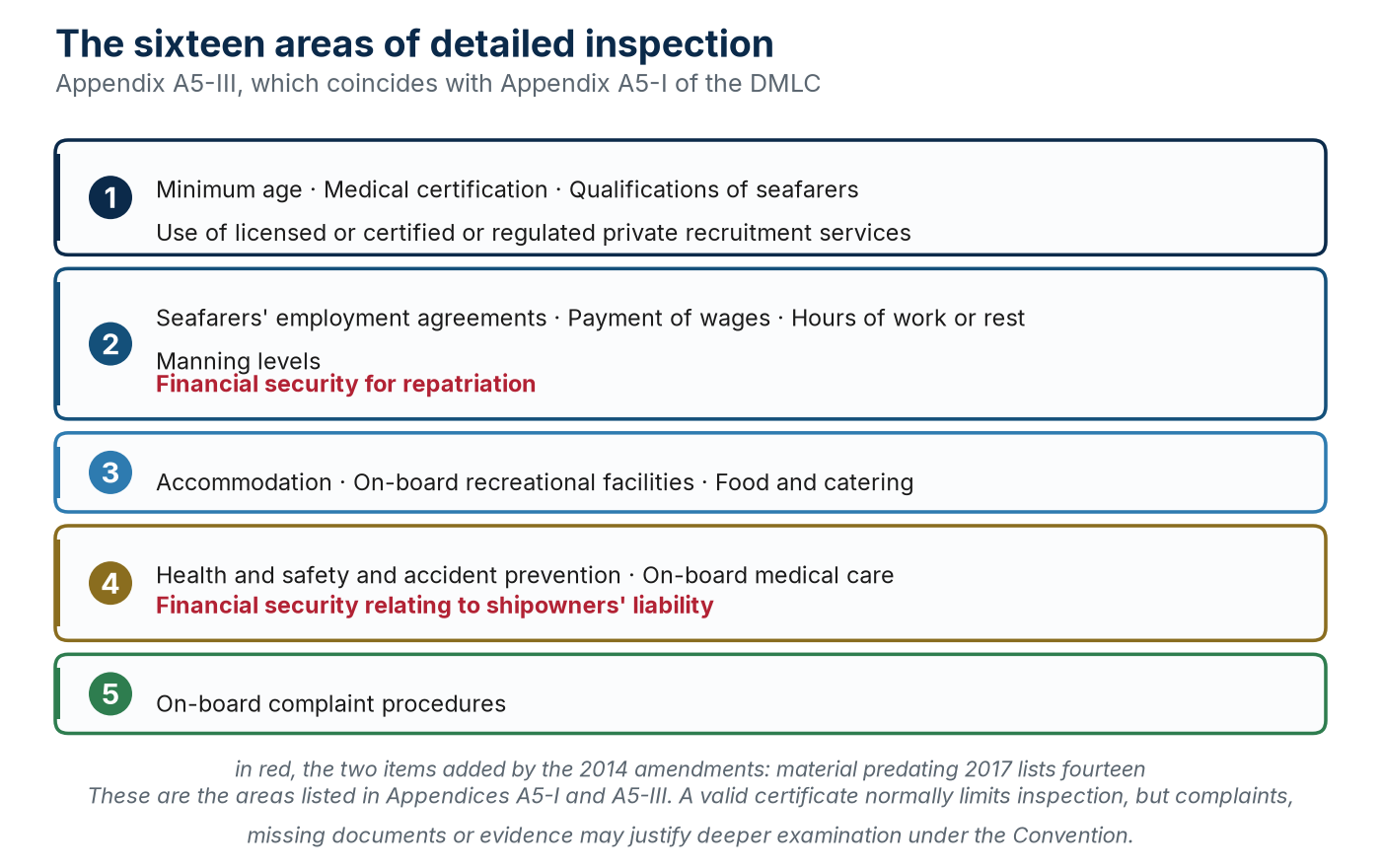
Appendices A5-I and A5-III list sixteen certification and detailed-inspection areas. Standard A5.2.1.2 says a detailed inspection covers them in principle; this does not prohibit other relevant MLC inquiries. A complaint may limit detailed inspection to its subject unless clear grounds justify widening the inspection (.3).
| Title | Areas |
|---|---|
| 1 | Minimum age · Medical certification · Qualifications of seafarers · Use of licensed or certified or regulated private recruitment and placement services |
| 2 | Seafarers' employment agreements · Payment of wages · Hours of work or rest · Manning levels · Financial security for repatriation |
| 3 | Accommodation · On-board recreational facilities · Food and catering |
| 4 | Health and safety and accident prevention · On-board medical care · Financial security relating to shipowners' liability |
| 5 | On-board complaint procedures |
Table 9.1 — The sixteen items of Appendices A5-I and A5-III. The two in italics were added by the 2014 amendments: material predating 2017 lists fourteen.
How much MLC deficiencies actually weigh
When reading PSC statistics distinguish inspections, individual deficiencies, detained ships and MLC categories. Title 4 does not represent all MLC deficiencies and a deficiency share is not a share of non-compliant ships. Use official annual reports with explicit year, denominator and classification; frequency alone does not determine the severity of an individual case.
The second channel: the onshore complaint
Standard A5.2.2 allows a seafarer to complain to the authorised officer in the port of call. Initial investigation considers use of the onboard procedure where appropriate; exhausting it is not an absolute prerequisite. Clearly hazardous conditions or serious or repeated breaches engage A5.2.1.6: prevent departure until rectified or an expeditious implementation plan is accepted. Other unresolved cases are referred to the flag for advice and a corrective plan; confidentiality remains protected. The broader definition of complaints from other interested parties belongs to A5.2.1.3.
Deficiencies concerning care, rest, food and living conditions can affect health and safety. Assess actual conditions, evidence and statutory severity criteria rather than document possession alone.
Key takeaways
- Appendices A5-I and A5-III organise the sixteen DMLC and detailed-inspection areas.
- A valid certificate normally limits inspection, but complaints or evidence may justify a deeper examination.
- Onshore complaints enable an initial PSC investigation while protecting the complainant’s identity.
Repatriation and abandonment of crew
Module objectiveRecognise the three alternative abandonment conditions and verify financial security, cover and early operational indicators.
Amendments to MLC 2006 since the original text have specifically strengthened protections against the abandonment of seafarers, a phenomenon that has occurred with particular severity in cases of shipowner insolvency or ship arrest.
When a seafarer is deemed to have been abandoned
The definition is in Standard A2.5.2.2 and is alternative: any one of the three limbs suffices. The shipowner
- (a) fails to cover the cost of the seafarer’s repatriation; or
- (b) has left the seafarer without the necessary maintenance and support — adequate food, accommodation, drinking water, essential fuel for survival on board, necessary medical care; or
- (c) has otherwise unilaterally severed their ties with the seafarer, including failure to pay contractual wages for a period of at least two months.
What the Convention provides in cases of abandonment
- Obligation on the shipowner to provide financial security (typically through P&I insurance) covering repatriation and essential expenses in the event of abandonment.
- Minimum coverage of the security: outstanding wages and other entitlements for up to four months, the cost of repatriation, and essential needs until arrival home (Standard A2.5.2.9).
- Certificate of financial security to be kept on board and posted in a conspicuous place, verifiable at inspection.
- Reporting mechanisms to the Flag Administration and to the competent international organisations in confirmed cases of abandonment.
The scale of the phenomenon
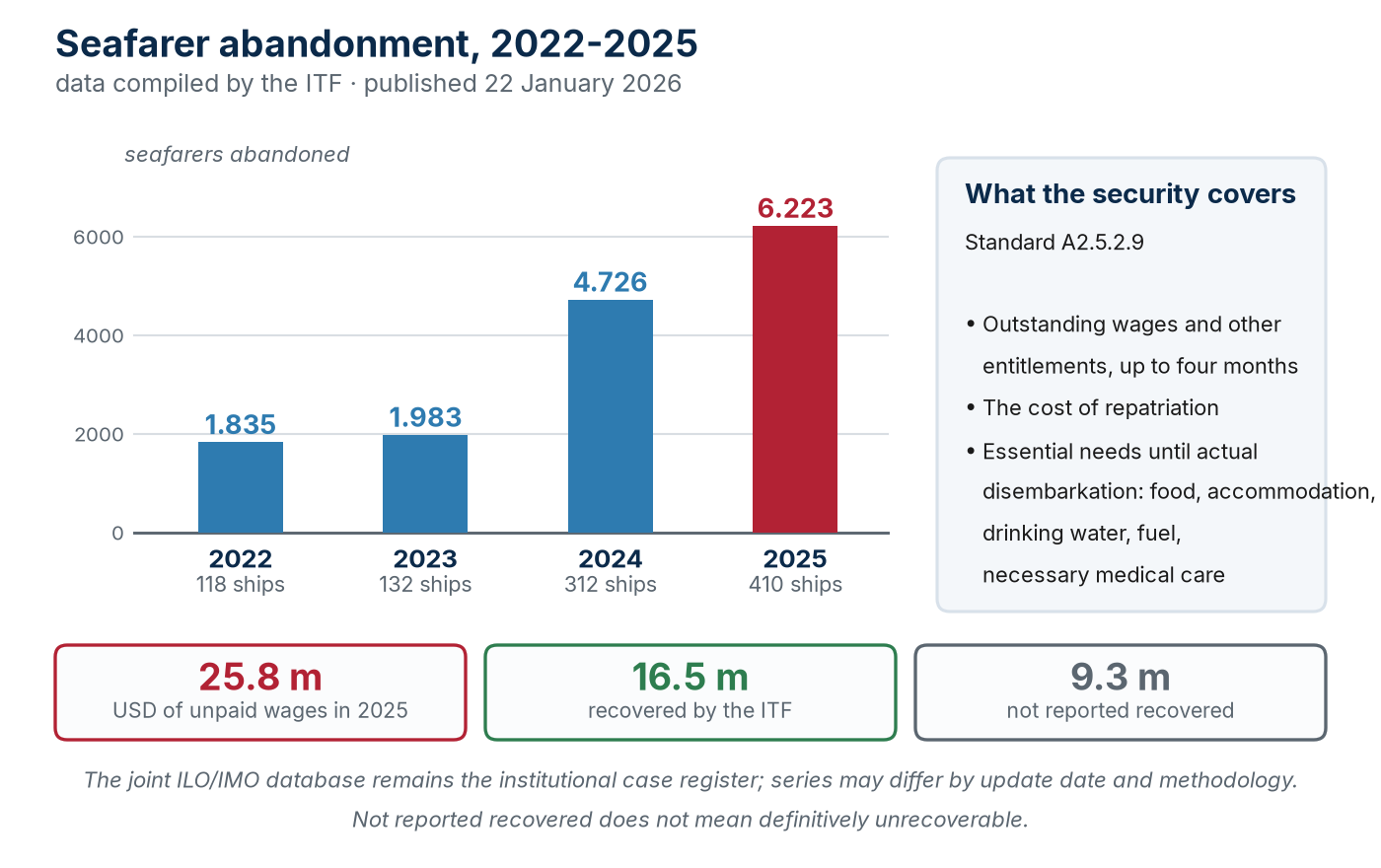
In 2025 6,223 seafarers were abandoned on 410 ships, with USD 25.8 million in unpaid wages, of which the ITF reports recovering USD 16.5 million; the difference is the amount not reported as recovered at the report date, not an amount proven definitively unrecoverable. In three years the number of abandoned seafarers has more than tripled. The financial security introduced in 2014 is therefore not a safeguard for a residual scenario: it is the mechanism holding up the most exposed part of the whole system. Checking it at inspection — certificate on board, in force, posted, and naming the right registered owner — is anything but a formality.
An abandoned crew, often without provisions, fuel or wages, in a foreign port, is the hardest scenario the Convention addresses — and it rarely arrives suddenly: almost always it is preceded by weeks of late wages, thinning supplies and communications that grow scarcer. The two months of unpaid wages test exists precisely to fix a certain moment on a situation that degrades by degrees. Anyone managing ships should read it as a leading indicator, not as a threshold to be reached.
The ITF 2025 data describe cases compiled by the union; the institutional ILO/IMO register may differ by update date and methodology. Abandonment conditions are alternatives: there is no need to wait for two months of unpaid wages where repatriation or maintenance already fails. The four-month cap concerns wages and other entitlements covered by financial security, not every assistance cost or the shipowner’s entire debt. Essential needs are covered until arrival home; access to security must be direct and assistance expeditious (A2.5.2).
Key takeaways
- Failure to repatriate, lack of necessary support or unilateral severance are alternative abandonment tests.
- Financial security covers up to four months of wages and entitlements, repatriation and essential needs.
- The 2025 ITF figures show exceptional growth but must be distinguished from the joint ILO/IMO case register.
How the Convention is updated: five rounds of amendments
Module objectiveReconstruct Article XV tacit acceptance, distinguish the five amendment rounds and separate current from future requirements.
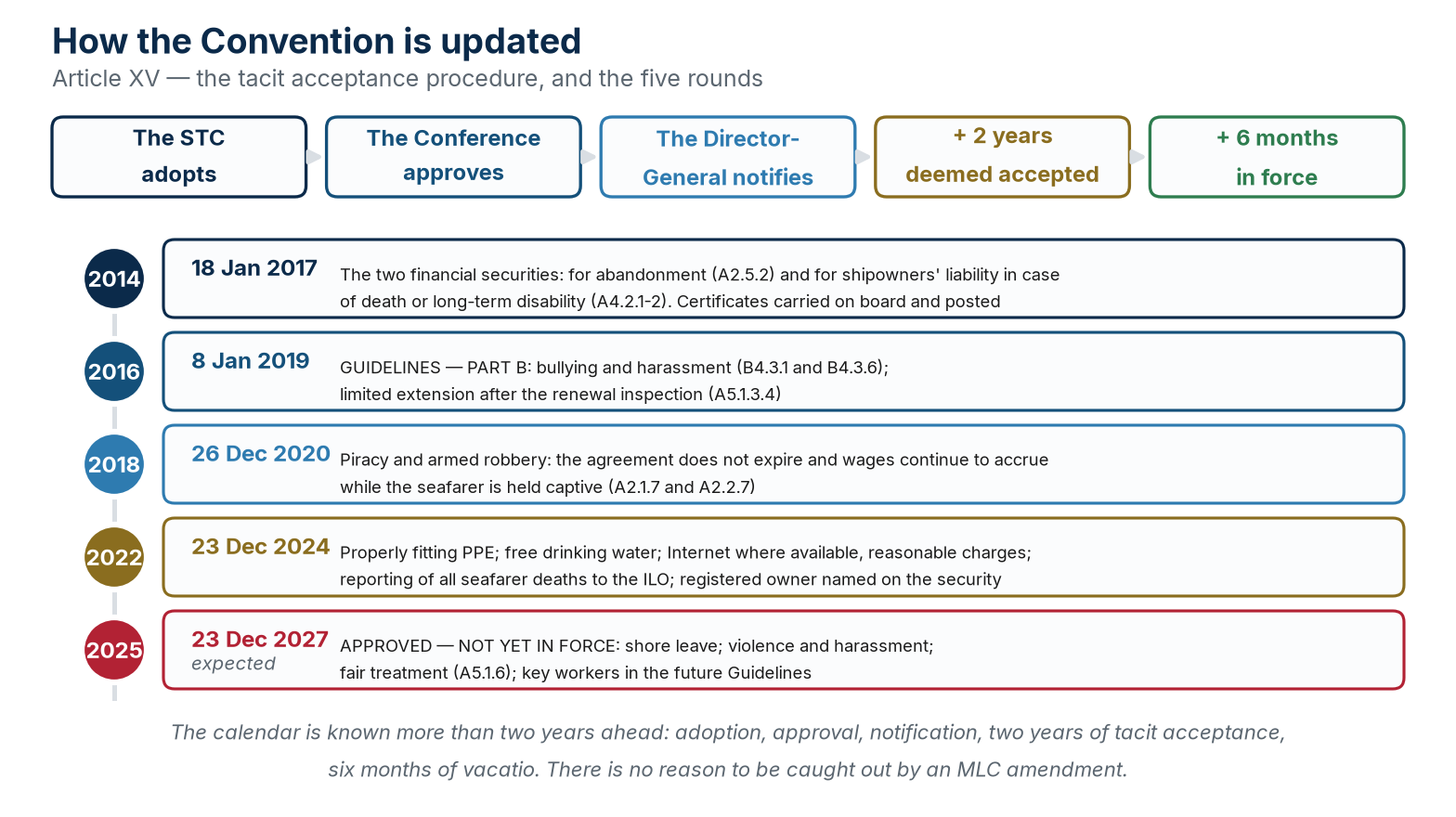
Article XV provides a simplified procedure for updating the Code. The STC adopts proposed amendments and the International Labour Conference approves them; the Conference still has a role. Distinguish approval, acceptance and entry into force, and check the flag State’s position.
The Article XV mechanism
- A Special Tripartite Committee (STC), made up of government, shipowner and seafarer representatives, adopts the amendment to the Code.
- The International Labour Conference approves it.
- The Director-General notifies ratifying States. The normal disagreement period is two years; the Conference may set another period of at least one year (XV.6).
- At the deadline, the amendment is deemed accepted unless more than 40% of ratifying Members representing at least 40% of ratifying Members’ gross tonnage formally disagree (XV.7). Both conditions must be met.
- Normal entry into force follows six months after acceptance. Check individual declarations of disagreement, express acceptance or deferral under Article XV.8-11.
For the amendments approved in 2025, NORMLEX gives 23 June 2027 as the end of the disagreement period and 23 December 2027 as expected entry into force. They are not in force on 15 September 2026: prepare implementation without treating them as current MLC requirements.
The five rounds
| Round | In force from | What it introduced |
|---|---|---|
| 2014 | 18 January 2017 | The two financial securities: for abandonment (Standard A2.5.2) and for shipowners’ liability in the event of death or long-term disability from an occupational cause (A4.2.1-2). Both certificates must be carried on board and posted |
| 2016 | 8 January 2019 | Non-binding Guidelines B4.3.1 and B4.3.6, which must be given due consideration, include bullying and harassment in occupational safety and health policies; limited extension for up to five months from the old expiry, after the renewal inspection in the circumstances of Standard A5.1.3.4 |
| 2018 | 26 December 2020 | Piracy and armed robbery: the employment agreement does not expire and wages continue to accrue while the seafarer is held captive, until release and repatriation or death (A2.1.7 and A2.2.7) |
| 2022 | 23 December 2024 | PPE of appropriate size; free drinking water and updated food requirements; social connectivity and internet access on board, where reasonably practicable and at reasonable cost; prompt disembarkation for medical care ashore and repatriation of remains; annual reporting to the ILO of all seafarer deaths; the registered owner’s name on financial security documents |
| 2025 | 23 December 2027 (expected) | Requirements expected from 23 December 2027, subject to Article XV acceptance: visa-free and non-discriminatory shore leave, subject to specified formalities, health, safety and operational conditions, non-discriminatory repatriation, shipowner-borne costs including carriage of up to 30 kg of luggage, an express prohibition of violence, harassment and sexual assault, fair treatment, strengthened complaints. Menstrual-hygiene products, medical-training references and recognition of seafarers as key workers appear in the future Guidelines |
Table 11.1 — The five rounds of amendments to the Code.
The 2022 amendments have applied since 23 December 2024. A3.1.17 includes social connectivity in appropriate recreational facilities and services to be provided on board. Guidelines B3.1.11 address Internet access, reasonable practicability and reasonable charges; they do not establish guaranteed free Internet on every ship. Check applicable text and flag implementation alongside properly fitting PPE, free water and adequate food. Frequent documented inspections of supplies, water and spaces already existed in A3.2.7.
Amendment rounds strengthen existing protections and introduce further requirements. Shore leave, for example, was already addressed by Regulation 2.4.2 in the original text. For each change identify the amended paragraph, its legal force and application date rather than presenting the entire subject as new.
Key takeaways
- STC adoption, Conference approval, notification, acceptance and entry into force are separate legal steps.
- The 2022 amendments have applied since 23 December 2024.
- The 2025 amendments are expected in force on 23 December 2027; they are not yet MLC inspection requirements.
The role of crewing management
Module objectiveTranslate MLC requirements into recruitment, contracting, rotation planning and welfare monitoring processes.
The crewing management function plays a central role in ensuring MLC compliance over time, from crew selection and training to contract management, through to the planning of embarkation rotations, which directly affects fatigue and wellbeing.
Crewing management levers relevant to MLC
- Realistic planning of embarkation rotations, systematically avoiding unplanned extensions.
- Selection and training that ensure linguistic understanding of procedures, including complaint procedures.
- Monitoring of turnover and crew satisfaction indicators as early signals of welfare problems.
A high turnover rate, read together with a low number of formal complaints, can indicate that seafarers prefer not to return rather than report a problem. Crewing management should read these two indicators together, not separately.
Key takeaways
- Crewing affects MLC compliance before, during and after service on board.
- Realistic rotations, language comprehension and complaint access reduce documentary and substantive risk.
- Turnover, extensions and complaints should be read together as early indicators.
Beyond compliance: a welfare culture
Module objectiveDistinguish documentary compliance from real welfare and identify organisational practices supporting dignity, health and operational reliability.
As with safety, crew welfare is built through a genuine organisational culture, not merely through documentary compliance with the Convention's minimum requirements.
What distinguishes an authentic welfare culture
- Real, not merely formal, access to communication with family, internet connectivity and psychological support.
- Active listening to crew needs, beyond the minimum set out in the Convention.
- Investment in training and professional growth, not just contractual compliance.
MLC requirements provide a minimum floor; a welfare policy can support retention and safety, but outcomes need evaluation. Read access to care, actual rest, turnover and reports alongside operating conditions; no single indicator proves wellbeing or compliance.
Key takeaways
- MLC provides a floor; a welfare culture requires effective access and support.
- Zero complaints do not prove a healthy environment where trust and reporting freedom are absent.
- Connectivity, mental health and development affect retention and safety, although their legal status is not identical.
Emerging trends
Module objectiveMonitor MLC developments without confusing proposals, approved amendments, entry into force and current duties.
The framework of MLC 2006 and crew welfare management continues to evolve, driven by greater attention to mental health and growing integration with the other control systems seen in previous courses.
Directions to watch
- Growing attention to mental health and prolonged isolation, particularly for crews engaged on long voyages or routes with infrequent port calls.
- Greater integration between MLC data and vetting/PSC data, with a combined reading of the ship's overall operational quality.
- Monitor ILO text, amendment status and flag implementation. For the 2025 amendments, the next expected entry into force is 23 December 2027; verify further proposals or STC schedules when published.
Wellbeing and operational safety are distinct but connected. Fatigue and isolation can increase error risk: assess schedules, resources, support and organisational conditions rather than automatically assigning the cause to an individual seafarer.
Key takeaways
- Mental health, violence and harassment, connectivity and fair treatment are expanding the welfare agenda.
- The 2025 changes remain future requirements until their expected entry into force on 23 December 2027.
- Updates must be checked against current ILO text, flag implementation and effective date.
Recurring mistakes
From the Mistake Library of SuperbaKnowledge, filtered to the subjects this course covers. This view selects and organises content published in SuperbaKnowledge; it does not modify or replace it. The linked Knowledge page remains the reference version, while official texts remain authoritative.
| Topic | Mistake | Typical consequence | Topic sheet |
|---|---|---|---|
| Crew Fatigue | Rest hour logging treated as a mere documentary formality, without reflecting real fatigue management on board | Formal compliance that fails to prevent chronic fatigue build-up in the crew | See the topic sheet |
| MLC Complaint Handling | Complaint procedure not clearly explained to the seafarer on joining | MLC deficiency in a PSC inspection | See the topic sheet |
| Prevention of Violence and Harassment | PSSR training renewed without checking that it includes the new competency required from 2026 | Certification formally completed but not compliant with STCW requirements in force from 2026; the 2025 MLC amendments remain future until their expected entry into force | See the topic sheet |
Glossary of acronyms
| Acronym | Definition |
|---|---|
| AB | Able Seafarer, the rating to which the ILO benchmark wage refers |
| CBA | Collective Bargaining Agreement |
| DMLC | Declaration of Maritime Labour Compliance |
| DPA | Designated Person Ashore — a creature of the ISM Code, not of the MLC |
| ILC | International Labour Conference, which approves amendments to the Code |
| ILO | International Labour Organization |
| ITF | International Transport Workers' Federation |
| JMC | ILO Joint Maritime Commission, whose Subcommittee on Wages sets the pay benchmark |
| MLC | Maritime Labour Convention 2006 |
| P&I | Protection and Indemnity (shipowners' mutual insurance) |
| PSC | Port State Control |
| RO | Recognized Organization, to which the flag delegates inspection and certification |
| SEA | Seafarer Employment Agreement |
| STC | Special Tripartite Committee, the body that adopts amendments to the Code |
| STCW | Standards of Training, Certification and Watchkeeping for Seafarers |
References and sources
- ILO — MLC, testo consolidato / consolidated text (2022)
- ILO — testi e stato degli emendamenti / amendment texts and status
- ILO — paga base AB 2026–2028 / AB basic wage 2026–2028
- ITF — abbandono nel 2025 / abandonment in 2025
- ILO — 2025: adopted text, not yet in force
Consolidated list of the sources cited. Updated as of August 2026; always consult the official text in force, including the most recent amendments.
| Source | Scope |
|---|---|
| Maritime Labour Convention, 2006, as amended (ILO) | Consolidated text: Articles, Regulations and the Code, Part A (Standards) and Part B (Guidelines) |
| 2014, 2016, 2018, 2022 and 2025 amendments to the Code | In force respectively from 18 January 2017, 8 January 2019, 26 December 2020, 23 December 2024 and (expected) 23 December 2027 |
| Appendices A5-I and A5-III | The sixteen items covered by the DMLC and by detailed inspection in PSC |
| ILO, Guidelines for port State control officers carrying out inspections under the MLC, 2006 | Inspection practice and detention criteria |
| STCW Code, section A-VIII/1 | Hours of rest for watchkeeping personnel and the regime of exceptions |
| ILO Joint Maritime Commission, Subcommittee on Wages of Seafarers | Benchmark minimum wage for the able seafarer |
| Paris MoU, Annual Report | Inspection and detention statistics, deficiencies by category |
| ILO/IMO database on seafarer abandonment; ITF reports | Abandonment cases, seafarers affected, unpaid wages |
| Flag Administrations | Applicable national requirements and substantial equivalences (DMLC Part I) |
This course is educational material for training purposes and does not constitute a professional certification or qualifying credential. Read the full disclaimer.