
Port State Control
Preparing, managing and governing PSC inspections
Learning objectives
- Explain PSC's role in the international control system and its relationship with class, flag and vetting.
- Describe the main regional regimes (Paris MoU, Tokyo MoU, USCG) and their relevant operational differences.
- Distinguish the Memorandum layer from the binding layer of Directive 2009/16/EC and assess the impact of the (EU) 2024/3099 revision.
- Navigate the United States regime and the eligibility criteria for QUALSHIP 21 and E-Zero.
- Conceptually calculate a ship's risk profile (Ship Risk Profile) and the resulting inspection windows.
- Manage an inspection on board from the inspector's arrival to the closing of the report.
- Interpret deficiency action codes and distinguish a rectification from a detention.
- Reconstruct the escalation mechanism towards banning and its commercial consequences.
- Prepare the ship for annual thematic Concentrated Inspection Campaigns (CICs).
- Build a PSC KPI dashboard useful for fleet management.
Port State Control within the control system
Module objectiveDistinguish the purpose, authority and consequences of PSC from flag-State control, class and vetting.
Key takeaways
- PSC is a public control over foreign ships and does not transfer primary compliance responsibility away from the company and flag State.
- Class, vetting and PSC may observe the same facts, but they operate under different legal bases, authority and consequences.
- A detention has public and operational effects that may propagate to targeting, reputation and commercial decisions.
Port State Control (PSC) is the inspection of foreign ships by the port State under applicable conventions and national law. Primary responsibility for compliance remains with the company and flag State. PSC is a complementary control: it does not require prior proof of flag State failure and does not mean that every ship is inspected at every call. Selection, inspection obligations and exclusions depend on the applicable regime.
Origin and purpose
Modern PSC took shape after a series of serious accidents and cases of substandard ships escaping their own flag's controls. Cooperation between port States, formalised in regional Memoranda of Understanding (MoUs), was created to prevent a ship refused or detained in one port from simply moving to a less attentive nearby port (the phenomenon known as «port shopping»).
PSC within the control triangle
As already seen for technical management, it is essential to distinguish PSC from class and from vetting: PSC is a public, statutory and mandatory control; class is a technical control based on privately, contractually accepted rules; vetting is voluntary commercial due diligence that is nonetheless de facto necessary to operate in certain segments.
| Control | Nature | Extreme consequence |
|---|---|---|
| PSC | Public, statutory, mandatory | Detention, refusal of access (banning) |
| Class | Private, technical, contractual | Suspension of class |
| Vetting | Commercial, voluntary but de facto necessary | Commercial rejection, exclusion from chartering |
Table 1.1 — PSC compared with class and vetting.
A PSC detention is a public event: it is recorded in regional databases, visible to all other member States of the regime and often also to charterers through due diligence services. It is not a problem that stays «between the ship and the inspector»: it has cascading consequences for reputation, vetting and insurance costs.
Regional regimes: Paris MoU, Tokyo MoU, USCG
Module objectiveRecognise the structure and operational differences of major PSC regimes without assuming a single global database.
There is no single worldwide Port State Control: cooperating regional regimes exist, each with its own database, performance lists and targeting logic, while sharing the same underlying IMO convention framework. This module gives the map; the two that follow go deeper into the two settings a European fleet meets most often — the binding legal layer of the European Union and the autonomous United States regime.
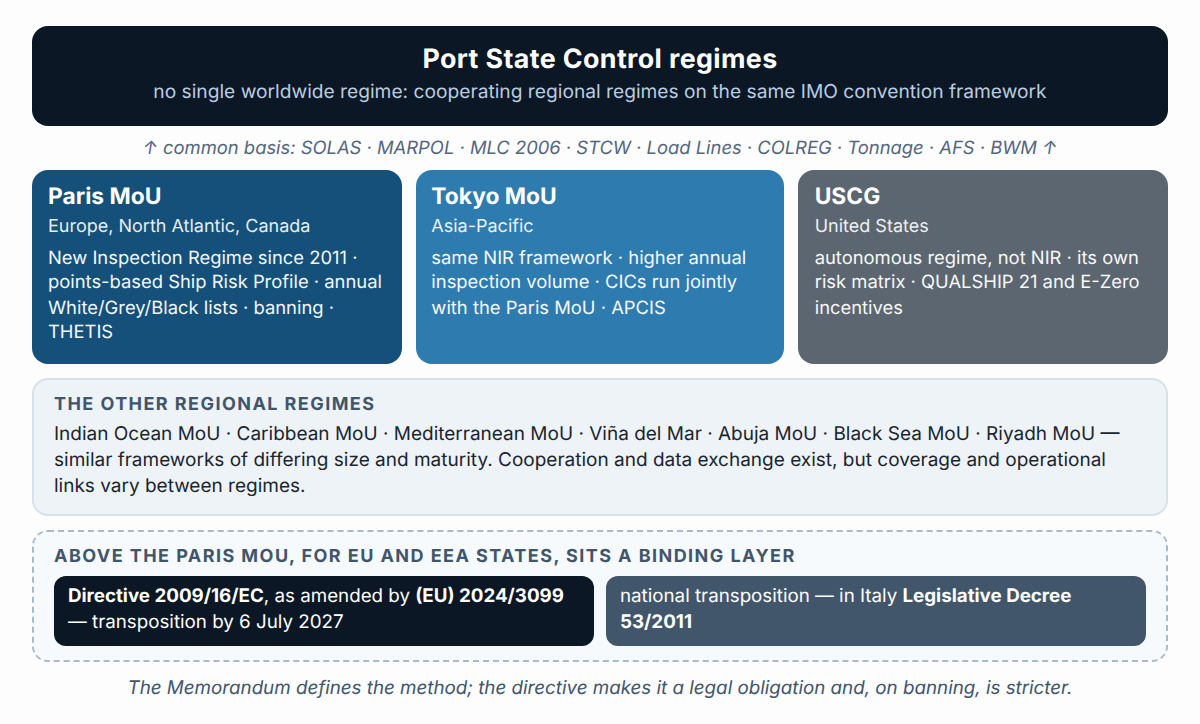
The main regimes
| Regime | Area | Distinctive notes |
|---|---|---|
| Paris MoU | Europe and North Atlantic | New Inspection Regime (NIR) since 2011; annual White/Grey/Black lists; banning mechanism |
| Tokyo MoU | Asia-Pacific | Same NIR framework; higher annual inspection volume than the Paris MoU; joint CICs |
| USCG | United States | Autonomous regime, not based on NIR; its own risk matrix system |
| Indian Ocean MoU, Caribbean MoU, Mediterranean MoU, Viña del Mar, others | Various regions | Similar frameworks, of varying size and maturity |
Table 2.1 — Overview of the main regional PSC regimes.
Cooperation and data sharing
Regional regimes cooperate and exchange information through agreements, regional databases and shared systems such as IMO GISIS and EQUASIS. Integration is neither uniform nor invariably available in real time: THETIS and APCIS remain separate systems and, according to the Tokyo MoU Annual Report 2025, the direct APCIS–THETIS link is temporarily suspended. Official sources for the relevant regime should therefore be checked separately before a port call.
A company with ships calling at both European and Asian ports must simultaneously monitor the performance lists of several regimes, which can differ from one another even for the same flag. A careful vetting/PSC officer keeps a dashboard covering all regimes relevant to their fleet's routes, not just the most familiar one.
Key takeaways
- Paris and Tokyo MoUs operate coordinated regional systems; the USCG applies an autonomous regime.
- Cooperation does not remove differences in targeting and procedure.
- Data exchange exists, but coverage and links are neither uniform nor invariably real-time.
The European layer: from Directive 2009/16/EC to 2024/3099
Module objectiveDistinguish the Memorandum from the EU legal basis and place Directive (EU) 2024/3099 in its correct timeline.
The Paris MoU is an administrative agreement between maritime Authorities: it defines method, criteria and tools, but it is not a legally binding instrument. For European Union Member States, and for the EEA States that take part, the binding source is Directive 2009/16/EC, which adopts the Memorandum's framework and turns it into an obligation of domestic law — in Italy through Legislative Decree 53 of 24 March 2011. In practice the two texts coexist: the inspector applies the MoU method, but the legal basis of their power, and its limits, sit in the directive.
What the directive adds to the Memorandum
| Aspect | Paris MoU | Directive 2009/16/EC |
|---|---|---|
| Legal nature | Administrative agreement between Authorities, non-binding | EU legislative act, binding and transposed into national law |
| Scope | The Memorandum region: Europe, the North Atlantic, Canada | EU and EEA Member States |
| Inspection commitment | Annual share agreed among the Authorities (Annex 11) | A legal obligation, with infringement proceedings for failure to comply |
| Appeals | Right of appeal (§3.12), which does not suspend the measure | Article 20: the same principle, plus the duty to correct the published information within 24 hours of the decision |
| Penalties | Not provided for | Left to Member States in the transposing law |
Table 3.1 — The Memorandum and the directive compared.
The 2024 revision: what changes and from when
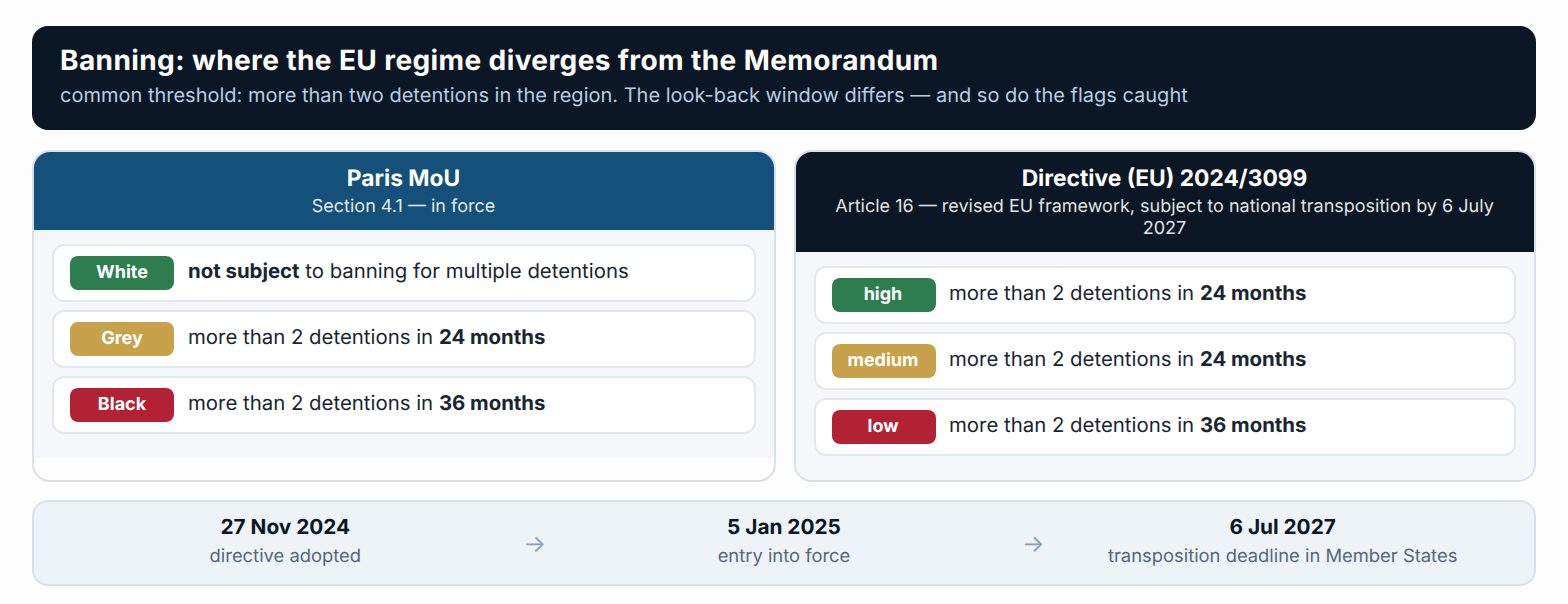
Directive (EU) 2024/3099, adopted on 27 November 2024 and in force since 5 January 2025, is the broadest revision since 2009. Member States must adopt and publish the necessary national provisions by 6 July 2027: until the transposing rules apply, the revised criteria should not be described as already operational on a uniform basis across all Member States. 6 July 2027 is the directive's transposition deadline, not the expiry date of the performance lists.
| Change | Content | Practical effect |
|---|---|---|
| Three new conventions in scope | BWM 2004 (ballast water), the Nairobi Convention 2007 (wreck removal), the Hong Kong Convention 2009 (ship recycling) | Certificates and compliance under these conventions become full PSC inspection subjects, and the related deficiencies weigh on the ship's environmental profile |
| Banning extended to well-performing flags | More than 2 detentions in 24 months for ships flying flags on the high or medium performance list; 36 months for those on the low list | This is the most significant divergence from the Memorandum: under the EU regime even a White List ship can be excluded from ports, which the MoU does not provide for |
| Greater weight for environmental parameters | Deficiencies under MARPOL 73/78, AFS 2001, BWM, CLC 92, Bunker Oil 2001, Nairobi and Hong Kong enter the profile calculation | Environmental deficiencies enter the revised profile; check weights and application in the applicable implementing provisions. |
| A parallel regime for fishing vessels | A voluntary system for Member States, parallel and separate, for fishing vessels of 24 metres in length and over (new Article 3(4a)) | It does not alter merchant ship targeting, but extends the perimeter of PSC to a fleet excluded until now |
| Electronic statutory certificates | The Commission must define functional and technical specifications for a validation tool | Prepares the shift from checking a paper document to verifying validity directly in the database |
Table 3.2 — The main changes introduced by Directive (EU) 2024/3099.
The thresholds introduced by Directive (EU) 2024/3099 must be distinguished from the regime applicable to the call. The revision extends refusal of access for repeated detentions to high- and medium-performance flags over 24 months; the transposition deadline is 6 July 2027. Check the national rules applicable in the port before applying these criteria. Preparing the fleet for revised requirements does not mean treating them as uniformly operational in 2026.
THETIS and EMSA: who actually calculates the profile
THETIS is both a database and an operational tool: it records inspection reports and makes them available, manages the workflow from port call to inspection and follow-up, and recalculates Ship Risk Profile and priority daily from the available data. It is the European information system run by EMSA (the European Maritime Safety Agency): it assigns Priority I or II and distributes the annual inspection commitment among Member States. When a PSCO opens a ship's record, they are reading the output of that calculation, not a personal assessment. Around the same core EMSA runs separate systems — THETIS-MRV for greenhouse-gas emissions reporting and THETIS-EU for compliance checks under other Union legislation — which remain modules of the THETIS portfolio with their own legal purposes: they do not merge into a single ship file.
Check the official ship status and recorded data before the call. A revoked measure that has not been corrected may distort the profile within the rolling 36-month history; its effect depends on the other parameters. An error does not automatically lead to an expanded inspection: type and priority follow the applicable criteria. Request prompt correction of the record with supporting evidence.
Key takeaways
- The Paris MoU defines the regional method; the directive creates legal duties for EU Member States.
- Directive 2024/3099 is in force, but national provisions are due by 6 July 2027.
- THETIS is both a database and an operational tool, not merely a list of reports.
The United States regime: risk matrix and QUALSHIP 21
Module objectiveApply USCG criteria without automatically transferring categories and thresholds from regional Memoranda to the United States regime.
Key takeaways
- The USCG regime is autonomous: targeting, examinations and consequences must be checked against current Work Instructions.
- QUALSHIP 21 rewards documented quality at flag, ship and company level; E-Zero adds specific environmental conditions.
- A common preparation standard may use the strictest internal benchmark, but a separate check of US requirements remains necessary.
The United States belongs to no Memorandum: the United States Coast Guard exercises port State control through a system of its own, independent in its targeting criteria, its consequences and — above all — its incentives. Anyone operating transatlantic routes has to read two different grammars, not one translated.
How USCG targeting works
The US system does not use the NIR Ship Risk Profile. Selection rests on a matrix that weighs flag performance, recognized organization performance, ship management performance, the arrival information (type, age, certificates, hazardous conditions), the individual ship's history — deficiencies, detentions, control actions, casualties, violations, EQUASIS data — and any enrolment in the QUALSHIP 21 and E-Zero programmes.
Flags are classified on their three-year detention ratio: High Risk above 2.0%, Medium Risk between 1.0% and 2.0%; the Coast Guard targets flags above 1.0% that have recorded multiple detentions. Recognized organizations with a detention ratio above 2.0% are designated Priority I for approval purposes.
In 2025 the Coast Guard examined 11,279 distinct ships, flying 79 different flags, across 76,351 port calls, conducting 8,999 PSC exams (up from 8,710 in 2024) and issuing 78 detentions (down from 82): an annual detention ratio of 0.86%, down from 0.94%, and 1.00% on the three-year rolling average. At the close of 2025, 605 ships held the E-Zero designation, nearly two hundred more than the year before; the Bahamas, Germany, Italy and the Philippines became QUALSHIP 21 eligible. These are far smaller absolute numbers than the Paris MoU's, but with more concentrated targeting.
QUALSHIP 21 and E-Zero: the incentive, not just the penalty
What really sets the US regime apart is the reward for quality. QUALSHIP 21 recognises foreign ships of documented quality by reducing their inspection exposure, and its criteria operate on three levels that must all be satisfied together. The eligibility criteria in force are set out in Coast Guard Work Instruction CVC-WI-002(2).
| Level | Requirement |
|---|---|
| Flag | Three-year detention ratio below 1.0%; at least 10 US PSC examinations in each of the previous three years; a completed IMSAS audit with the final audit report and, where applicable, an accepted CAP and CPICAP available |
| Vessel | No USCG detention in the preceding 36 months; no serious marine incident; no more than one Notice of Violation or civil penalty in 36 months; a successful US PSC examination within 24 months; certificates not issued by a targeted recognized organization |
| Company | Vessel not owned or operated by a company associated with more than one US detention in 24 months |
For QUALSHIP 21, the USCG 2025 report places implementation of the new flag IMSAS criteria in 2027: check the eligibility list published for the year of the call.
Table 4.1 — QUALSHIP 21 eligibility criteria.
Within the programme, the E-Zero designation rewards environmental performance. It is reserved for ships with at least three consecutive years in QUALSHIP 21, with no break longer than 30 days, and requires: zero MARPOL detentions worldwide over the past three years; no environmental deficiencies in the US over the same period; no violation of Right Whale reporting or speed restriction rules, on a five-year lookback; and an installed USCG type-approved ballast water management system.
| Area | Benefit |
|---|---|
| All enrolled ships | Three-year enrolment, certificate and public recognition; operational incentives depend on vessel type |
| Tank vessels | Reduced scope of the annual Certificate of Compliance examination; additional E-Zero arrangements as specified in the Work Instruction |
| Passenger vessels | No reduction in the PSC examination; certificate and public recognition still apply |
Table 4.2 — QUALSHIP 21 benefits.
QUALSHIP 21 logic is cumulative, but losing it is immediate: a single substandard-vessel detention resets the 36 months and the status with them. And because one of the criteria applies to the company, the effect does not stop at the ship involved: a second detention within 24 months puts the eligibility of the whole managed fleet at risk. It is the exact opposite of short-term reasoning.
The temptation, for a fleet trading on both sides, is to keep two separate checklists. It works badly: the criteria diverge in detail but converge in substance — a clean record, a solid flag and class, a company with no detention pattern. It is better to build a single internal standard set to whichever regime is most demanding in each area, and to use the differences as an extra pre-arrival check rather than as a parallel system.
The New Inspection Regime and the Ship Risk Profile
Module objectiveCalculate and interpret the Ship Risk Profile while distinguishing risk category, periodic window and supplementary-inspection factors.
Key takeaways
- The Ship Risk Profile combines static and dynamic parameters; Low Risk status requires every applicable criterion to be met together.
- Periodic windows turn elapsed time into Priority II and then Priority I according to the ship category.
- Overriding and unexpected factors may make a ship inspectable outside its window, but they do not have the same priority effect.
The New Inspection Regime (NIR), introduced by the Paris MoU in 2011 and subsequently adopted in similar forms by other regimes including the Tokyo MoU, replaced simplistic targeting based on fixed inspection percentages with a risk-based system: inspection resources are concentrated on ships statistically more likely to have deficiencies, while rewarding quality ships with longer intervals between inspections.
The Ship Risk Profile (SRP) factors
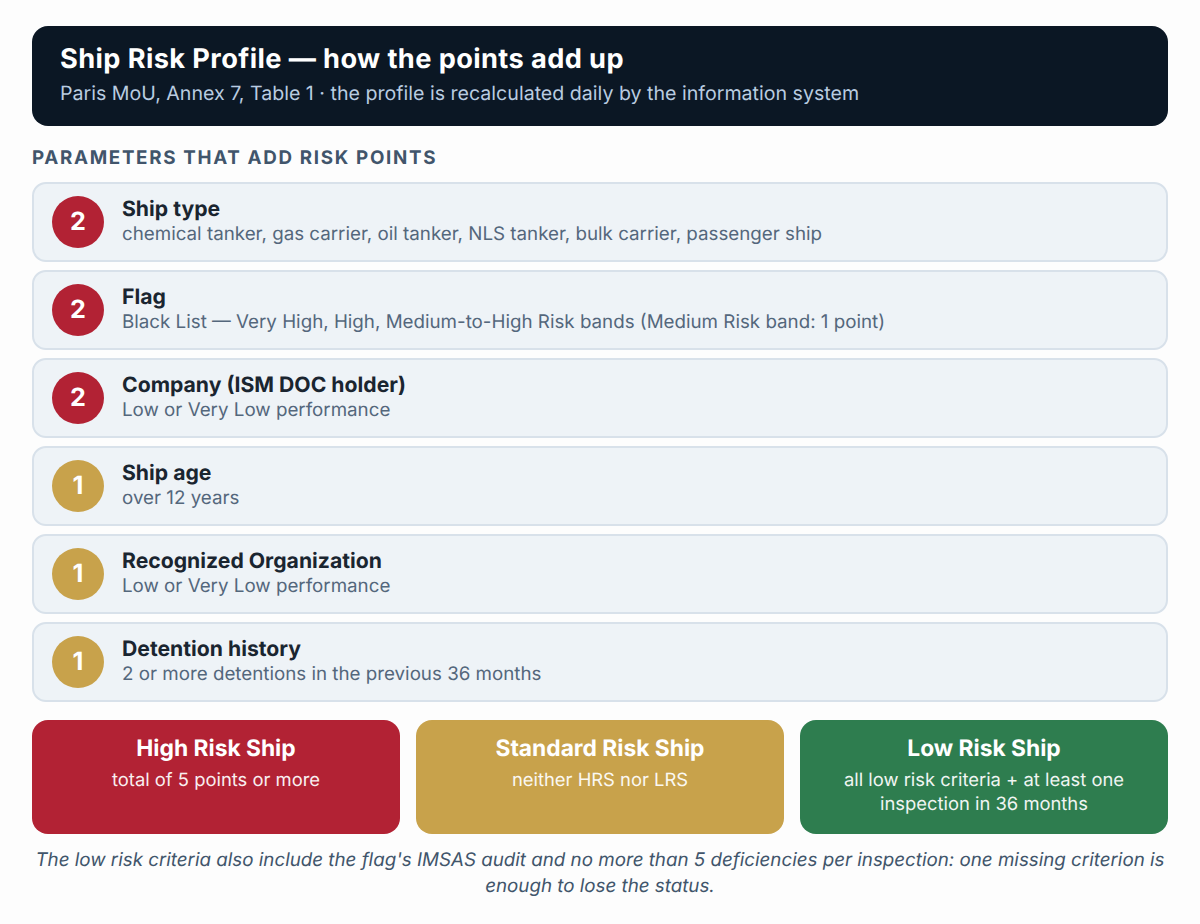
| Parameter | Risk-increasing criterion (points) | Low risk criterion |
|---|---|---|
| Ship type | Chemical tanker, gas carrier, oil tanker, NLS tanker, bulk carrier, passenger ship — 2 | All types |
| Ship age | Over 12 years — 1 | Any age |
| Flag — WGB list | Black List, Very High, High and Medium-to-High Risk bands — 2; Medium Risk band — 1 | White List |
| Flag — IMO audit | — | IMSAS audit carried out |
| Recognized Organization | Low or Very Low performance — 1 | High performance and RO recognised by at least one Paris MoU State |
| Company (ISM DOC holder) | Low or Very Low performance — 2 | High performance |
| Deficiencies (36-month history) | — | No more than 5 deficiencies per inspection, with at least one inspection in the previous 36 months |
| Detentions (36-month history) | 2 or more detentions — 1 | No detention |
Table 5.1 — Ship Risk Profile parameters and weightings (Paris MoU, Annex 7, Table 1).
The sum of the weightings determines the category. A ship is a High Risk Ship (HRS) if it reaches 5 or more points. It is a Low Risk Ship (LRS) only if it meets every criterion in the low risk column and has had at least one inspection in the previous 36 months: a single missing criterion is enough to lose the status. In any other case it is a Standard Risk Ship (SRS). The profile is recalculated daily by the information system on the dynamic parameters — age, 36-month history, company performance — as well as after every inspection and whenever the applicable flag and RO performance tables change.
The three risk categories and inspection windows
Based on the resulting score, the ship is classified as a Low Risk Ship (LRS), Standard Risk Ship (SRS) or High Risk Ship (HRS). Each category determines a time window within which the ship must undergo a periodic inspection: the higher the risk, the narrower the window. The windows are 5–6 months for an HRS, 10–12 months for an SRS and 24–36 months for an LRS: from the first figure the ship may be inspected (Priority II), from the second it must be (Priority I).
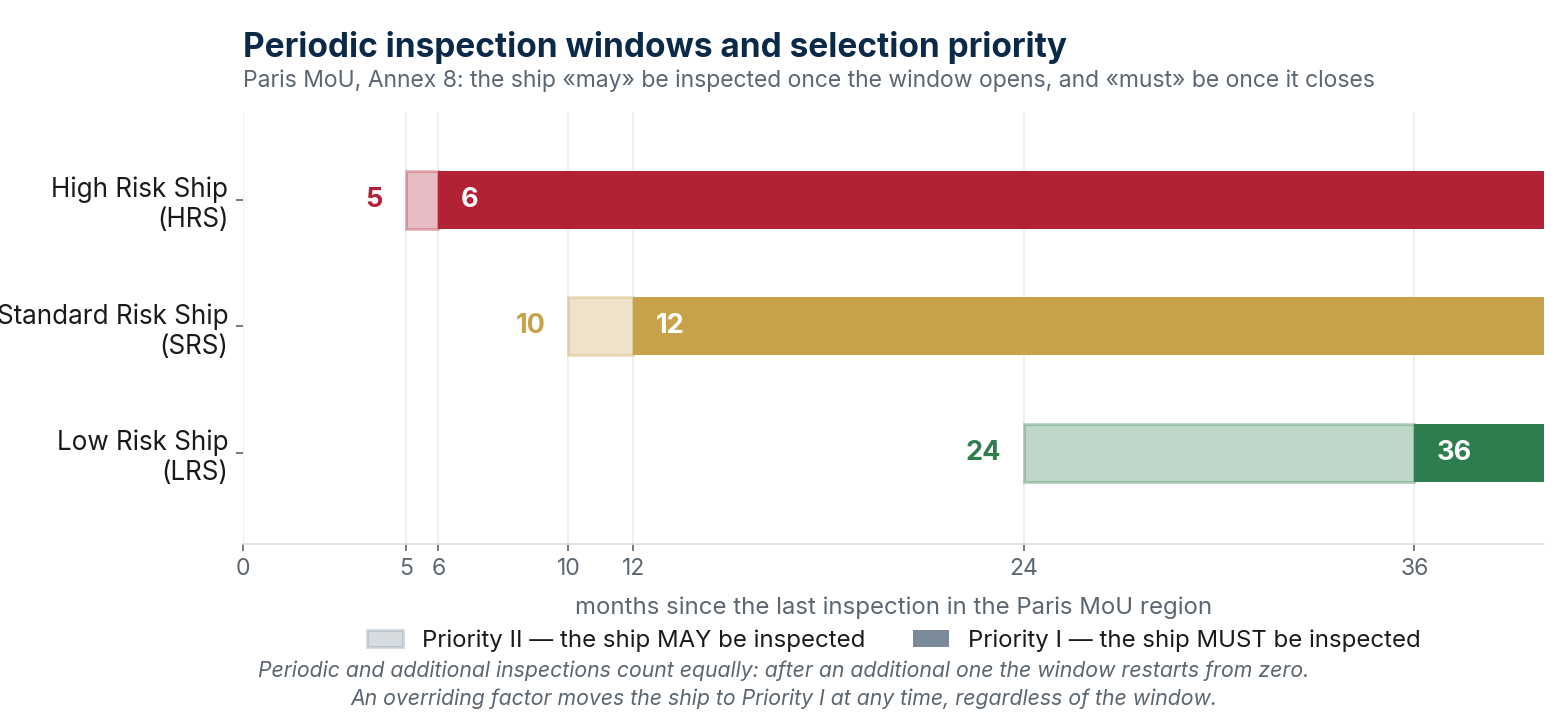
Overriding and unexpected factors: when the window no longer matters
The Memorandum distinguishes two families of events that can trigger an additional inspection outside the window, with different effects on priority: overriding factors oblige the Authority to inspect, while unexpected factors authorise it to do so, leaving the decision to the inspector's professional judgement.
| Overriding factors → Priority I (inspection mandatory) | Unexpected factors → Priority II (Authority's judgement) |
|---|---|
| Ships reported by another Member State or by the Secretariat, excluding unexpected factors | Ships reported by pilots or relevant authorities, including VTS information on the ship's navigation |
| Ships involved in a collision, grounding or stranding on their way to port | Ships that did not comply with the reporting obligations |
| Ships accused of an alleged violation of the provisions on discharge of harmful substances or effluents | Ships with an outstanding ISM deficiency, 3 months after it was issued |
| Ships manoeuvred in an erratic or unsafe manner, without following IMO routing measures or safe navigational practice | Previously detained ships, 3 months after the detention |
| Ships suspended or withdrawn from their Class for safety reasons after the last PSC inspection | Ships subject to a report or complaint by the master, a seafarer or any person with a legitimate interest, unless manifestly unfounded |
| Ships that cannot be identified in the database | Ships operated in a manner to pose a danger, or reported with problems concerning their cargo, in particular noxious or dangerous cargo |
| — | Ships whose actual risk parameters, from a reliable source, are worse than those recorded |
| Ships carrying certificates issued by an RO whose Paris MoU recognition has been withdrawn since the last inspection in the region |
Table 5.2 — Overriding and unexpected factors (Paris MoU, Annex 8, §§11-12).
Failure to comply with ETA notification and a crew complaint are unexpected factors, not overriding ones: they do not oblige the Authority to inspect, but the ship remains eligible as Priority II in subsequent ports too. Conversely, suspension or withdrawal of class for safety reasons is an overriding factor and entails a mandatory additional inspection.
Since the SRP is based on a 36-month history, there is no last-minute shortcut: the most effective way to reduce your risk profile is to maintain a low number of deficiencies and zero detentions over a multi-year horizon, as well as choosing a flag and class with a solid track record. Decisions made today about operational quality weigh on the risk profile for the following three years.
The White, Grey and Black lists
Module objectiveUse current flag and recognised-organisation lists as risk-profile inputs without turning them into absolute judgements on an individual ship.
Key takeaways
- Performance lists are updated periodically and must be checked for the date of the port call.
- The Black List contains different bands with different Ship Risk Profile weights; Grey and White are not equivalent.
- The flag or RO position is a targeting input: it does not replace the ship’s history, condition and preparation.
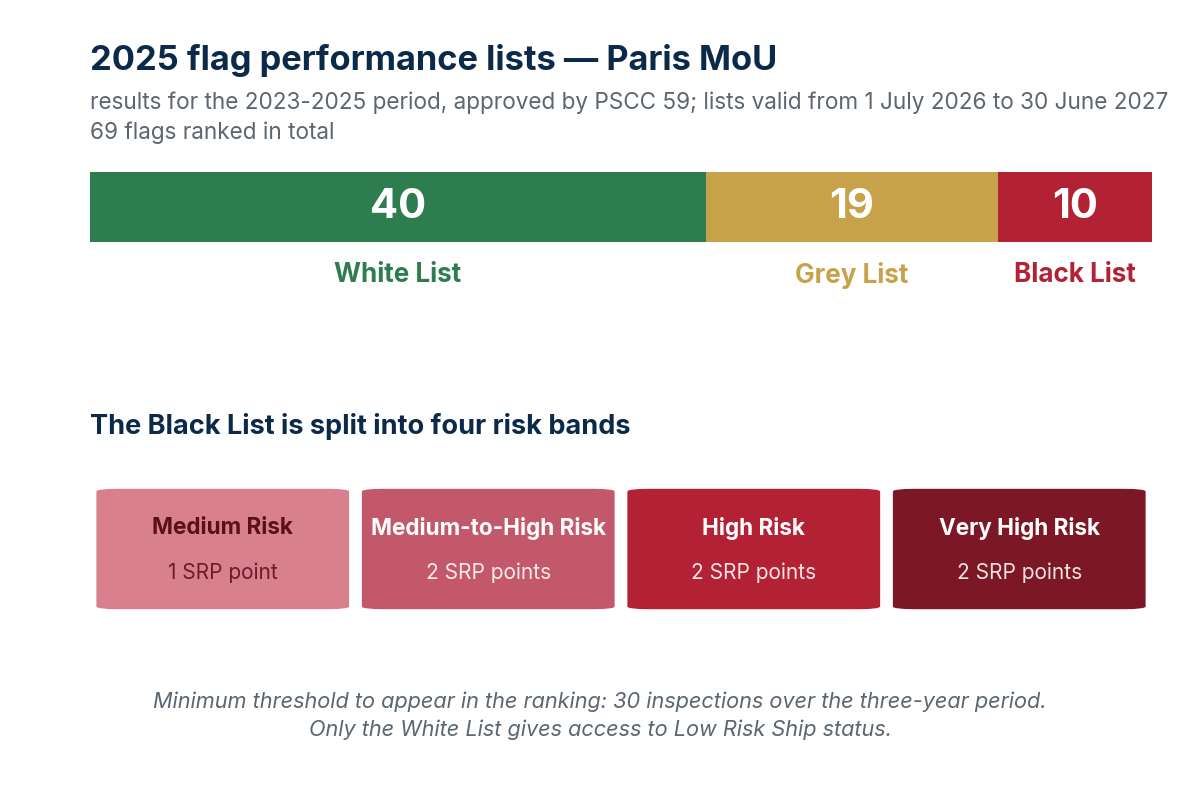
Every year the Paris MoU publishes, in its annual report, the White, Grey and Black (WGB) list: a ranking of flag performance based on the number of inspections and detentions recorded over a rolling three-year period, for flags that exceed a minimum inspection threshold in that period.
The most recent data (Paris MoU)
According to the results for the 2023-2025 period, approved by the Paris MoU Committee at its 59th meeting, the new lists apply from 1 July 2026 to 30 June 2027. They comprise 40 flags on the White List, 19 on the Grey List and 10 on the Black List. The top positions for performance are held by the Cayman Islands, Sweden, Norway, Denmark and Japan, followed by Singapore, France, Finland, the Netherlands and Luxembourg. Among high-volume flags, Liberia recorded 6,319 inspections and 276 detentions over the three-year period (rank 29), the Marshall Islands 5,166 inspections and 167 detentions (rank 21), and Panama 5,731 inspections and 338 detentions (rank 36). An HRS becomes Priority II after five months and Priority I after six months from its last inspection in the region: HRS status does not in itself mean inspection at every port call.
The Black List is not a single block
For Ship Risk Profile purposes the Black List is itself divided into bands of increasing risk — Medium Risk, Medium-to-High Risk, High Risk, Very High Risk — and the distinction has a concrete effect: the three upper bands are worth 2 points in the profile calculation, the Medium Risk band 1. Two ships both flying a «black flag» can therefore end up in appreciably different targeting positions.
Recognized Organizations have a performance list too
The same annual report ranks Recognized Organizations with at least 60 inspections over the three-year period. In the 2023-2025 exercise, high performers include DNV (18,350 inspections, 26 detentions), Bureau Veritas (12,261 inspections, 31 detentions) and Lloyd's Register (11,729 inspections, 25 detentions); a single organisation, Hellas Naval Bureau of Shipping, is classed as low performance. The classification bears directly on the individual ship: a Low or Very Low RO adds 1 point to the Ship Risk Profile of every ship carrying its certificates.
A flag with few ships but fewer inspections than the minimum threshold (30 over the three-year period) does not appear in the ranking: its ships therefore cannot benefit from flag-based Low Risk status, regardless of the fleet's actual quality.
Practical consequences of list position
| Position | Typical consequences for ships of that flag |
|---|---|
| White List | The only position that allows Low Risk Ship status; wider inspection windows; under the Memorandum it does not lead to banning for multiple detentions |
| Grey List | No penalty points in the profile, but no access to Low Risk status either; the ship remains subject to banning after more than two detentions in 24 months |
| Black List | The Very High, High and Medium-to-High Risk bands carry 2 Ship Risk Profile points; the Medium Risk band carries 1. No Black List position allows Low Risk status; banning after more than two detentions over a longer window, 36 months; difficulty accessing quality charterers; higher insurance premiums and financing costs |
Table 6.1 — Practical consequences of list position for an individual ship.
Before the inspection: notification and selection
Module objectiveManage pre-arrival notifications and selection logic before a call in the Paris MoU region.
A PSC inspection is almost never a random event: it results from a selection process based on the Ship Risk Profile, supplemented by external reports and advance notification obligations.
Notification obligations (ETA)
The Memorandum provides for two distinct messages, with different addressees and content.
- 72-hour message (72 ETA) — owed by ships eligible for an expanded inspection, that is HRS and risk ship types over 12 years old, bound for a port or anchorage in the region. It carries ship identification (mandatory IMO number), port of destination, ETA and ETD, planned duration of the call, for tankers the hull configuration and the condition, volume and nature of cargo and ballast, the operations planned in port, the statutory surveys and substantial maintenance work scheduled during the call, and the date of the last expanded inspection in the Paris MoU region.
- 24-hour message (24 ETA) — owed by every ship bound for a port or anchorage in the region, at least 24 hours before arrival; or on departure from the previous port if the passage takes less than 24 hours; or as soon as the information is available if the port of call is unknown or changes during the voyage. It carries ship identification, port of destination, ETA and ETD.
Failure to comply with the reporting obligations is not an overriding factor but an unexpected factor: it does not oblige the Authority to inspect, but authorises an additional visit at Priority II and keeps the ship eligible in subsequent ports.
Priority I and Priority II
| Priority | Situation | Category of inspection |
|---|---|---|
| I the ship must be inspected | An overriding factor is present | Additional |
| HRS not inspected in the last 6 months | Periodic | |
| SRS not inspected in the last 12 months | Periodic | |
| Any ship not inspected in the last 36 months | Periodic | |
| II the ship may be inspected | HRS not inspected in the last 5 months | Periodic |
| Ship with unexpected factors | Additional | |
| SRS not inspected in the last 10 months | Periodic | |
| LRS not inspected in the last 24 months | Periodic |
Table 7.1 — Inspection and selection scheme (Paris MoU, Annex 8, Table 3).
Periodic and additional inspections count equally: after an additional inspection the window for the next periodic one restarts from zero. If a Priority II inspection is not carried out, the ship remains Priority II until the window closes, at which point it becomes Priority I.
External reporting sources
- Crew complaints, often relating to working conditions (MLC) or safety.
- Reports from agents, port pilots or terminal operators who notice visible anomalies.
- Information shared by other member States or other regional regimes.
- Reports of accidents, near-misses or pollution occurring near the port.
A common mistake is to think of PSC preparation as a last-day onboard activity. Truly effective management starts with punctual compliance with notification obligations, with a pre-emptive check of the ship's SRP status before planning the call, and with transparent dialogue between the ship and the office about any known issues before arrival.
Key takeaways
- Check current national and port notifications: Annex 12 of the archived Memorandum (46th amendment) still lists 72 ETA, whereas Directive (EU) 2024/3099 deletes Article 9, with transposition due by 6 July 2027. These indications are not a universal checklist for 2026.
- Failure to report is an unexpected factor, not an overriding factor.
- Priority I requires inspection; Priority II indicates eligibility under the applicable criteria.
Inspection on board: types and conduct
Module objectiveDistinguish the category, type and possible extension of a PSC inspection and prepare the ship proportionately.
Understanding the different types of inspection and how the inspector conducts the visit helps the crew manage the event methodically, avoiding both excessive anxiety and underestimation.
Types of inspection
| Type | When it applies |
|---|---|
| Initial | Periodic inspection of SRS and LRS: check of the certificates and documents listed in Annex 10, of the overall condition and hygiene of the ship, and of the rectification of outstanding deficiencies |
| More detailed | On SRS and LRS, when the initial inspection reveals «clear grounds» to examine specific areas in depth |
| Expanded | Mandatory for every periodic inspection of an HRS. For SRS and LRS it applies only if the ship is a risk ship type — chemical tanker, gas carrier, oil tanker, NLS tanker, bulk carrier, passenger ship — and is more than 12 years old |
| Additional | Triggered by an overriding or unexpected factor. Under Annex 9, Table 4, it is more detailed; the PSCO may expand it for an HRS or an SRS/LRS of a risk ship type over 12 years old. Additional is a selection category, not a fourth inspection type alongside initial, more detailed and expanded. |
Table 8.1 — Types of PSC inspection (Paris MoU, Annex 9, Table 4).
This is the most common preparation error: the ship is made ready for a documentary visit and instead receives an in-depth examination of every Annex 9 area. The rule concerns the periodic category: a periodic inspection of a High Risk Ship is always expanded. Where the inspection is additional, it is more detailed and may be expanded according to the PSCO's professional judgement and the criteria in Annex 9.
How the visit actually unfolds
- Welcoming the inspector: identity verification and communicating the purpose of the visit to the Master.
- Document check: statutory and class certificates, DOC/SMC, logbooks, records.
- General inspection round: apparent condition of the hull, deck, engine room, accommodation.
- Targeted follow-up if clear grounds emerge: practical tests (e.g. steering gear test, fire drill).
- Interview with the crew, including on hours of rest and MLC conditions.
- Debrief with the Master: communication of identified deficiencies and their action codes.
The Master has the right and the duty to understand every deficiency raised, to ask for clarification on the assigned action code and, if they consider the outcome unfair, to activate the appeal procedures provided by the regime. Cooperating with the inspector, providing access and documentation without obstruction, is quite different from passively accepting every conclusion without understanding it.
Key takeaways
- A periodic inspection of an HRS is always expanded.
- An additional inspection is more detailed and may be expanded where prescribed.
- Clear grounds, risk and PSCO professional judgement determine the depth of the visit.
Deficiencies and action codes
Module objectiveInterpret a deficiency, its action code and the criteria that may lead to detention.
Every deficiency found is assigned an action code that determines how it is handled: some must be rectified before departure, others within a set period, and the most serious result in detention. The codes are not left to the individual inspector's discretion: they are standardised by the Port State Control Committee instruction — in the version in force, PSCC59/2026/03 «Detention and Action Taken» — and the same coding is read by inspectors throughout the region and by charterers' due diligence systems. Being able to read them means knowing in advance what the ship will have to demonstrate, and by when.
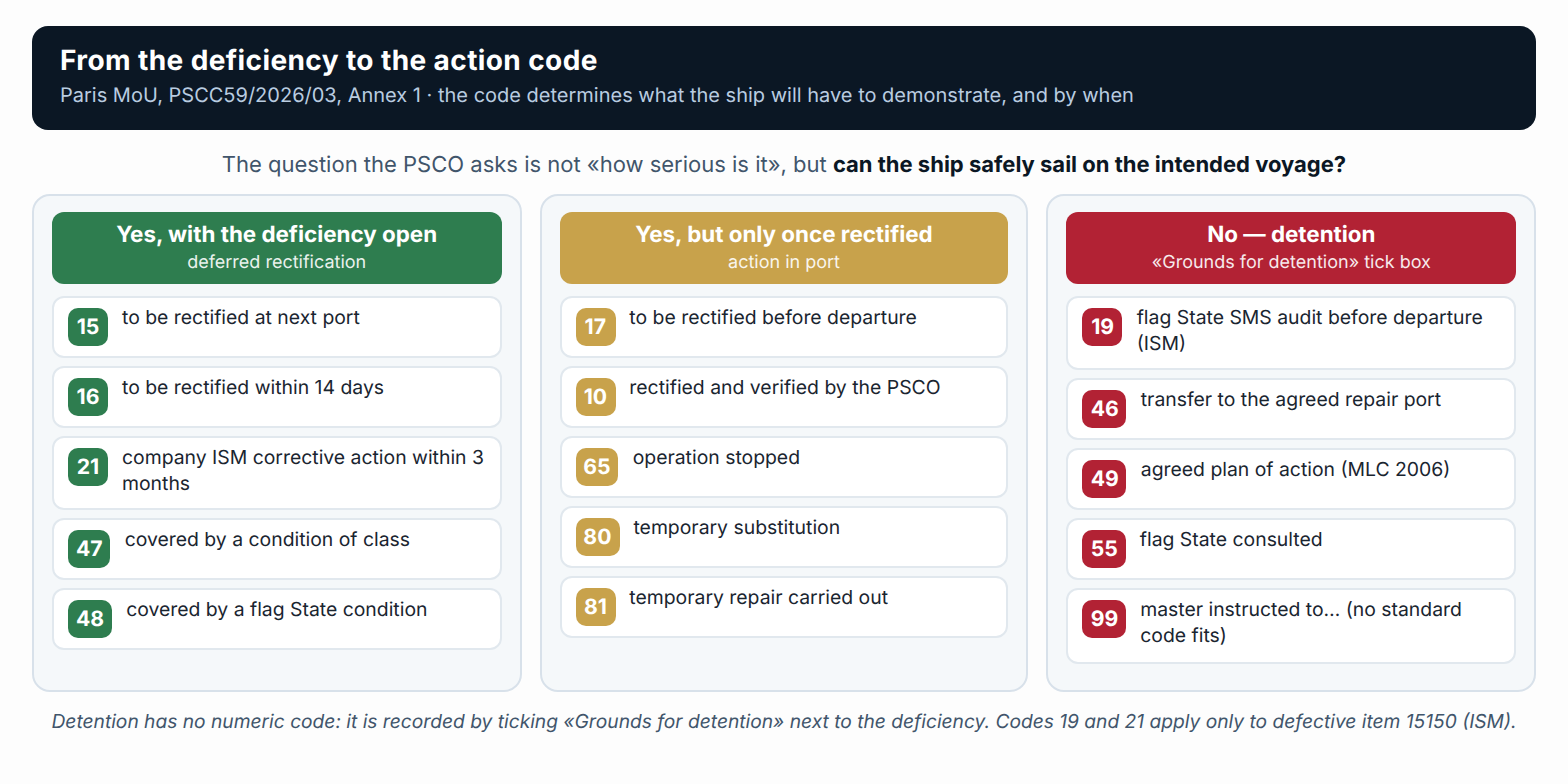
The Paris MoU action taken codes
Action codes are not a descriptive label but a codified language: they fall into three families — action on the individual deficiency, action on the inspection, and reporting action — and they determine what happens to the ship after departure. The group that matters for day-to-day management is the first.
| Code | Action | When it is used |
|---|---|---|
| 10 | Rectified | Deficiency rectified and verified by the PSCO |
| 15 | To be rectified at next port | Deficiency that cannot be rectified before departure and which the PSCO requires to be closed at the next port |
| 16 | To be rectified within 14 days | Deficiency that, in the PSCO's professional judgement, is not serious enough to require urgent rectification or verification before departure. The 14 days are a maximum: it remains the master's responsibility to rectify it as soon as necessary and reasonable within that period |
| 17 | To be rectified before departure | Deficiency to be resolved before the ship sails but not serious enough to warrant detention. If the ship is not detained, rectification is the master's responsibility and no PSCO verification is required at that port call. This is the code for any «accidental damage» related deficiency |
| 19 | Safety management audit by the Administration required before departure | Only for a detainable ISM deficiency (defective item 15150): the PSCO has established a link between the deficiencies found and a serious failure, or serious lack of effectiveness, in the implementation of the ISM Code |
| 21 | Corrective action on the ISM system by the Company required within 3 months | Only for defective item 15150, where the deficiencies do not warrant detention but still indicate a failure or lack of effectiveness of the ISM Code. Also used as the final action taken once the external audit required by code 19 has been carried out |
| 26 | Competent Security Authority informed | Only for security series deficiencies (1610X) for which clear grounds have been found |
| 46 | To be rectified at agreed repair port | Only for a detainable deficiency for which the PSCO agrees the ship may sail to a repair port. After the declared ETA at the repair port the code generates an unexpected factor and makes the ship eligible for an additional inspection |
| 47 | As in the agreed condition of class | Deficiency not fully rectified but covered by a condition of class. Not to be used for statutory requirements: only for items exclusively covered by the structural, mechanical and electrical requirements of the classification society, and only for ships with a keel date on or after 1 July 1998 |
| 48 | As in the agreed flag State condition | Deficiency that cannot be fully rectified before departure, covered by a document with a condition issued by the flag State or by an RO on its behalf. Also used for unrectified accidental damage |
| 49 | As in the agreed plan of action | Only for MLC 2006 detainable deficiencies. The plan is proposed by master and owner, submitted to the flag State, attached to the notice of release from detention and uploaded in THETIS |
| 55 | Flag State Administration consulted | When the flag State is consulted over a deficiency |
| 65 | Operation stopped | The PSCO orders an operation or activity observed during the inspection to be stopped |
| 80 | Temporary substitution | Deficiency rectified by a temporary substitution of equipment or a temporary arrangement — for example the engine room being manned while a fire detection deficiency is not yet repaired |
| 81 | Temporary repair carried out | A repair that is only temporary, accepted by the PSCO on a proposal from the ship, RO or flag, with full rectification required within a specified time |
| 95 / 96 | Letter of warning issued / withdrawn | Only for the letters of warning specified by the Port State Control Committee |
| 99 | Master instructed to… | Only where no standard code fits. After the description of the deficiency the PSCO must state in clear text what the master is instructed to do and the time allowed. Not available for 15150 ISM or the 1610X security series, with the single exception of 16105 (access control to ship) |
Table 9.1 — Deficiency action taken codes (Paris MoU, PSCC59/2026/03, Annex 1).
In the inspection report a detention is not recorded with a numeric code but with tick boxes alongside the deficiency: Grounds for detention, RO resp. where responsibility traces back to the recognised organisation that issued or endorsed the certificate, Accidental Damage and ISM related. At inspection level there are further boxes — vessel expelled on security or other grounds, MARPOL investigation of a contravention of the discharge provisions, inspection suspended, dismissal or exclusion on AFS grounds — and at reporting level the boxes «Flag State Administration informed» and «Recognised organisation informed».
When a deficiency becomes grounds for detention
The decision to detain a ship does not come from counting deficiencies but from a structured assessment. The PSCO first checks two documentary preconditions and then twelve operational capabilities of the ship and its crew, all referred to the voyage about to begin.
| Preconditions | The ship and crew are able to… |
|---|---|
| Relevant, valid documentation | navigate safely throughout the forthcoming voyage |
| Crew as required by the Minimum Safe Manning Document or equivalent | safely handle, carry and monitor the condition of the cargo throughout the voyage |
| operate the engine room safely throughout the voyage | |
| maintain proper propulsion and steering | |
| fight fires effectively in any part of the ship | |
| abandon ship speedily and safely and effect rescue | |
| prevent pollution of the environment | |
| maintain adequate stability | |
| maintain adequate watertight integrity | |
| communicate in distress situations | |
| provide safe and healthy conditions on board | |
| provide the maximum of information in case of accident, through the VDR |
Table 9.2 — Detention assessment criteria (Paris MoU, PSCC59/2026/03, §2.3.3).
If even one of these assessments is negative, taking into account all the deficiencies found, the ship is a strong candidate for detention. And the converse of the usual assumption also holds: a combination of individually less serious deficiencies may warrant detention if, taken together, they compromise one of these capabilities.
ISM deficiencies: the code 19 and code 21 mechanism
ISM deficiencies are recorded under defective item code 15150 when the PSCO links technical or operational evidence to a failure in ISM Code implementation. Other deficiencies and detentions also affect company performance: in the Paris MoU deficiency index, ISM-related deficiencies have weight 5 and other deficiencies weight 1 (Annex 7, paragraph 17).
- If that link indicates a failure or lack of effectiveness in implementation, but the deficiencies do not warrant detention, the ISM deficiency is given code 21: the company must take corrective action on the system within 3 months. Once the 3 months elapse, the still-open deficiency generates an unexpected factor and the ship becomes eligible for an additional inspection again.
- If the link indicates a serious failure, the ISM deficiency is a ground for detention and is given code 19: the flag Administration must carry out a safety management audit before the ship can depart. After the audit, code 21 records the corrective action still required from the company within three months; it is not equivalent to code 10 for verified rectification.
Code 21 makes the company responsible for corrective action on the system. Cause analysis, implementation on board and ashore, and effectiveness checks require the relevant personnel to participate. Office paperwork alone does not demonstrate that the system works. PSCC59/2026/03 provides for re-inspection eligibility after three months; check the report and status recorded in THETIS.
When the inspection is suspended
Where all statutory certificates are missing, expired or invalid, PSCC59/2026/03 exceptionally permits suspension after the document check. In other cases of an obviously substandard ship, complete the prescribed checks: Annex 10 documents, overall and working conditions, previous deficiency rectification, more detailed inspections in areas with clear grounds and randomly elsewhere, operational controls, and detainable deficiencies in several areas. Missing all certificates is therefore not a general prerequisite for every suspension.
Once all these conditions are met, the ship may be detained and the inspection suspended until the responsible parties — flag State and recognised organisation — have ensured that the ship complies with all the relevant Conventions. Suspension is not to be confused with halting an inspection for operational or safety reasons, for example overnight, which is simply continued later.
Most frequent deficiency areas
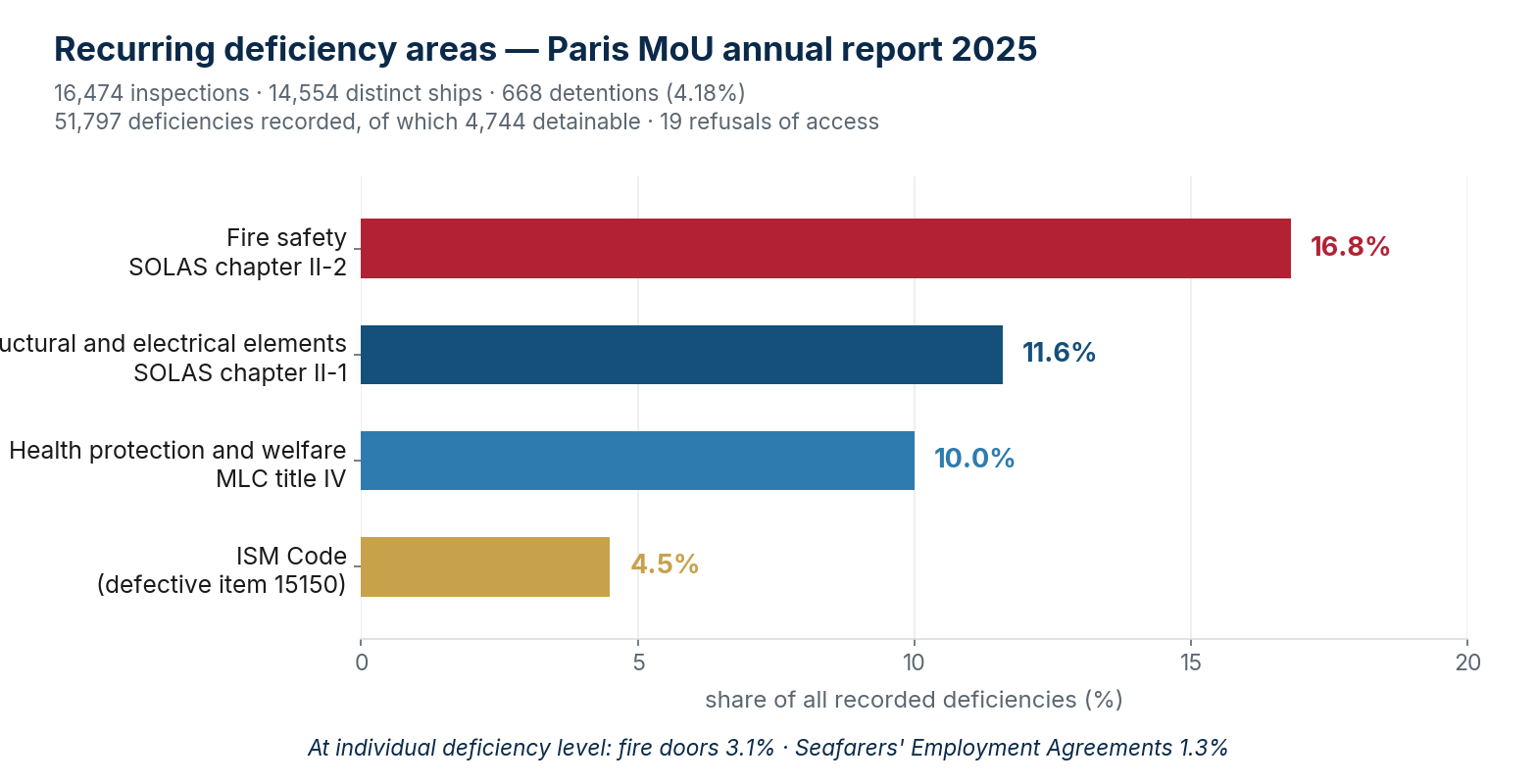
Fire safety and life-saving appliance deficiencies remain among the most frequent in absolute terms, but ISM Code-related deficiencies deserve particular attention: they signal not an isolated problem but a weakness in the management system, and tend to draw additional scrutiny to the company, not just the individual ship.
An isolated deficiency on a specific piece of equipment is normal operational management. A pattern of recurring deficiencies in the same area, especially across several ships in the same fleet, signals a systemic problem in the SMS that must be addressed at company level, not ship by ship.
Key takeaways
- The action code sets the action, the deadline and the method of verifying rectification.
- Detention is an overall decision, not merely a numerical deficiency code.
- ISM deficiencies and substandard conditions require a systemic assessment, not isolated repairs.
Detention and banning
Module objectiveReconstruct the triggers, duration and escalation of refusal of access under the Paris MoU.
Detention is the most serious measure a PSC inspection can impose short of a full access ban: the ship is held in port until the deficiencies that caused the detention have been rectified and verified.
When detention is triggered
A detention is ordered when the deficiencies found are such that the ship, crew or environment would be at risk if the ship departed in the condition found. It is not tied to a minimum number of deficiencies: even a single very serious deficiency (for example a critical steering gear failure) can justify a detention on its own.
Escalation towards banning
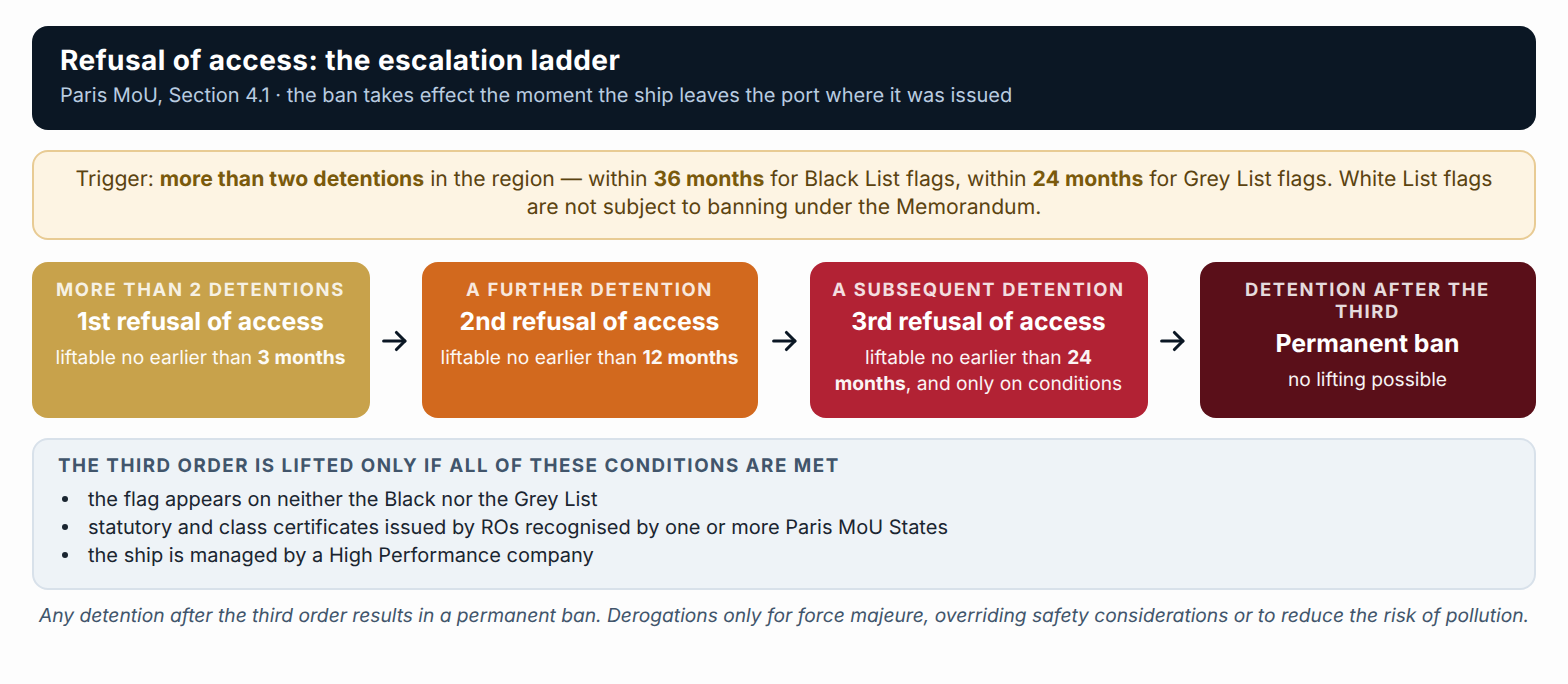
Under the Paris MoU regime, refusal of access — a ban on calling at any port or anchorage in the region — is triggered when a ship has been detained more than twice in the region within a window that depends on its flag's list: 36 months for Black List flags, 24 months for Grey List flags. The detention threshold is therefore the same; what changes is how far back the history is examined, which is why a Black List flag stays exposed for longer. White List flags are not subject to banning for multiple detentions under the Memorandum — the EU revision provides an extension to be assessed against applicable national transposition (Module 03). The order takes effect as soon as the ship leaves the port or anchorage where it was issued.
| Order | When it is triggered | Lifting |
|---|---|---|
| 1st refusal of access | More than 2 detentions in 24 months (Grey flag) or in 36 months (Black flag) | Not before 3 months from issue, and only if the conditions of the relevant PSCC Instruction are met |
| 2nd refusal of access | A further detention after the first order is lifted | Not before 12 months |
| 3rd refusal of access | Any subsequent detention | Not before 24 months, and only if all of the following apply: the flag appears on neither the Black nor the Grey List; statutory and classification certificates are issued by ROs recognised by one or more Paris MoU States; the ship is managed by a High Performance company; the conditions of the relevant PSCCInstruction are also met. If even one is missing, the ban becomes permanent |
| Permanent ban | Any detention subsequent to the third refusal of access | None |
Table 10.1 — Refusal of access escalation (Paris MoU, Section 4.1).
An individual port State may derogate from the ban only in the event of force majeure or overriding safety considerations, or to reduce or minimise the risk of pollution, and provided the owner, operator or master has implemented adequate measures to ensure safe entry.
Commercial and insurance consequences
- Loss of commercial availability during detention; any off-hire depends on the contract terms and facts.
- A detention enters the rolling 36-month history, prevents LRS status and may change category and windows depending on other parameters; it does not automatically make the ship HRS.
- Visible flagging in due diligence systems used by charterers and vetting bodies (SIRE, RightShip).
- Possible increase in H&M and P&I insurance premiums and financing terms.
- In the most serious cases, a supplementary company audit by the flag or the classification society.
The direct commercial loss from a detention is often the smaller part of the real cost: the impact on the Ship Risk Profile for three years, visibility to charterers and any resulting increase in insurance costs weigh more heavily and for longer than the actual days of downtime.
Key takeaways
- More than two detentions trigger the threshold for Grey flags in 24 months and Black in 36 months.
- Minimum lifting periods rise from 3 to 12 and then 24 months.
- After the third order, failure to meet every condition results in permanent refusal.
Concentrated Inspection Campaigns (CICs)
Module objectivePrepare ship and crew for a Concentrated Inspection Campaign using the official topic, questionnaire and campaign window.
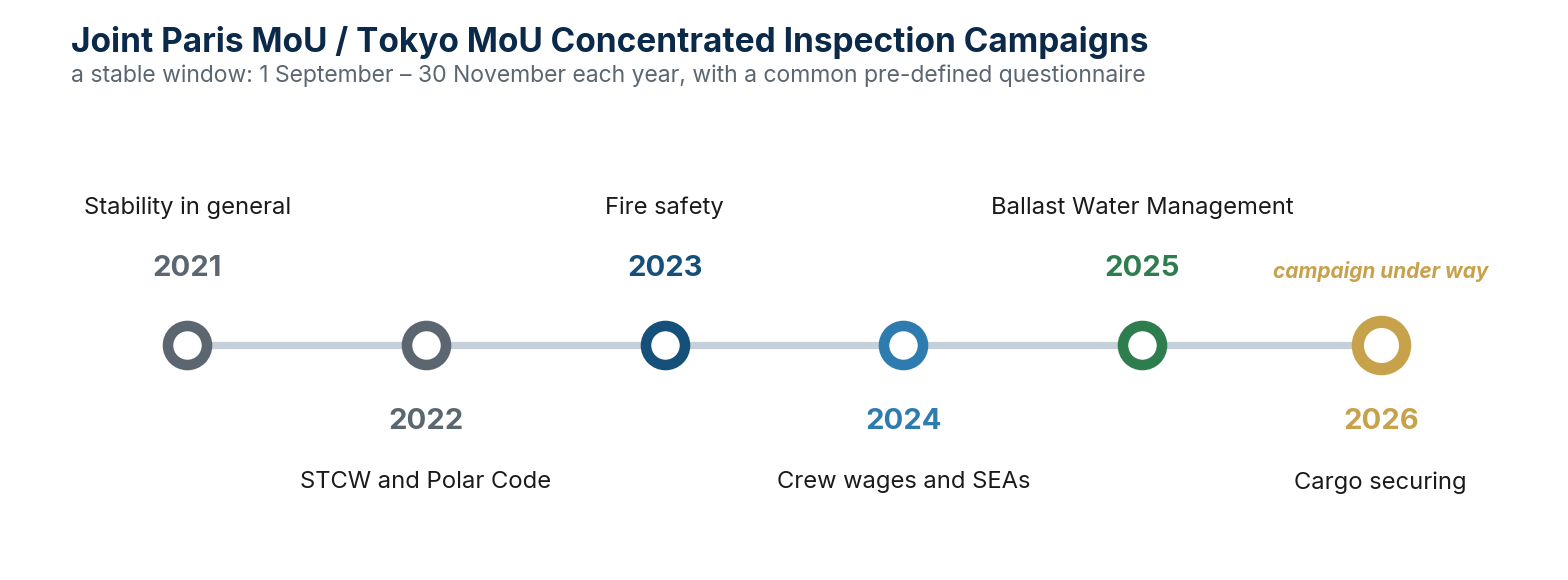
In addition to ordinary inspections, regional regimes periodically conduct Concentrated Inspection Campaigns: targeted inspections on a specific theme, carried out during a defined period of the year, often in cooperation between multiple MoUs.
How a CIC works
Each campaign focuses on a theme chosen based on emerging risk trends or recent safety concerns. The Paris MoU and Tokyo MoU coordinate their themes and run joint campaigns, with a common pre-defined questionnaire the PSCO completes in addition to the normal inspection; for the 2026 campaign the announced window is 1 September – 30 November.
| Year | Joint campaign theme |
|---|---|
| 2021 | Stability in general |
| 2022 | STCW and Polar Code |
| 2023 | Fire safety |
| 2024 | Crew wages and Seafarers' Employment Agreements |
| 2025 | Ballast Water Management |
| 2026 | Cargo securing of cargo units and cargo transport units |
Table 11.1 — Joint Paris MoU / Tokyo MoU Concentrated Inspection Campaign themes.
The Paris MoU and Tokyo MoU are jointly running a campaign on Cargo Securing of Cargo Units and Cargo Transport Units, from 1 September to 30 November 2026. The stated objective is to collect compliance data on the SOLAS obligations for loading, stowage and securing: an approved Cargo Securing Manual consistent with the ship's actual arrangement, the condition and certification of lashing equipment, records of periodic inspections of the equipment, and crew competence in the operations. PSCOs use a questionnaire pre-defined jointly by the two Memoranda.
Preparing the ship for a CIC
- Check the campaign theme announced by your relevant regime well in advance.
- Carry out a targeted internal audit on the thematic area, using logic similar to the pre-vetting seen in the Vetting course.
- Ensure theme-specific documentation is up to date and consistent with onboard practice.
- Train the crew on the theme with a brief practical refresher, not just theory.
The themes chosen for campaigns often anticipate areas that will become the subject of structural attention in subsequent years. An attentive vetting/PSC officer treats CICs not just as a seasonal formality, but as an early signal of where the safety management system will need to be strengthened.
Key takeaways
- A CIC adds a thematic questionnaire to the routine inspection.
- The 2026 cargo securing campaign runs from 1 September to 30 November.
- Effective preparation checks documents, actual condition and crew competence.
Post-inspection management and appeals
Module objectiveManage closure, evidence, costs and appeal after an inspection or a detention.
Formal closure of the inspection does not mark the end of the vetting/PSC officer's work: post-inspection management — closing deficiencies, internal communication, any appeal — is often what determines the event's real impact on the ship and the company.
The deficiency closure process
- Formal recording of every deficiency in the company's management system, with an owner and a deadline.
- Corrective action on the cause, not just rectification of the symptom (the same CAPA logic seen in ISM management).
- Collecting closure evidence (photos, certificates, updated records) to present, if requested, at the next port of call or to the regime.
- Sharing the lesson learned with the rest of the fleet, to prevent the same deficiency elsewhere.
The cost of a detention falls on the owner
An aspect often overlooked in planning: where an inspection confirms or reveals deficiencies warranting detention, all costs relating to the inspections fall on the owner, the operator or their representative in the port State, and the same applies to the costs of inspections carried out under the banning procedures. Above all: the detention is not lifted until full payment has been made, or a sufficient guarantee given to cover it. It is therefore not a charge to be settled afterwards: it is a condition of sailing again.
The right of appeal
The owner, the operator or their representative has the right to appeal against a detention or refusal of access decision, and the Authority must properly inform the master of that right and of how to exercise it. There are, however, two limits worth knowing before the situation arises.
- An appeal does not suspend the measure. The Memorandum (§3.12) and Directive 2009/16/EC (Article 20) say so in the same terms: the ship remains detained, or excluded, while the appeal is examined. The lever for sailing again is rectification, not appeal.
- Undue detention or delay. Article 19(8) of Directive 2009/16/EC places the burden of proof on the owner or operator when alleging undue detention or delay for compensation. This is not a general rule for every appeal under Article 20. Preserve technical evidence and follow the applicable national procedure.
After revocation or amendment following an appeal, Article 20(4) requires the database to be updated without delay and published information corrected within 24 hours of the decision. An incorrect record may distort the profile while the inspection remains within its rolling 36-month history; the appeal does not start a new 36-month period.
The quality of any appeal depends almost entirely on the documentation gathered during the inspection itself: photographs, times, names of those involved, a copy of the report. A good Master keeps a systematic record of every PSC inspection, regardless of outcome, precisely to be ready to reconstruct the facts if necessary.
Key takeaways
- Every deficiency should enter a rectification and CAPA process supported by verifiable evidence.
- An appeal does not suspend detention or refusal of access.
- Correction of the official record after a successful appeal should be actively verified.
PSC KPIs and fleet management
Module objectiveBuild a PSC dashboard that distinguishes volume, severity, recurrence and future inspection workload.
As with vetting, Port State Control also generates valuable data for managing the whole fleet, if collected and analysed systematically rather than ship by ship.
The essential KPI dashboard
| KPI | What it measures | How to read it |
|---|---|---|
| Deficiencies per inspection, by type and category | Recurrence of deficiencies across comparable inspections | Segment by initial, more detailed and expanded, and by technical area |
| Detention rate | Share of inspections ending in detention | Read together with sample size and the multi-year trend |
| Deficiency closure time | Speed of the rectification and CAPA process | Separate technical closure from formal closure |
| Recurrence at 12 and 36 months | Repetition of the same deficiency or the same cause | More useful than a raw average on its own |
| HRS / SRS / LRS distribution | Fleet exposure by category | These are categories: no «average SRP» can be computed from them |
| Ships at Priority I or II at upcoming calls | Imminent inspection workload | Base it on official status and the planned voyage |
Table 13.1 — Company Port State Control KPI dashboard.
PSC data and vetting data (SIRE, CDI, RightShip) often tell the same story from different angles. A ship with recurring PSC deficiencies on human factors is unlikely to have outstanding SIRE observations on the same themes. Integrating the two dashboards into a single view gives the company a more complete picture of the fleet's real health.
Key takeaways
- KPIs should be segmented by inspection type and technical area.
- HRS, SRS and LRS are categories and should not be converted into a numerical average.
- Recurrence and Priority I or II status are more actionable than a raw deficiency average.
Emerging trends in Port State Control
Module objectiveSeparate PSC requirements already in force from evolving interoperability and future regulatory developments.
Like vetting, Port State Control is also evolving, driven by digitalisation, decarbonisation and growing harmonisation between different regional regimes.
Requirements already subject to verification
Documentation concerning EEXI, SEEMP and CII already forms part of the applicable MARPOL framework and may be checked through PSC under the instruments in force. This is not a future prospect: it is material an inspector can ask for today, alongside traditional safety and MARPOL checks.
Developments to monitor
Any new duties arising from a future IMO Net-Zero framework should be described only after adoption and entry into force, clearly separated from current requirements. Treating what is still under discussion as though it were in force is the quickest way to prepare the ship for the wrong thing.
Interoperability between regimes
Regimes cooperate, exchange data and conduct joint campaigns — the Paris and Tokyo MoUs already run joint CICs — but their databases remain distinct and operational links may be partial or temporarily unavailable. Cooperation narrows the room for «port shopping», it does not remove it, and each regime remains legally autonomous in its own decisions.
The best-prepared companies do not simply chase the latest thematic campaign: they build a management system that anticipates the directions in which public oversight is moving, from decarbonisation to data digitalisation. Those who treat PSC as a mere formality to get through always remain a step behind those who treat it as a source of continuous improvement.
Key takeaways
- EEXI, SEEMP and CII already belong to the MARPOL framework that PSC can verify.
- A future IMO Net-Zero framework should be labelled as a development, not a current requirement.
- Cooperation between regimes does not mean a single database or complete synchronisation.
Recurring mistakes
From the Mistake Library of SuperbaKnowledge, filtered to the subjects this course covers. This view selects and organises content published in SuperbaKnowledge; it does not modify or replace it. The linked Knowledge page remains the reference version, while official texts remain authoritative.
| Topic | Mistake | Typical consequence | Topic sheet |
|---|---|---|---|
| Appeal Against a Detention | Correcting deficiencies postponed pending the outcome of the appeal | Unnecessarily prolonged ship detention, since the detention is not suspended during the appeal | See the topic sheet |
| Black Sea MOU | Preparation based only on Paris MoU statistics, without considering regional specifics | Underestimation of the real inspection/detention risk in the region | See the topic sheet |
| Pre-PSC Checklist | Checklist applied only when an inspection is considered 'likely' | Pre-existing deficiencies remain undetected at port calls perceived as low risk | See the topic sheet |
| Communicating with the Port State Control Officer (PSCO) | Prepared, uniform answers from the whole crew, perceived as insincere | The PSCO extends the inspection beyond what was expected | See the topic sheet |
| Concentrated Inspection Campaigns (CIC) | No specific preparation ahead of an announced CIC | A more thorough inspection on the topic catches the crew unprepared | See the topic sheet |
| Detention and Banning | Underestimating the impact of a detention on the Ship Risk Profile for the following 36 months | More frequent, more thorough inspections continue well beyond resolution of the episode | See the topic sheet |
| Deficiency Management | Deficiency rectified but not linked to the SMS NC/CAPA system | The root cause remains unresolved, risk of recurrence | See the topic sheet |
| Indian Ocean MOU | Breadth and variety of member states underestimated in voyage planning | Calls at member states of the regime not recognized as such | See the topic sheet |
| Mediterranean MOU | Paris MoU statistics and priorities applied uncritically to calls in the Med MoU region | Preparation not calibrated to the real regional specifics | See the topic sheet |
| Ship Risk Profile and New Inspection Regime (NIR) | No monitoring of the Ship Risk Profile by the Company | Learning the risk level only at the moment of selection for inspection comes as a surprise | See the topic sheet |
| Tokyo MOU | Underestimating the relevance of BWMS functioning ahead of inspections in the Asia-Pacific region | Deficiency in the category most frequently found in recent campaigns | See the topic sheet |
| USCG Port State Control | Assumption that Paris/Tokyo MOU compliance is enough for US calls too | Unpleasant surprise when facing USCG-specific, non-harmonised requirements | See the topic sheet |
Related PSC deficiencies
From the PSC Knowledge Base of SuperbaKnowledge. This view selects and organises content published in SuperbaKnowledge; it does not modify or replace it. The linked Knowledge page remains the reference version, while official texts remain authoritative.
| Deficiency | Regulation | Indicative frequency | Possible consequence | Topic sheet |
|---|---|---|---|---|
| Cargo Securing Manual not consistent with the ship's configuration (CIC 2026 focus) | SOLAS VI/5.6 and VII/5, CSS Code | To monitor (CIC 1 Sep - 30 Nov 2026) | Deficiency in the thematic campaign | See the topic sheet |
| Expired certificate or onboard copy not updated after renewal | General PSC documentary requirements | Medium | Deficiency, aggravating factor if repeated | See the topic sheet |
Glossary of acronyms
| Acronym | Definition |
|---|---|
| APCIS | Asia-Pacific Computerized Information System (Tokyo MoU) |
| CIC | Concentrated Inspection Campaign |
| DOC | Document of Compliance (ISM) |
| EMSA | European Maritime Safety Agency |
| EQUASIS | Public database on the quality of the world fleet |
| ETA | Estimated Time of Arrival |
| ETD | Estimated Time of Departure |
| HRS | High Risk Ship |
| IMSAS | IMO Member State Audit Scheme |
| ISM | International Safety Management Code |
| LRS | Low Risk Ship |
| MLC | Maritime Labour Convention 2006 |
| MoU | Memorandum of Understanding |
| NIR | New Inspection Regime (Paris MoU / Tokyo MoU) |
| NOV | Notice of Violation (USCG) |
| NLS | Noxious Liquid Substances (NLS tanker) |
| PSC | Port State Control |
| PSCO | Port State Control Officer |
| RO | Recognized Organization |
| SMC | Safety Management Certificate (ISM) |
| SMS | Safety Management System |
| SRP | Ship Risk Profile |
| SRS | Standard Risk Ship |
| PSCC | Port State Control Committee (Paris MoU) |
| QS21 | QUALSHIP 21 (USCG quality recognition programme) |
| SEA | Seafarers' Employment Agreement |
| THETIS | The Hybrid European Targeting and Inspection System (Paris MoU) |
| USCG | United States Coast Guard |
| VTS | Vessel Traffic Service |
| WGB | White, Grey and Black list |
References and sources
Consolidated list of the sources and organisations cited in the course. References are up to date as of 15 September 2026; for official versions of criteria, lists and procedures, always consult the publications of the owning organisations.
| Source / organisation | Scope |
|---|---|
| Paris MoU — consolidated text of the Memorandum, 46th Amendment (adopted 30 May 2025, effective 1 July 2025) | Ship Risk Profile and weightings (Annex 7), inspection and selection scheme (Annex 8), inspection types and clear grounds (Annex 9), 72/24-hour reporting obligations (Annex 12), refusal of access (Section 4) |
| Paris MoU — PSCC59/2026/03 «Detention and Action Taken» | Detention criteria and standard action taken codes |
| Paris MoU — parismou.org | Annual flag and RO performance lists, CIC themes and results, annual reports |
| Tokyo MoU — tokyo-mou.org | NIR regime for Asia-Pacific, joint CICs; Annual Report 2025 for the status of inter-regional database links (APCIS–THETIS temporarily suspended) |
| Directive 2009/16/EC, consolidated text, and Directive (EU) 2024/3099 | Legal basis of PSC in the Union, ship risk profile (Annex I), refusal of access (Article 16), appeals (Article 20), new conventions in scope |
| Italian Legislative Decree 53 of 24 March 2011 | Italian transposition of the directive |
| EMSA — emsa.europa.eu | THETIS, THETIS-MRV, THETIS-EU and Member States' inspection commitments |
| United States Coast Guard — dco.uscg.mil | Autonomous US PSC regime; Port State Control Annual Report 2025; CVC-WI-002(2), revised 14 January 2026, for QUALSHIP 21 and E-Zero criteria; CVC-WI-021(3), revised 14 May 2026, for PSC targeting |
| IMO — imo.org | SOLAS, MARPOL, STCW, Load Lines; resolution A.1206(34) — Procedures for Port State Control, 2025 |
| ILO — ilo.org | Maritime Labour Convention, 2006 (MLC) |
| IACS / classification societies | Class rules and relationship with RO status |
Paris MoU and Tokyo MoU — official publications on annual lists, SRP criteria and CIC themes.
USCG — circulars and notices relating to its own risk matrix regime.
Flag Administration and classification society for relevant performance history.
This course is educational material for training purposes and does not constitute a professional certification or qualifying credential. Read the full disclaimer.