
Vetting
SIRE 2.0 · CDI · RightShip · TMSA 3
Learning objectives
- Explain why vetting exists, who requires it and how it relates to class, flag and PSC.
- Distinguish the scope, logic and criteria of SIRE 2.0, CDI (10th Edition SIR) and RightShip (Safety Score/GHG Rating), recognising when each applies.
- Describe the structure of TMSA 3 (13 elements, 4 levels) and its role in the maturity of the company's management system.
- Reconstruct the life cycle of a SIRE 2.0 inspection, from the dynamic CVIQ to report publication.
- Recognise the 9 Performance Influencing Factors and their impact on the assessment of human factors.
- Organise ship and crew preparation to demonstrate real competence, not memorised answers.
- Manage observations, rejection risk and rectification plans through a traceable process.
- Build a vetting KPI dashboard useful to the company and to clients/charterers.
Why vetting exists
Module objectiveDistinguish inspection, vetting decision, class and statutory control.
Vetting is the process by which a commercial party — an oil, chemical or trading company, a charterer, a terminal — assesses a ship's suitability before entrusting it with a cargo or a nomination. It is not a legal requirement: it is a form of private due diligence the market adopted once formal compliance with the conventions proved insufficient, on its own, to guarantee real operational safety. The SIRE programme was launched in 1993, four years after the Exxon Valdez (1989). The Erika (1999) and the Prestige (2002) came later: they did not create vetting, they made it unavoidable — and, on the public side, produced the European Union's Erika packages.
Vetting, class and PSC: three different logics
It is essential not to confuse these three control systems, which answer to different parties and follow different logics:
| System | Who governs it | Nature of the control |
|---|---|---|
| Class | Classification society / RO | Technical-structural, based on class rules |
| PSC | Port State (regional MoUs) | Statutory, mandatory, with power of detention |
| Vetting | Oil majors, chemical companies, traders, charterers | Commercial, voluntary but de facto necessary to operate |
A ship can be fully compliant with class, flag and PSC and still remain «not vettable» for a given client if its observation history or TMSA does not meet that charterer's standards. Vetting adds a filter that public law does not provide.
The vetting ecosystem
There is no single vetting programme: each market segment has developed its own, fed by the system maturity measured through company self-assessment.
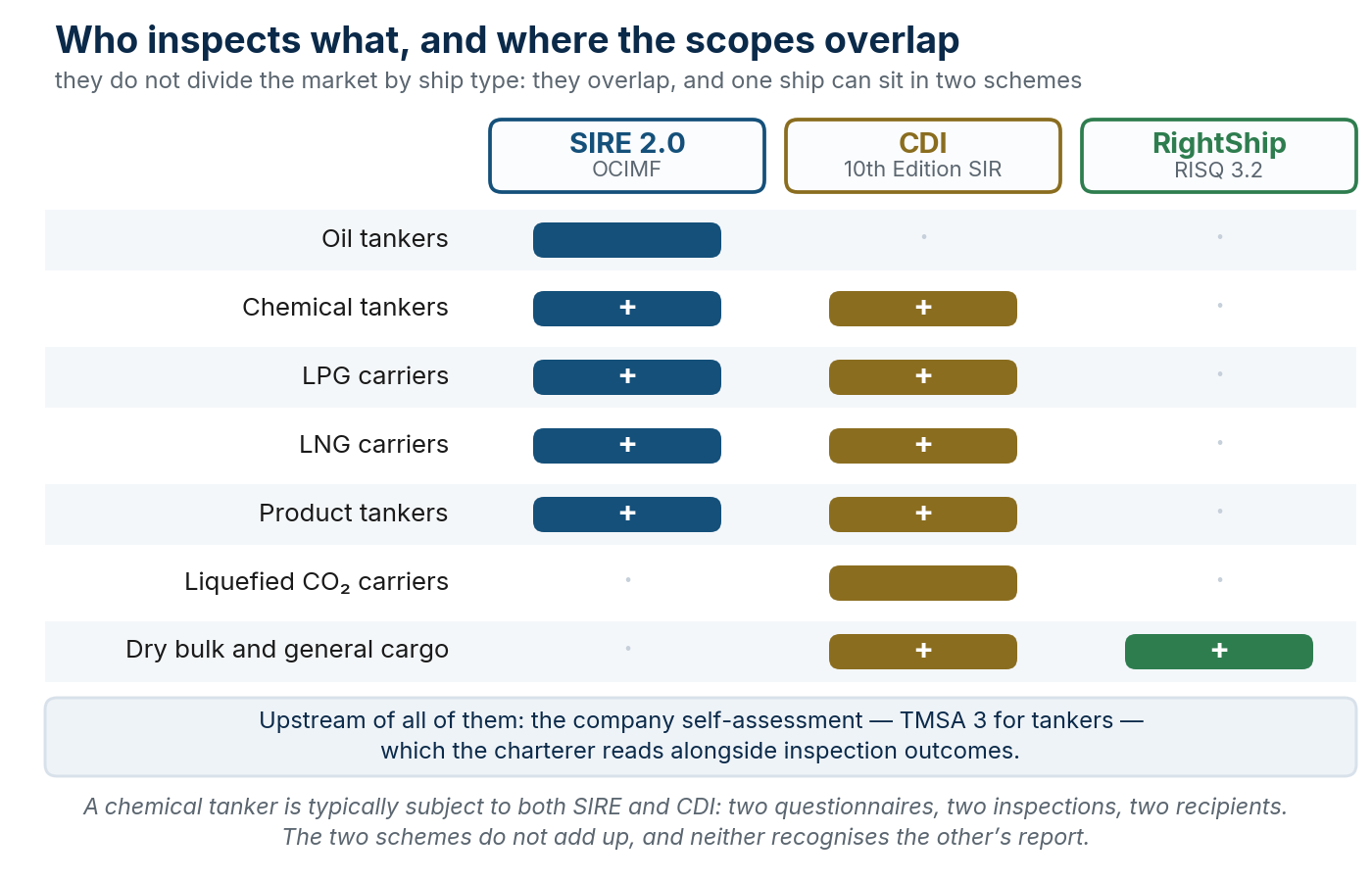
The three major programmes, in summary
| Programme | Segment | Owner |
|---|---|---|
| SIRE 2.0 | Oil tankers, chemical tankers, LPG and LNG carriers. It does not cover barges, which follow a separate route | OCIMF (Oil Companies International Marine Forum) |
| CDI — 10th Edition SIR | Chemical tankers and LPG carriers throughout; since 2024 also LNG, product tankers and dry bulk; since November 2025 liquefied CO2 carriers | Chemical Distribution Institute |
| RightShip — RISQ / Safety Score | Dry bulk and general cargo | RightShip |
The split «SIRE for oil tankers, CDI for chemicals» is convenient but wrong. The SIRE 2.0 Question Library is written for Oil, Chemical, LPG and LNG vessels: a chemical tanker is typically subject to both SIRE and CDI, with two questionnaires, two inspections and two different recipients. Anyone planning the inspection calendar has to allow for it, because the two schemes do not add up and neither recognises the other's report.
An inspection report is an input to vetting, not a universal acceptance certificate. A classification society may also act as a flag’s Recognized Organization: that statutory function remains distinct from class rules. Check any contractual obligations separately.
Key takeaways
- Inspection collects evidence; the recipient decides commercial acceptability.
- Class and delegated statutory certification are separate functions even within the same organisation.
- Programmes may overlap: check vessel, cargo and customer requirements.
SIRE 2.0: structure and principles
Module objectiveExplain CVIQ and response tools without confusing variability with total unpredictability.
On 2 September 2024 OCIMF permanently withdrew the VIQ7 questionnaire and made SIRE 2.0 the programme's only tanker inspection tool. It is not an incremental update of the old SIRE: it is a radical transformation in how tankers are assessed. The change was not sudden — the Question Library was published in January 2022 to give the industry time to prepare, the roll-out began in June 2023, and it opened to all programme users on 22 January 2024.
From a static questionnaire to a dynamic regime
The old VIQ7 offered a fixed questionnaire, with binary yes/no answers, easily «learned by heart» by the crew ahead of inspection. SIRE 2.0 reverses this approach: each inspection generates a Compiled Vessel Inspection Questionnaire (CVIQ) tailored to that ship, and every question is assessed through one or more response tools.
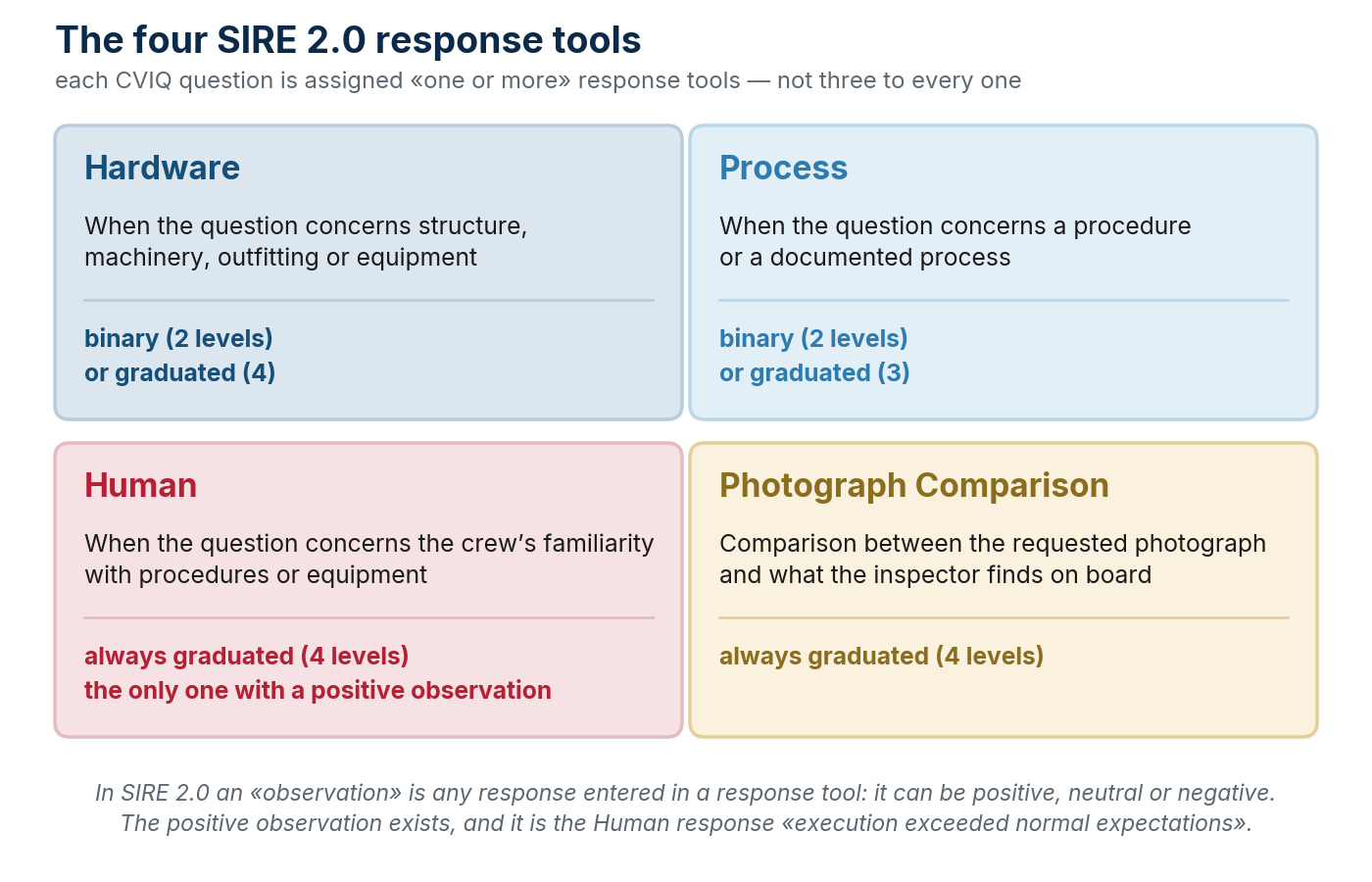
There are four response tools. Hardware, for questions about structure, machinery, outfitting or equipment; Process, for questions about a procedure or documented process; Human, for questions about the crew's familiarity with a procedure or with operating a piece of equipment; and Photograph Comparison, for comparing the requested photograph with what the inspector finds on board. The point most often lost is that not every question uses three: OCIMF states that each question is assigned «one or more» response tools, and a question may carry only one.
Distinctive features
| Element | What it involves |
|---|---|
| Dynamic questionnaire (CVIQ) | Composition specific to ship type, age, history: no more predictable questions |
| Tablet-based inspection | Photographic evidence, GPS and time records, real-time observations in the digital record |
| Differentiated response scales | Each response tool has its own scale, binary or graduated: there is no single «multi-level» scale |
| Response tools per question | Hardware, Process, Human and Photograph Comparison, assigned one or more per question — not three to every question |
| 9 Performance Influencing Factors | They attach to negative Human observations: they explain why execution was not as expected (Module 8) |
| Real competence verification | The crew must demonstrate they can do the task, not just recall an answer |
The inspection life cycle
With VIQ7, effective preparation could rely on a list of expected answers. With SIRE 2.0 this approach no longer works: the CVIQ changes with every inspection, and the inspector observes the real consistency between what the crew says, what procedures prescribe, and what the hardware shows. Effective preparation is now a matter of ongoing competence and documentary consistency, not a pre-inspection cram session.
Key takeaways
- Applicable Core questions recur; Rotational questions vary between inspections.
- Each question has one or more assigned response tools.
- Prepare actual competence and conditions, not agreed answers.
How a SIRE 2.0 inspection is built, and how it closes
Module objectiveReconstruct the SIRE 2.0 inspection cycle from HVPQ/PIQ inputs and CVIQ compilation to operator comments and publication.
The previous module said the CVIQ is tailored to the ship. This one says where the measurements come from, on what scales the inspector answers, and what the operator can do afterwards. These are the three parts of the mechanism a company has real leverage over — and also the three most often skipped, leaving people preparing for an inspection of which they know only the day on board.
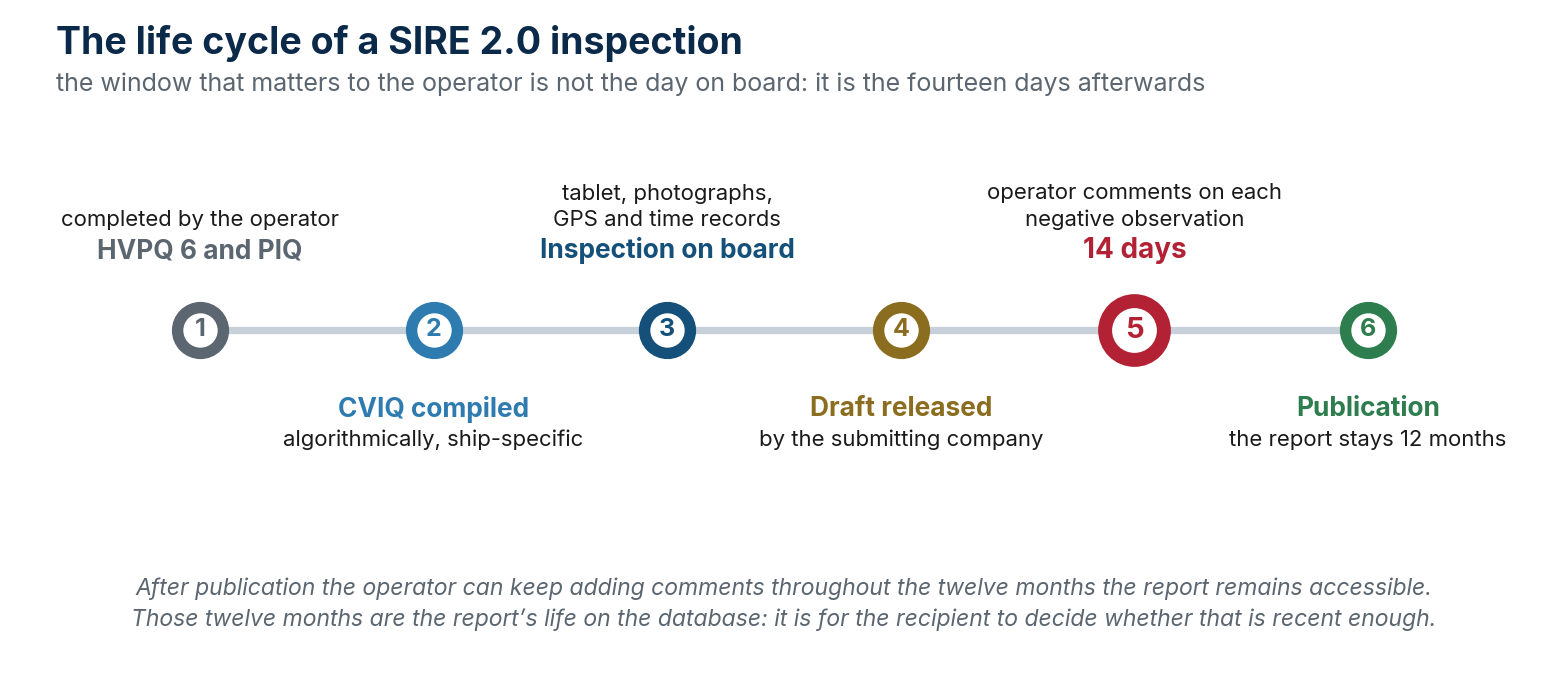
Before: the two questionnaires the operator completes
The CVIQ does not come from nowhere. Before the inspector ever steps aboard, two operator-completed questionnaires have already narrowed the field of possible questions.
| Questionnaire | What it contains | Why it matters |
|---|---|---|
| HVPQ 6 Harmonised Vessel Particulars Questionnaire | Permanent or infrequently changing data: vessel, construction, outfitting, certification | Determines which questions are applicable to that ship |
| PIQ Pre-Inspection Questionnaire | The information the operator supplies ahead of the inspection | Its answers drive the CVIQ's Conditional questions |
An out-of-date HVPQ is the easiest way to be assigned questions that do not concern the ship — or to miss the ones that do. This is not a loophole: it is the opposite. Misdeclared outfitting produces a questionnaire that does not describe the ship, and an inspection that starts crooked. HVPQ and PIQ are worth re-reading with the same care given to preparing the deck, because they are the one piece of the CVIQ the company writes itself.
How the CVIQ is assembled: four question categories
The CVIQ draws on HVPQ/PIQ data to select applicable questions. OCIMF classifies questions by topic risk; it does not use previous vessel or fleet inspection performance in the compiler.
| Category | How it is assigned |
|---|---|
| Core | To every inspection where applicable. These are the questions meeting OCIMF's risk criteria |
| Rotational | To individual vessels on an occasional and unpredictable basis: the allocation changes from one inspection to the next |
| Campaign | Rotational questions made mandatory for every inspection, for a defined period, in response to an incident or an industry trend |
| Conditional | Selected on vessel type, outfitting or recent operational history — including the PIQ answers |
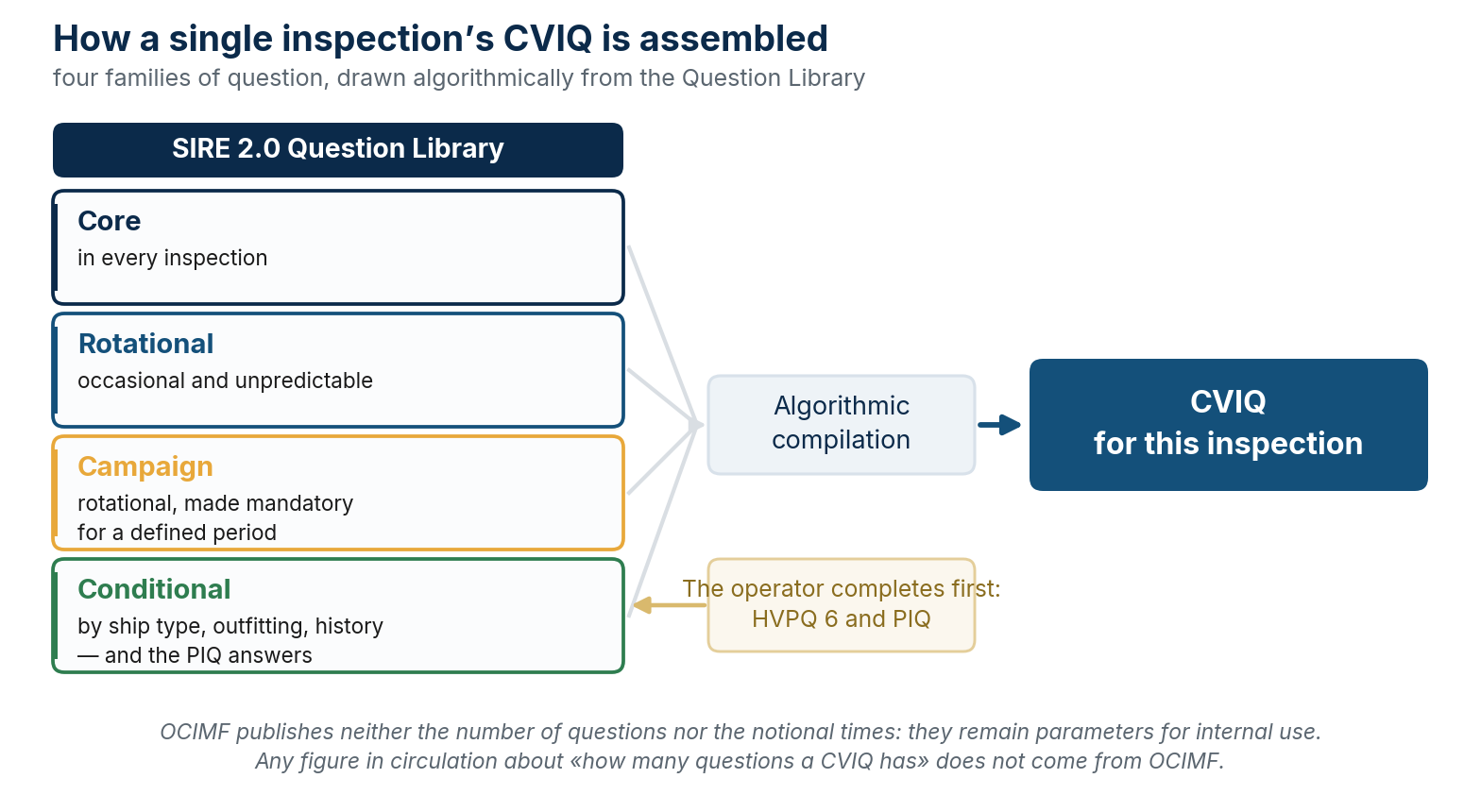
OCIMF does not publish the number of questions assigned to an individual CVIQ or the allocation of time by inspection area. It does, however, state that the questionnaire is compiled to require approximately eight hours of onboard inspection activity: this is a planning estimate, not a guaranteed duration, and the actual content depends on the vessel and the CVIQ generated. What is public is the Question Library, issued in two parts across twelve chapters: you can study the subject, not the questionnaire.
The response scales: one per response tool
There is no such thing as «the SIRE 2.0 scale». Each response tool has its own, and depending on the question it may be binary or graduated.
| Response tool | Type | What the inspector can record |
|---|---|---|
| Hardware | binary — 2 levels | Free from obvious deterioration or deficiency · observable or detectable deficiency, requiring a negative observation |
| graduated — 4 levels | The two above, plus two degrees of slight superficial deterioration: one with no comment needed, one with a mandatory comment or photograph | |
| Process | binary — 2 levels | As expected, procedure or document present · not as expected, procedure or document deficient |
| graduated — 3 levels | The two above, plus «largely as expected», with a mandatory comment | |
| Human | always graduated — 4 levels | Execution exceeded normal expectations · was as expected · was largely as expected · was not as expected |
| Photograph Comparison | always graduated — 4 levels | From a representative photograph to one that is not representative, which requires a negative observation |
In SIRE 2.0 an observation is any response entered in a response tool, and it can be positive, neutral or negative. The positive observation genuinely exists: it is the Human response «execution exceeded normal expectations», and it appears in green in the report. Carrying on using «observation» as a synonym for a negative finding — a habit inherited from VIQ7 — leads to misreading your own report and missing what went well, which is exactly the material with which you show a charterer that the system works.
After: the fourteen days
The report does not go to publication carrying only the inspector's voice. From the day the draft is released by the company that commissioned the inspection, the operator has fourteen days to enter their operator comments against each negative observation. They can keep adding comments after publication too, throughout the twelve months the report remains accessible.
Let them lapse and you hand the charterer a report in which the only version of events is the inspector's. Used well, they are usually not spent disputing the observation: they are spent describing what has been done, with what evidence and to what deadline. It is the same work as the module on managing observations, but with a precise window — and the window opens the day the draft is released, not the day the office notices it has arrived.
OCIMF states that the compiler does not use previous inspection performance of the vessel or fleet to build the CVIQ. HVPQ and PIQ instead inform selection of applicable questions. OCIMF risk assessment classifies questions; it is not an individual vessel ranking. Core means recurring where applicable; Conditional concerns selection linked to declared characteristics and activities and need not be a category disjoint from the others. Operators may raise evidenced factual disagreements through the prescribed channels as well as explain correction, cause and prevention.
Key takeaways
- HVPQ and PIQ must accurately describe the vessel and its operating situation because they drive question selection.
- The exact question count is not public; OCIMF's approximately eight hours is an estimate, not a guarantee.
- The operator has fourteen days for initial comments and may add further comments while the report remains active.
TMSA 3: management system maturity
Module objectiveUse TMSA as an evidenced self-assessment by element and KPI.
The Tanker Management and Self Assessment (TMSA) is the tool with which the company — not the individual ship — evaluates the maturity of its management system against key performance indicators and four ascending stages. It has existed since 2004; the third edition was published in 2017 and, from 1 January 2018, became the only edition available for new self-assessments in the TMSA system. TMSA 3 remains the current edition: no fourth edition has been published.
2017 is also the year in which — from 1 February — the self-assessment tool was moved inside the SIRE application, under a single login. The detail is worth keeping straight: TMSA did not «enter SIRE» in 2017 as content — charterers had been reading it alongside inspections long before — but as software.
The 13 elements of TMSA 3
TMSA3 updated the previous structure, adding a dedicated element for maritime security and revising environmental and energy management to incorporate efficiency and emissions topics:
| § | Element — official OCIMF title |
|---|---|
| 1 | Leadership and the Safety Management System |
| 2 | Recruitment and Management of Shore-Based Personnel |
| 3 | Recruitment, Management and Wellbeing of Vessel Personnel |
| 4 | Vessel Reliability and Maintenance including Critical Equipment |
| 5 | Navigational Safety |
| 6 / 6A | Cargo, Ballast, Tank Cleaning, Bunkering, Mooring and Anchoring Operations |
| 7 | Management of Change |
| 8 | Incident Reporting, Investigation and Analysis |
| 9 | Safety Management |
| 10 | Environmental and Energy Management |
| 11 | Emergency Preparedness and Contingency Planning |
| 12 | Measurement, Analysis and Improvement |
| 13 | Maritime Security |
Self-assessment must align with records, interviews and evidence ashore and aboard. Verify applicable KPIs and declared stages; optimistic presentation does not replace demonstrated results.
The four maturity levels
| Level | What it represents |
|---|---|
| 1 | The minimum standard expected: basic requirements are met |
| 2 | First level of best practice beyond the minimum |
| 3 | Second level of best practice |
| 4 | Third and highest level of best practice |
Self-assessment must align with records, interviews and evidence ashore and aboard. Verify applicable KPIs and declared stages; optimistic presentation does not replace demonstrated results.
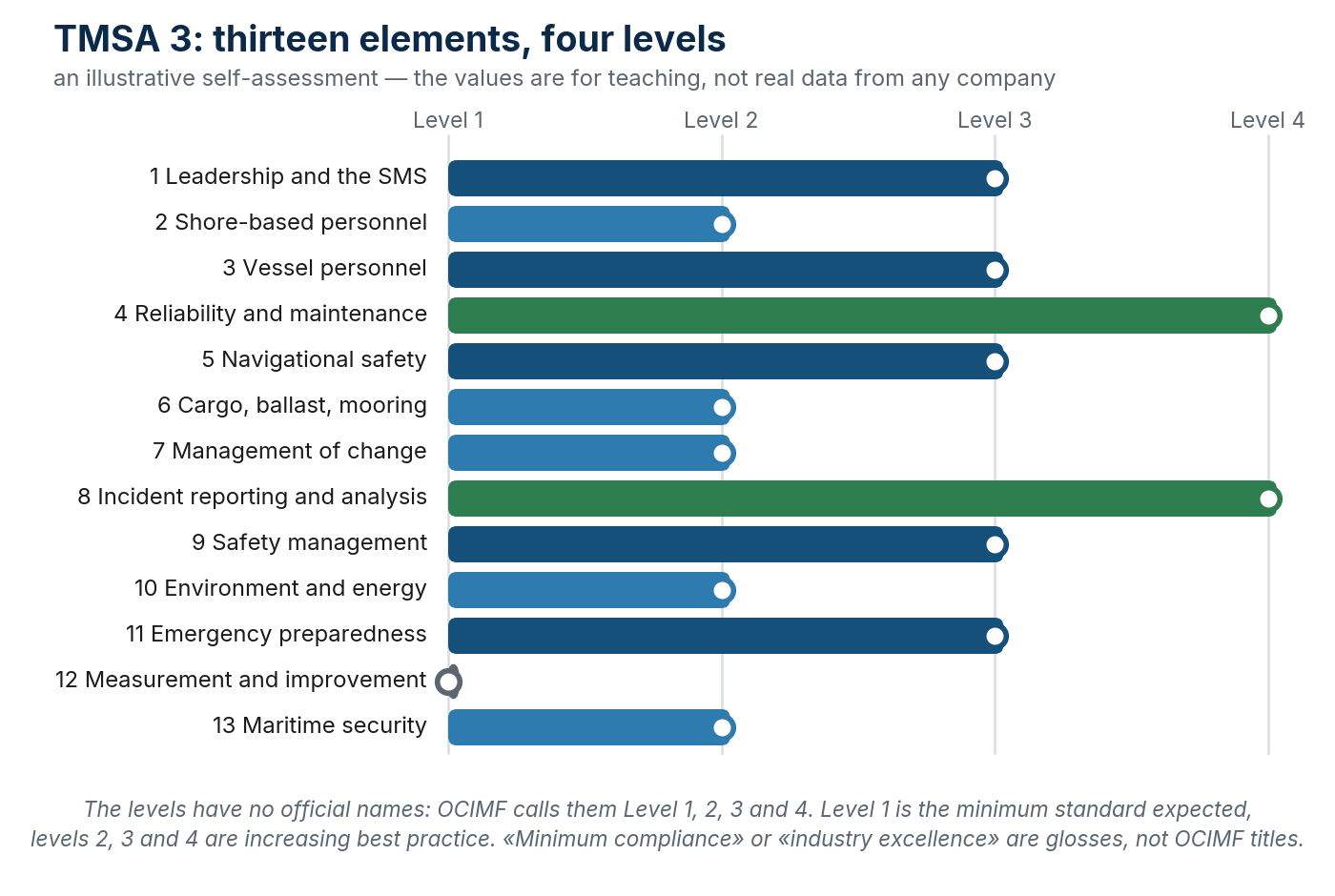
Self-assessment must align with records, interviews and evidence ashore and aboard. Verify applicable KPIs and declared stages; optimistic presentation does not replace demonstrated results.
Key takeaways
- TMSA 3 has thirteen elements and four stages.
- Declared stages need evidence for the applicable KPIs.
- There is no OCIMF certification of an overall company level.
CDI: vetting for the chemical sector
Module objectiveDistinguish the structure, scope and interpretation of the CDI 10th Edition SIR, selecting the correct Chapter 5 variant without turning the report into a score.
The Chemical Distribution Institute (CDI) is the chemical industry's non-profit organisation dedicated to the safety and quality of the maritime transport of chemical products. It operates a vetting system parallel to SIRE, historically focused on chemical tankers, LPG carriers and parcel tankers.
The 10th Edition SIR and the expanded scope
The tenth edition of the Ship Inspection Report (10th Edition SIR) has been operational since 5 February 2024 and widened the scope beyond chemical tankers and LPG carriers — which CDI already covered — adding LNG carriers, product tankers and dry bulk. Every chapter of the questionnaire is generic except Chapter 5, on cargo systems, which exists in ship-type-specific versions. With the programme for liquefied CO2 carriers, announced on 31 October 2025 and operational from 12 November 2025, those versions now number six.
| Chapter 5 version | Ship type |
|---|---|
| Chemical | Chemical tankers |
| LPG | LPG gas carriers |
| LNG | LNG carriers |
| LCO2 | Liquefied carbon dioxide carriers — since 12 November 2025 |
| Product Tanker | Product tankers |
| Dry Bulk Carrier | Bulk carriers |
How CDI reports the result — and why it is not a score
Unlike the response-tool model of SIRE 2.0, CDI keeps a structured questionnaire in which every question carries a category. There are four categories, not three: alongside the three that count towards the assessment sit the Non-scoring questions, collected for information only.
| Category | Basis | Correct interpretation |
|---|---|---|
| Statutory (S) | Applicable statutory requirements | Identifies questions anchored in regulatory obligations |
| Recommended (R) | Industry codes and practice | Identifies industry-recommended expectations |
| Desirable (D) | Expectations defined by CDI participants | Identifies desirable practices within the CDI system |
| Non-scoring (NS) | Information | Does not contribute to the assessment representation |
This is the commonest misconception about the scheme, and it needs clearing away. The CDI inspection procedures state it plainly: «The Inspection does not result in a pass or fail. The SIR is for consideration by a potential Charterer only»; and elsewhere, that the SIR «does not attempt to pass or fail the ship» but gives an assessment of compliance at the time of inspection against internationally accepted standards. The inspector is expressly forbidden from indicating what the outcome will be. There is therefore no «92% against 85%» comparable between ships: the database produces a summary with a performance diagram and a list of observations, and each charterer sets its own acceptance threshold.
CDI and decarbonisation: two different things
Since the tenth edition launched, the CDI-Marine database has offered an environmental benchmarking facility covering EEXI, EEDI and CII, letting operators and charterers compare a vessel anonymously against real fleet data. It is an analysis tool, not an inspection check. The July 2024 amendments (version 10.5) added something different: an actual question, 1.1.37, requiring vessels of 5000 GT and above to hold the Statement of Compliance for fuel consumption data verification (IMO DCS).
Treating CDI as a simple equivalent of SIRE for the chemical segment leads to preparation mistakes. The category classification requires prioritised oversight: first secure the Statutory items, the ones anchored to international regulation, then work on Recommended and Desirable. Not to «raise a score» — there isn't one — but because those categories help the recipient of the report distinguish the basis and the priority of the questions.
CDI is not only about ships
CDI-Marine is one of four schemes, and anyone working in chemicals sooner or later meets the other three as well.
| Scheme | What it covers |
|---|---|
| CDI-Marine | Ship inspections and the SIR report |
| CDI-Terminals | Inspections of bulk liquid storage terminals, running since 1997 — here too with no pass or fail outcome |
| CDI-IMPCAS | International Marine Packed Cargo Audit Scheme: audits of the packed chemical supply chain — tank container operators, container transport services, ship agents, freight forwarders, container terminals |
| CDI-Bulk | Assessment of dry bulk carriers |
Distinguish result presentation, any database indicators and acceptance decisions: the absence of a universal pass/fail does not mean the system cannot show quantitative summaries. Read the SIR with categories, observations and operator comments; do not turn an isolated percentage into a universal commercial threshold.
Key takeaways
- The 10th Edition SIR uses a common core and six Chapter 5 variants, including LCO₂ from November 2025.
- Statutory, Recommended, Desirable and Non-scoring describe the basis of questions; they do not produce a universal pass/fail result.
- Commercial acceptability remains the report recipient's decision.
RightShip: dry bulk vetting
Module objectiveInterpret the Safety Score, RISQ inspection and GHG Rating correctly, distinguishing indicators, vetting rules and customer criteria.
In the dry bulk and general cargo segment, the dominant reference is RightShip, with its own RISQ inspection programme and two summary indicators that guide chartering decisions: the Safety Score and the GHG Rating.
Safety Score: from risk prediction to commercial filter
The Safety Score is a score from 0 to 5 that replaced the earlier Risk Rating — the predictive star rating housed on the Qi platform — and went live alongside the new RightShip Platform on 8 February 2021. It is not a single model: values 0, 1 and 2 are assigned by binary rules — 0 identifies a sanctioned vessel, ineligible for vetting — while 3, 4 and 5 come out of a statistical model built on more than twenty safety considerations and five years of vessel, DOC, class and flag data. It is visible to all RightShip members and is the first filter in chartering due diligence.
Many charterers treat 3 as a commercial floor, and it is useful to know that. It is just as useful to know the other half: RightShip has never endorsed that use. NorthStandard puts it without hedging — «RightShip has never supported the use of either its previous Star Rating or the new Safety Score as a charterparty requirement». On RightShip's own scale, 1 and 2 flag vessels requiring improvement and 3, 4 and 5 vessels meeting or working towards industry standards; 3 is described as average. Writing a numerical threshold into a charter party is a choice by the parties, not the application of a standard.
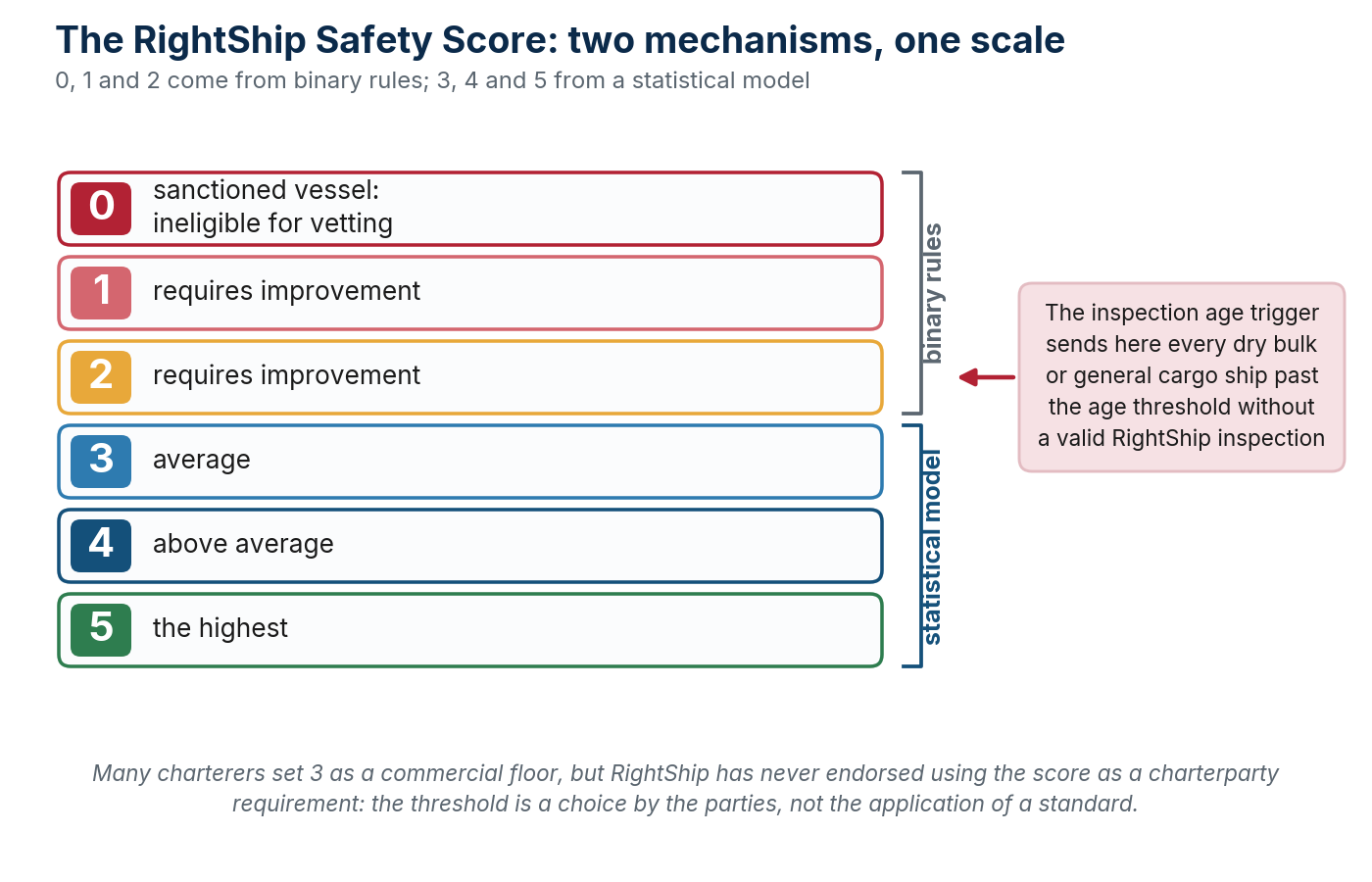
A rule that is changing the market: the inspection age trigger
The mechanism is simple and blunt: a dry bulk or general cargo ship that, past a given age, has no valid RightShip inspection sees its Safety Score set to 2 out of 5 and cannot pass a RightShip vetting nomination. The original calendar — announced in October 2024 — set 12 years from March 2025 and 10 years from March 2026. After industry feedback led by INTERCARGO, RightShip published a revised four-phase timeline on 11 December 2024.
| Phase | Vessel age | Safety Score downgrade |
|---|---|---|
| 1 | 13 years | between 1 July and 1 October 2025 |
| 2 | 12 years | 1 April 2026 |
| 3 | 11 years | 1 July 2026 — already in force |
| 4 | 10.5 years | 20 January 2027 |
The final threshold was raised by six months against the original plan for a practical reason: a ten-year requirement would have landed on top of the second Special Survey drydocking, overlapping an already-scheduled stoppage. The downgrade operates through the SS2-5 hybrid rule. Note that each phase actually has two moments: the requirement to pass a vetting nomination bites when the window opens, the score downgrade on the date shown above.
It is not a legal requirement but a de facto market requirement: major dry commodity trading houses make their nominations conditional on an adequate Safety Score. Missing the required inspection can prevent a RightShip recommendation; the nomination outcome depends on the applicable process.
GHG Rating: the other side of the coin
Alongside the Safety Score, RightShip assigns each ship a GHG Rating on a scale from A (most efficient) to E (least efficient). The old seven-point A–G scale was dropped on 6 December 2023, precisely to align with the five points of the IMO's CII scale. The comparison is relative: the vessel is measured in grams of CO2 per tonne-nautical-mile against ships of the same type within ±10% of its deadweight. And it is a rating of design, not of operation: it is built on EEDI, EVDI and EEXI with a speed-corrected methodology, so that an engine power limitation does not distort the comparison. The rating feeds into charterers' sustainability policies and, increasingly, into chartering contract clauses.
| RightShip tool | What it measures | Typical commercial use |
|---|---|---|
| Safety Score (0–5) | Operational safety risk | Eligibility filter; many charterers set 3 as a floor |
| GHG Rating (A–E) | Design efficiency against the peer group | ESG policies and charterer preference |
| RISQ inspection | Detailed physical inspection, now to RISQ 3.2, in force since 25 February 2026 | Data basis for the Safety Score and the age trigger |
What there is beyond the score
Reducing RightShip to the Safety Score and the GHG Rating leaves out half the platform a charterer actually works with.
| Tool | What it adds |
|---|---|
| CII insights since 5 June 2024 | The vessel's annual CII and an estimated-CII graph. Note carefully, though: RightShip states that there is no relationship between a vessel's CII and its GHG Rating, and that CII ratings do not feed into its vetting rules or Baseline Criteria, because CII in its current structure is unsuitable for vessel selection |
| Crew Welfare Self-Assessment | A crew wellbeing self-assessment developed with Human Rights at Sea: the dry bulk «human factor» strand, distinct from the Safety Score |
| Maritime Emissions Portal | The emissions tool aimed at ports and terminals |
| RightShip Platform | The single system since February 2021, when Qi and SVIS went read-only: this is where scores, ratings, triggered rules and vetting requests live |
This is the distinction to hold firm, because the two get confused constantly in meetings. CII measures how the ship actually traded over a year; the GHG Rating measures design potential, that is how efficient the ship is by construction. A vessel with a good GHG Rating can have a mediocre CII if it made many port calls and much manoeuvring — and the other way round. RightShip keeps them deliberately separate, and does not use CII to select vessels.
Timetable checked at 15 September 2026: the RightShip source also includes the 26 May 2026 revision to phase 4; it is not solely the December 2024 timetable. Age is calculated from delivery. Check the applicable rule and required inspection on the platform; a RightShip programme condition is not a universal legal prohibition on employing the vessel.
Key takeaways
- Safety Scores 0–2 arise from rules and 3–5 from the model, but the score does not replace the full vetting process.
- Vessel age and inspection validity may trigger specific rules under the current RightShip timetable.
- The GHG Rating is design-based and remains distinct from operational CII.
How long an inspection is worth, and who may carry it out
Module objectiveSeparate report availability, inspection validity and customer acceptance.
The three schemes seen so far apply different criteria, but they share two questions that come up in the office every week: how long is this report still useful, and who is entitled to come aboard. These are commercial questions before they are technical ones — mistiming an inspection's expiry costs more than any observation.
Validity is not a single number
«Twelve months» is the convenient answer, and it is wrong in two cases out of three.
| Scheme | Validity | How it is determined |
|---|---|---|
| SIRE 2.0 | 12 months | The report stays accessible on the database for twelve months from receipt. OCIMF notes, however, that it is for the recipient purchasing the report to decide whether it meets their requirements: it is not a guaranteed acceptance period, and each charterer may set tighter recency criteria |
| CDI | 12 months or 3 | Twelve months if the ship was loading or discharging the relevant cargo at the time of inspection; three months if inspected while not working cargo. Early archiving if technical management changes within the period |
| RightShip | 3 to 12 months | Set by a matrix combining the severity of findings (high, medium, low), their number, and the quality of the close-out submitted (good, average, poor) |
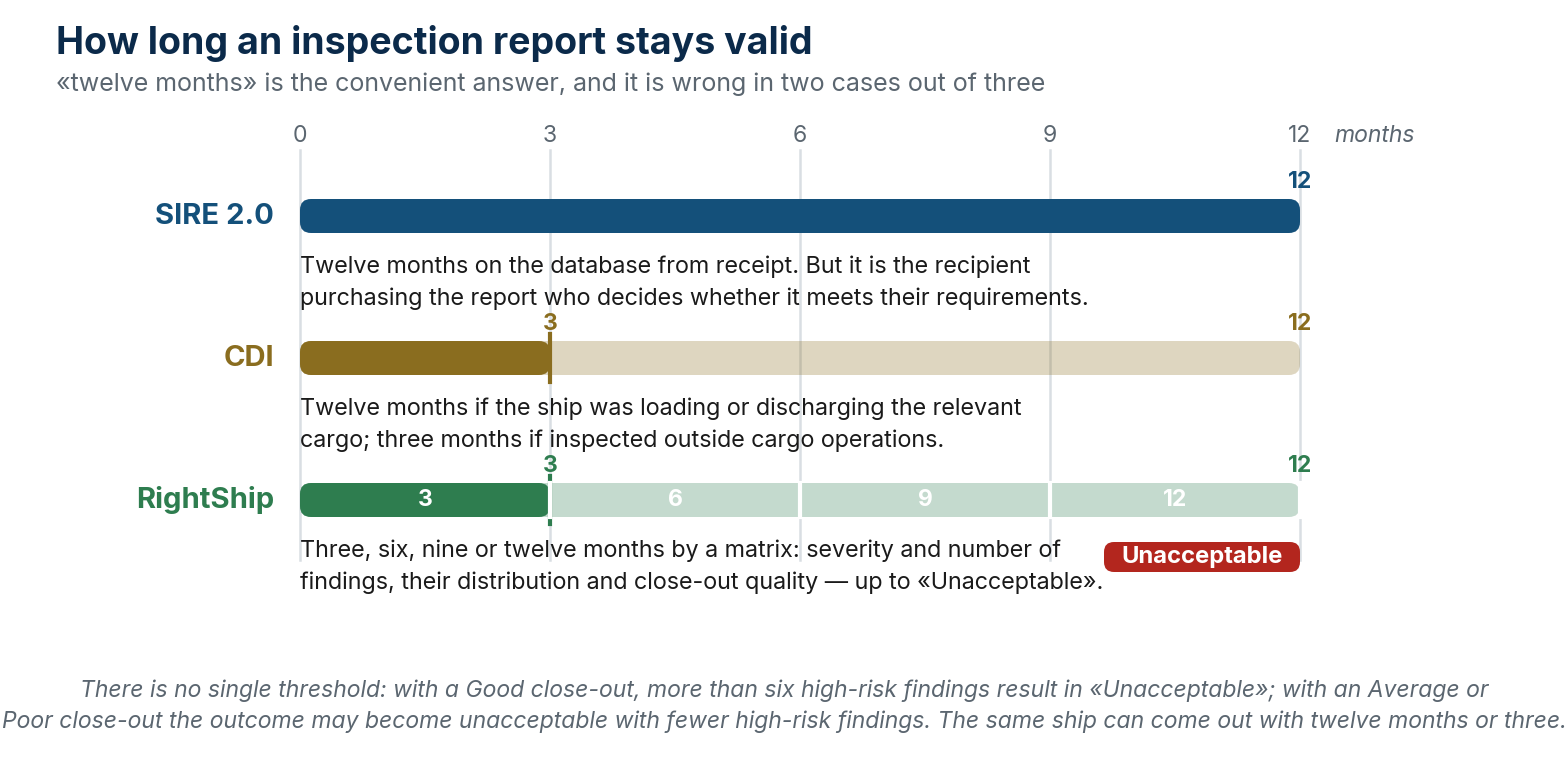
This is the mechanism that most surprises people coming from the tanker world. A full twelve-month validity is possible only when the number and severity of findings and the quality of the close-out fall within the relevant matrix band. There is no single threshold that applies to every case: with a Good close-out, more than six high-risk findings result in an «Unacceptable» outcome; with an Average or Poor close-out, the outcome may become unacceptable with fewer high-risk findings. Clusters of low- or medium-risk findings in the Navigation and Machinery Space sections may also indicate a systemic weakness. From 17 June 2026, show-stopper findings no longer produce an automatic effect on the Safety Score or inspection outcome: each finding is classified as Low, Medium or High and assessed through the current matrix. In practical terms: the same ship, with the same number of findings, can come out with twelve months or with three depending on how the company documented its close-outs.
Who may carry out the inspection
Neither of the two main schemes leaves the choice of inspector to chance, and knowing the requirements is part of controlling access to the ship.
For SIRE, Category 1 accreditation — ocean-going tankers — requires nomination by an OCIMF member that is also a submitting company, a valid officer-level STCW certificate, 60 months of sea service on vessels over 3,000 gt of which 18 months in a senior rank (master, chief officer, chief engineer, first or second engineer) on tankers, advanced dangerous-cargo training, a valid ISO/ISM auditor certification, and two accompanied inspections before the course and two after. An alternative route exists for candidates with less than 60 months' sea service who work in the marine assurance function of the nominating company. Category 3 covers barges. Renewal runs through a performance review plus refresher training, and the inspector must carry a valid SIRE accreditation card.
For CDI, inspections may only be performed by accredited inspectors appointed by the Marine Inspection Department. One further rule is worth knowing: an inspector may not carry out consecutive inspections on the same ship where technical management has not changed. Report access follows CDI programme agreements and authorisations.
A simple operational consequence follows from these rules. The useful window for renewing an inspection is not «within twelve months»: it is the point at which the ship is in a suitable port, working cargo where the scheme requires it, and with time to close out the previous observations properly. Planning it months ahead costs a few phone calls; discovering it against a fixture in negotiation costs the charter.
CDI reports may be accessed by authorised participants under programme agreements; access is not limited to a charterer that supposedly commissioned the inspection. CDI’s notice on supporting documents identifies the operator and chemical-company participants that purchased the report. Check permissions and confidentiality before distributing reports or attachments outside the system.
Key takeaways
- Twelve months in a database do not guarantee twelve months of commercial acceptance.
- Apply each programme’s current conditions and rules.
- Verify the inspector’s appointment, accreditation, identity and conflicts.
Human factors: the 9 Performance Influencing Factors
Module objectiveUse Performance Influencing Factors as causal context for Human observations and translate them into action on procedures, organisation, ergonomics and training.
One of the most significant innovations of SIRE 2.0 is the systematic introduction of Performance Influencing Factors (PIFs): nine human and organisational factors that explain why the execution of a task was not as expected. They need handling with precision, because this is the point on which the most inaccurate material circulates: PIFs are not nine competencies to display, and they do not apply to every question. They attach to negative Human observations, and the inspector selects one to account for the observation.
The official wording is the one OCIMF published in the SIRE 2.0 Programme – Introduction and Guidance, version 1.0 of January 2022. They are not one-word labels: they are descriptions.
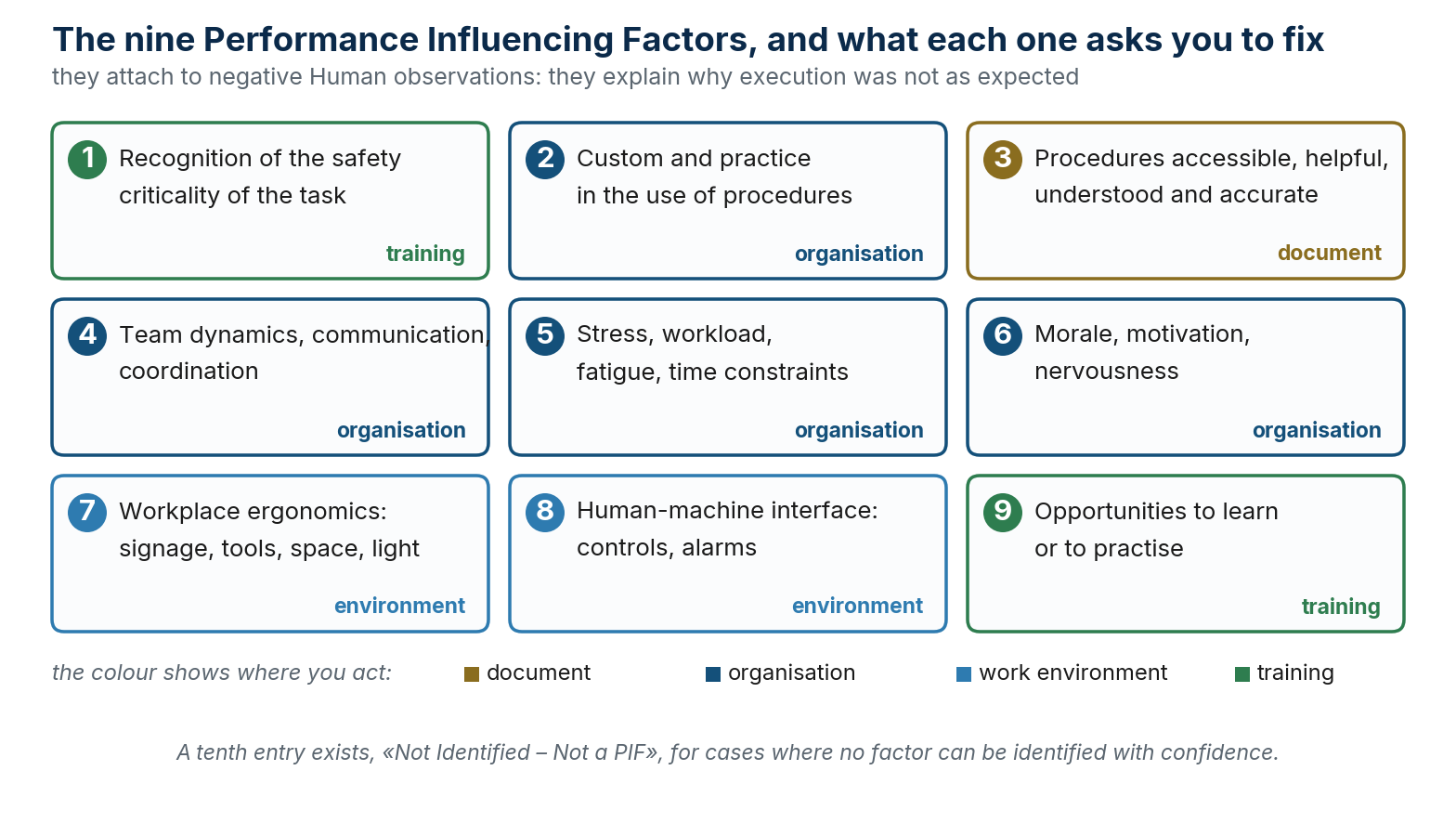
| # | Performance Influencing Factor — official wording |
|---|---|
| 1 | Recognition of safety criticality of the task or associated steps |
| 2 | Custom and practice surrounding use of procedures |
| 3 | Procedures accessible, helpful, understood and accurate for task |
| 4 | Team dynamics, communications and coordination with others |
| 5 | Evidence of stress, workload, fatigue, time constraints |
| 6 | Factors such as morale, motivation, nervousness |
| 7 | Workplace ergonomics including signage, tools, layout, space, noise, light, heat, etc. |
| 8 | Human-Machine Interface (e.g. controls, alarms) |
| 9 | Opportunities to learn or practise |
| — | Not Identified – Not a PIF: the option provided where no factor can be identified with confidence |
How it actually works
When the execution of a task is not as expected, the inspector records a negative Human observation and attaches the factor that, in their judgement, accounts for it. The whole value to the company sits here. The same observation — «the officer did not carry out the required check» — means something entirely different depending on whether it is attributed to factor 3 (the procedure was not accessible, or was inaccurate), to factor 5 (fatigue and time constraints) or to factor 9 (they had never had the chance to practise). The first calls for a document to be fixed, the second for work organisation, the third for a training plan. Reading a fleet's PIFs is how you tell which of the three.
They are not questions to answer: they are the explanation the inspector gives for what they saw go wrong. You cannot «prepare for the PIFs» the day before, because there is nothing to rehearse — you can only remove, well in advance, the reasons they would be cited: procedures that can be found and understood, rosters that hold, readable controls and alarms, real opportunities to practise. It is months of work, and it shows.
A PIF is an observed influence on performance, not an already proven root cause. The company checks context with the people doing the work and considers multiple causes before selecting actions. Factor-to-action links in the diagram are teaching examples, not OCIMF prescriptions or automatic rules.
Key takeaways
- PIFs are not competencies to recite and are not applied indiscriminately to every response.
- The nine official formulations, plus «Not Identified», describe the context influencing performance.
- The same observation requires different action depending on its associated PIF.
Ship preparation: hardware and procedures
Module objectiveOrganise a pre-vetting review that checks physical condition, documentation and consistency between stated procedures and observable practice.
Physical ship preparation remains a pillar of inspection success, but it must be organised as a continuous management process, not a last-minute intervention. A good pre-vetting programme clearly distinguishes what to check on hardware from what to check on procedures.
Highest-impact hardware areas
| Area | Typical points of attention |
|---|---|
| Steering and anchoring gear | Regular testing, up-to-date maintenance records, critical spares available |
| Fire-fighting and life-saving equipment | Certification deadlines, real operational readiness, not just physical presence |
| Cargo and ballast systems | Integrity of piping and valves, measurement systems, inerting systems |
| Engine room and machinery | Cleanliness, absence of leaks, functioning instrumentation, consistent logs |
| Personal safety and PPE | Availability, condition, observable actual use |
Documentary and procedural consistency
SIRE 2.0 mainly penalises inconsistencies between documents, stated practice and observed behaviour. Effective procedural preparation checks three levels together: that the procedure exists and is up to date; that the crew knows it; that it is actually followed in daily practice, not only when an inspector arrives.
Internal pre-vetting only has value if it is honest: it should look for discrepancies, not confirm that «everything is fine». A good vetting officer uses pre-vetting to build an action plan with owners and deadlines, exactly as they would with observations from a real inspection, and verifies its closure before the actual inspection.
For open defects distinguish immediate risk, interim measures, required reporting and repair plans. Do not conceal a known defect or fabricate retrospective records. A readiness review replaces neither prescribed tests nor the inspector’s assessment.
Key takeaways
- Equipment presence is not enough: it must work, be maintained and match records and certificates.
- Procedures, crew knowledge and actual work must tell the same story.
- A useful internal audit seeks discrepancies and manages their closure before inspection.
Crew preparation: real competence
Module objectivePrepare safe operational demonstrations and verifiable familiarisation.
With SIRE 2.0, crew preparation changes radically in nature. The old approach — memorising expected VIQ7 answers — not only no longer works, but can be counterproductive: a crew that answers a dynamic CVIQ «by rote» reveals exactly the lack of real competence the inspector is trying to verify.
From rote training to demonstrated competence
| Aspect | Outdated approach (VIQ7) | Required approach (SIRE 2.0) |
|---|---|---|
| Pre-inspection training | List of expected questions and answers | Practical drills on real tasks |
| Knowledge of procedures | Being able to recite them from memory | Being able to apply them under varying conditions |
| Communication with the inspector | Agreed, uniform answers | Natural dialogue, consistent with daily practice |
| Training focus | Questionnaire content | Behaviour, awareness, teamwork |
An effective preparation programme
- In-depth familiarisation of every new crew member with critical procedures, not just a sign-off acknowledging they have read them.
- Periodic practical drills on high-risk operations (mooring, bunkering, cargo operations), with honest debriefs.
- Inspection simulations conducted by a superior or a peer, with unexpected, non-agreed questions.
- Reporting culture: near-misses and doubts expressed without fear of repercussions, which is what a «safety culture» PIF really observes.
- Structured post-inspection debrief, to bring lessons learned to the whole fleet, not just the individual ship.
A common mistake is to focus preparation on documentation, leaving the crew exposed on the behavioural side. In SIRE 2.0, human interaction with the inspector — the naturalness of answers, the ability to show (not just describe) how a task is performed — matters as much as paperwork. Investing in behavioural training is not an optional cost: it is now central to vetting preparation.
The nine-PIF list has no item named “safety culture”. Reporting culture matters, but the associated factor depends on what was observed. Agree safe conditions and permitted methods for demonstrations involving critical equipment; the master retains operational responsibility.
Key takeaways
- Training verifies understanding and application of procedures.
- A demonstration must not compromise safety, rest or operations.
- PIFs describe context: they are neither a personal score nor a complete diagnosis.
Observation management and rejection risk
Module objectiveManage an observation from cause to effectiveness review while assessing severity, recurrence, distribution and the recipient's commercial criteria.
Every inspection generates observations. How the company manages them — not their mere existence — determines whether an inspection with observations remains a managed event or becomes a commercial problem.
From finding to commercial risk
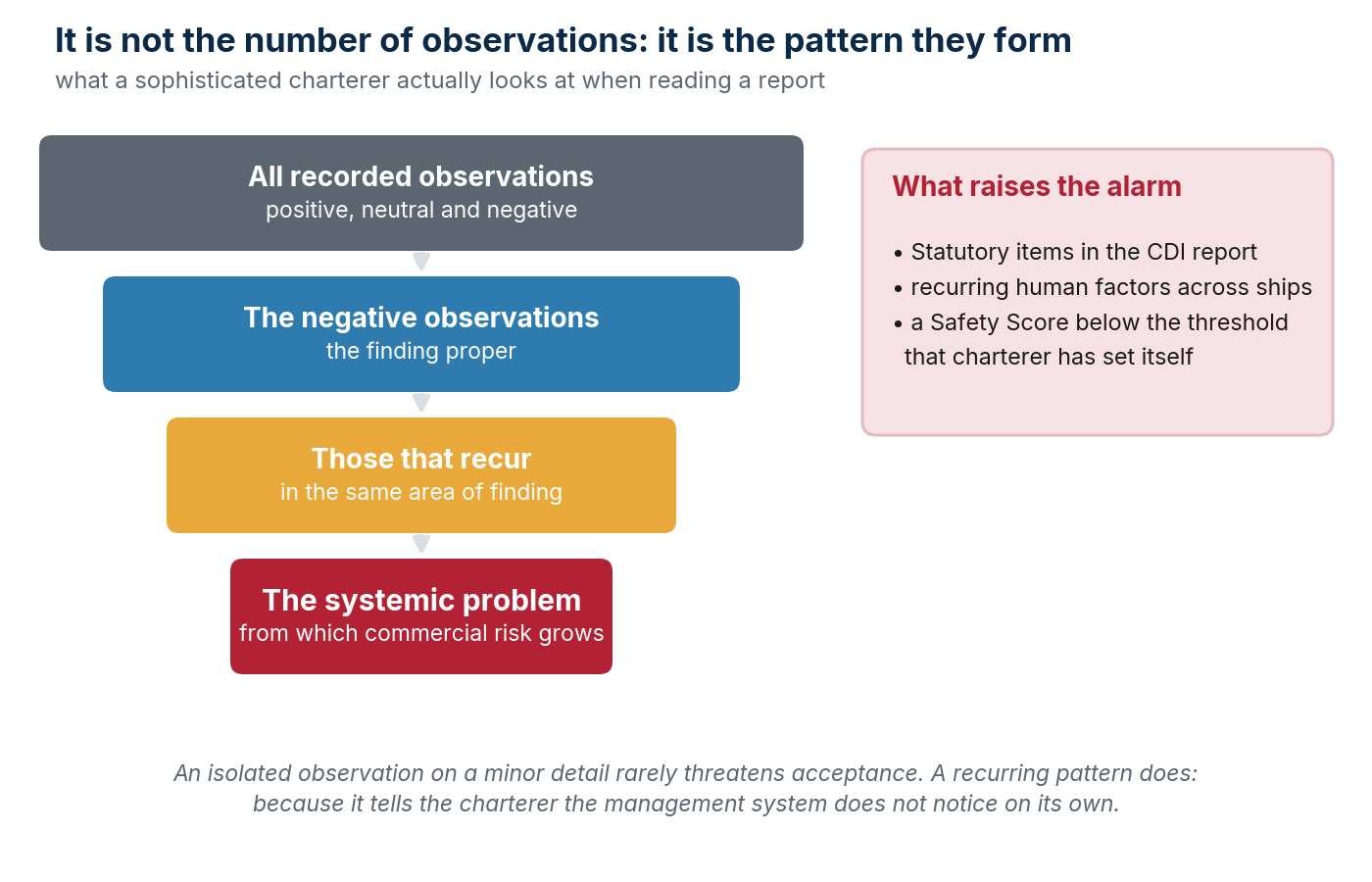
Not all observations carry the same weight. An isolated observation on a minor detail rarely compromises ship acceptance; a pattern of repeated observations in the same area (for example maintenance or crew competence) instead signals a systemic problem, and that is what really alarms a sophisticated charterer.
The closure process
- Immediate analysis of the observation: cause, not just symptom (the same root-cause logic used in incident investigation applies).
- Corrective action with an owner, a deadline and evidence of completion (photo, certificate, updated record).
- Effectiveness verification: has the action really removed the cause, or does the observation risk recurring at the next inspection?
- Communication to the charterer/client, when required, with evidence of closure and not just a statement of intent.
- Sharing the lesson learned with the rest of the fleet, to prevent the same observation on other ships.
When the ship risks commercial rejection
Rejection risk grows when observations touch Statutory/critical areas (CDI), when they involve recurring human factors, or when the RightShip Safety Score falls below the threshold that particular charterer has set itself. In these cases, reaction time matters as much as the quality of the response.
The temptation to minimise an observation or delay reporting it almost always causes greater damage when the problem resurfaces. More experienced charterers view favourably companies that proactively disclose a problem with a credible rectification plan, compared with those that wait to be found out.
Even one finding can be decisive depending on severity and recipient criteria. Separate immediate correction, causal analysis, corrective action and effectiveness verification. A published comment does not erase the original observation and a repair does not guarantee commercial acceptance.
Key takeaways
- The pattern and nature of observations matter more than an isolated count.
- A credible close-out includes cause, action, owner, deadline, evidence and effectiveness review.
- Rejection risk depends on the scheme and charterer criteria; no universal threshold exists.
Vetting KPIs and continuous improvement
Module objectiveBuild a dashboard combining quantitative and qualitative indicators without reducing SIRE, TMSA or RightShip to one number.
A good company-level vetting system does not simply react inspection by inspection: it builds a dashboard of indicators that makes it possible to see trends, anticipate problems and demonstrate credible continuous improvement to clients.
The essential KPI dashboard
| KPI | What it measures | Why it matters |
|---|---|---|
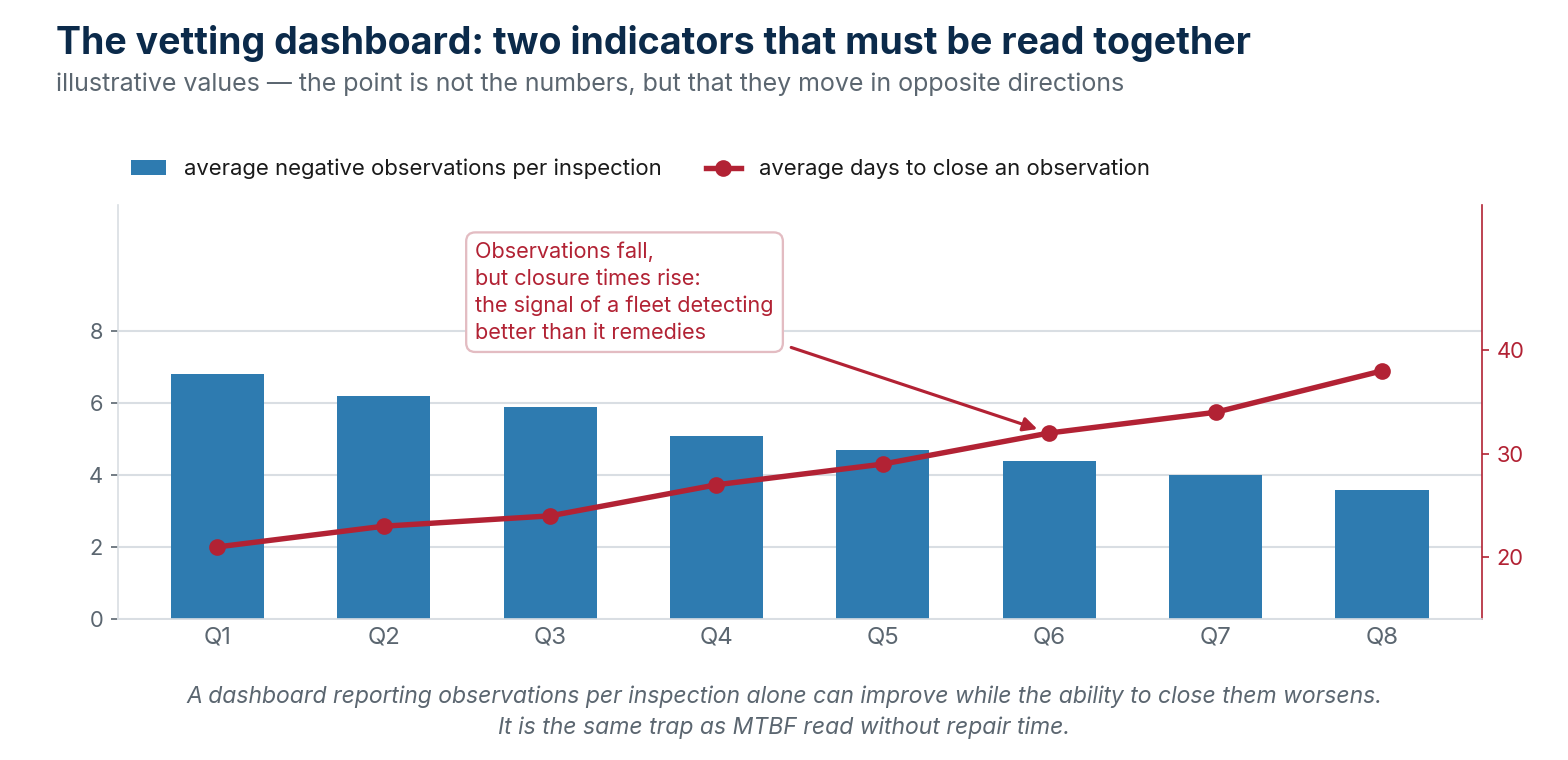
| Observations per inspection, normalised by scheme, area and response tool | Frequency and distribution of comparable findings | The trend is meaningful only with severity, recurrence and context; the raw count alone does not measure quality |
| Average observation closure time | Effectiveness of the CAPA process | Systematic delays signal organisational weakness |
| Rejection rate | Share of completed vetting decisions with a negative outcome | Direct impact on revenue and reputation |
| Share of applicable TMSA KPIs supported by evidence at Stage 3 or above | Declared and evidenced maturity in the selected areas | Avoids turning TMSA into a non-existent overall company «level» |
| Safety Score distribution and active rules (RightShip) | Access to the dry bulk market | Identifies the ships needing analysis or action before vetting; also check active exclusion or eligibility rules |
| Recurring observations by category | Systemic patterns (e.g. human factors, maintenance) | Guides investment and training priorities |
Vetting data, aggregated across the whole fleet, is one of the richest sources for understanding where to invest: if human factor observations dominate on three different ships, the problem is probably not the individual ship but training or organisational culture. The vetting officer who reads these patterns turns a commercial formality into a management improvement tool.
Define rejection rate as negative decisions / completed vetting decisions in the period, with rules for repeated nominations, withdrawals and pending decisions. Do not automatically use inspection count as denominator: one report may support several decisions. For CAPAs report median days to closure, overdue share and still-open actions; an average covering only closed cases can hide a backlog.
Key takeaways
- Data must be normalised by scheme, area and response tool before comparing vessels or periods.
- Severity, recurrence, closure time and CAPA effectiveness complete the raw count.
- TMSA should be monitored through applicable KPIs and available evidence, not as a non-existent single company level.
Vetting and the commercial chartering relationship
Module objectiveCoordinate technical evidence and commercial decisions under the contract.
Vetting is not an isolated formality: it is an integral part of the process by which a ship is proposed, assessed and ultimately accepted or rejected for a charter. Understanding this relationship helps the vetting officer engage effectively with the company's commercial functions.
The role of vetting in the chartering process
- Pre-fixture screening: even before commercial negotiation, the charterer checks the Safety Score, SIRE/CDI history and TMSA to decide whether the ship is «on the list».
- Formal vetting: once negotiation begins, an updated inspection is requested if the existing one is no longer valid or does not cover the client's requirements.
- Contractual conditions: the charter party may include clauses making operations conditional on a valid vetting outcome for the entire duration of the charter.
- Monitoring during the charter: a serious observation during the charter period can trigger suspension clauses or a request for immediate action.
Talking to the commercial team: the right language
The vetting officer who can translate technical outcomes into terms the commercial team understands (delay risk, rejection risk, timeline for closing observations) becomes a strategic partner, not just a compliance function. A good internal vetting report always answers three questions: is the ship acceptable now? If not, when will it be? What is needed to speed things up?
The most effective companies schedule inspection renewals before validity expires, aligning with the ship's commercial availability windows, avoiding discovering the need for vetting right when a fixture is already being negotiated. Advance planning is, here too, the difference between managing and chasing.
Key takeaways
- Check customer criteria for the vessel, cargo, voyage and period.
- Technical closure does not guarantee renewed commercial acceptance.
- Responsibilities and remedies depend on the actual clauses.
Emerging trends in vetting
Module objectiveMonitor programme development while distinguishing published updates, inspection-traceability data and future hypotheses not yet formalised.
The vetting system continues to evolve, driven by digitalisation, the decarbonisation agenda and the extension of due diligence to market segments previously less commercially regulated.
Convergence between programmes
CDI's expansion beyond traditional chemical tankers (10th Edition SIR) and the tightening of RightShip thresholds in dry bulk point to a common trend: vetting programmes, born for specific segments, tend to overlap and cover an increasingly wide range of ship types. For the vetting officer this means needing to know more than one system even when operating in a single market segment.
Decarbonisation and vetting
CDI includes environmental data and checks within its scope, while RightShip keeps the GHG Rating, CII and vetting rules distinct. The commercial weight of environmental performance therefore depends on the programme and on each recipient's criteria. Any future development of SIRE should be described only once published by OCIMF.
Digitalisation and inspection traceability
SIRE 2.0 uses a vessel-compiled CVIQ, photographs and tablet records. The system records the date, time and GPS position at the start, suspension, resumption and completion of the inspection, together with observation timestamps. These data increase the traceability of inspection activity; they do not constitute continuous monitoring of the vessel. Companies that invest early in onboard data, condition monitoring and digital reporting will arrive better prepared for the next cycles of vetting programme updates.
Unlike many other areas of technical management, vetting rules change relatively often: new questionnaire editions, new thresholds, new segments covered. The effective vetting officer dedicates regular time to checking updates published by OCIMF, CDI and RightShip, rather than discovering them at the next inspection.
For each update record source, version, application date and affected ships. Attribute acceptance conclusions to the recipient and nomination concerned; neither SIRE nor TMSA provides a universal continuous vessel rating.
Key takeaways
- Follow changes through official OCIMF, CDI and RightShip publications.
- The weight of environmental performance depends on the programme and customer criteria.
- GPS and timestamps improve SIRE 2.0 inspection traceability; they do not continuously monitor the vessel.
Recurring mistakes
From the Mistake Library of SuperbaKnowledge, filtered to the subjects this course covers. This view selects and organises content published in SuperbaKnowledge; it does not modify or replace it. The linked Knowledge page remains the reference version, while official texts remain authoritative.
| Topic | Mistake | Typical consequence | Topic sheet |
|---|---|---|---|
| CDI-M: the Ship Inspection Report for chemical tankers, gas carriers and beyond | Preparing on the Chapter 5 of the wrong vessel type | Observations in an area believed to be covered | See the topic sheet |
| Flag Change | Flag change completed without ensuring continuity of statutory certificate validity | Documentary gap period in which the ship operates without fully valid certificates | See the topic sheet |
| Class-Statutory Survey Coordination | Class and statutory surveys planned separately despite falling within the same HSSC window | Doubled operational disruption and extra cost for two separate surveyor visits | See the topic sheet |
| IP Code (Industrial Personnel) | Pre-existing authorisation before 1 July 2024 assumed valid indefinitely, without planning the transition to the IP Code | Authorisation lapses at the next survey without an Industrial Personnel Safety Certificate ready | See the topic sheet |
| HSSC-Vetting Coordination | HSSC calendar and vetting inspection calendar managed separately without being shared | Unintended concentration of surveys and vetting inspections in the same time window | See the topic sheet |
| Digital Statutory Certificates | Electronic certificate treated as a simple PDF scan, without the required technical safeguards | The document is not recognized as the legal equivalent of the paper certificate | See the topic sheet |
| Multi-Class Survey | Bilateral Agreement between the two Classification Societies not checked before planning the survey cycle | Duplicated surveys or coverage gaps between the two class societies | See the topic sheet |
Related PSC deficiencies
From the PSC Knowledge Base of SuperbaKnowledge. This view selects and organises content published in SuperbaKnowledge; it does not modify or replace it. The linked Knowledge page remains the reference version, while official texts remain authoritative.
| Deficiency | Regulation | Indicative frequency | Possible consequence | Topic sheet |
|---|---|---|---|---|
| Certificate extended beyond the 3 months permitted from the original expiry | HSSC — Res. A.1207(34) | Low-Medium | Certificate considered invalid, possible detention | See the topic sheet |
Vetting schemes
From the Vetting Knowledge section of SuperbaKnowledge. This view selects and organises content published in SuperbaKnowledge; it does not modify or replace it. The linked Knowledge page remains the reference version, while official texts remain authoritative.
| Scheme | Scope | Distinctive feature | Topic sheet |
|---|---|---|---|
| General | Vetting preparation treated as an isolated event rather than the ship's permanent state | Unstable score between one inspection and the next, loss of charterer/oil major confidence | See the topic sheet |
| OCIMF SIRE 2.0 | Tankers | Fully replaced VIQ7 from 2 September 2024; no new VIQ7 inspection is possible any longer | See the topic sheet |
| SIRE 2.0 | Crew answering uniformly and rehearsed rather than explaining the actual procedure | Assess observed performance and the relevant factor; response style alone causes no automatic penalty. | See the topic sheet |
| SIRE 2.0 | Focusing only on Hardware, neglecting the Procedure and Human Factors dimensions | A 'Not as Expected' observation even with equipment in perfect condition, if the procedure is not understood by the crew | See the topic sheet |
Glossary of acronyms
| Acronym | Definition |
|---|---|
| CAPA | Corrective and Preventive Action |
| CDI | Chemical Distribution Institute |
| CII | Carbon Intensity Indicator |
| CVIQ | Compiled Vessel Inspection Questionnaire (SIRE 2.0) |
| DCS | Data Collection System (IMO): fuel oil consumption data collection |
| EEXI | Energy Efficiency Existing Ship Index |
| GHG | Greenhouse Gas |
| HSEQ | Health, Safety, Environment and Quality |
| HVPQ | Harmonised Vessel Particulars Questionnaire (SIRE) |
| IMPCAS | International Marine Packed Cargo Audit Scheme (CDI) |
| ISM | International Safety Management Code |
| KPI | Key Performance Indicator |
| LNG | Liquefied Natural Gas |
| LPG | Liquefied Petroleum Gas |
| MoU | Memorandum of Understanding (PSC) |
| OCIMF | Oil Companies International Marine Forum |
| PIF | Performance Influencing Factor |
| PIQ | Pre-Inspection Questionnaire (SIRE 2.0) |
| PSC | Port State Control |
| RISQ | RightShip Inspection Ship Questionnaire |
| RO | Recognized Organization |
| SIR | Ship Inspection Report (CDI) |
| SIRE | Ship Inspection Report Programme (OCIMF) |
| SMS | Safety Management System |
| TMSA | Tanker Management and Self Assessment |
| VIQ | Vessel Inspection Questionnaire (pre-SIRE 2.0 version) |
References and sources
Review of 15 September 2026. Primary sources for corrections:
- OCIMF — SIRE 2.0 FAQs
- RightShip — revised age trigger
- RightShip — current validity criteria
- CDI — report supporting documents and access
Consolidated list of the sources and organisations cited in the course, updated in September 2026. For official versions of questionnaires and criteria always consult the publications of the owning organisations, because in this field the rules change faster than the regulations.
| Source / organisation | Scope |
|---|---|
| OCIMF — ocimf.org | SIRE 2.0 Programme – Introduction and Guidance v1.0 (January 2022): response tools, question categories, response scales, Performance Influencing Factors. Question Library, January 2022. TMSA 3 (2017). SIRE inspector accreditation |
| Chemical Distribution Institute — cdi.org.uk, cdim.org | CDI Marine Ship Inspection Procedures, section 4: question categories, absence of a pass/fail outcome, report validity. 10th Edition SIR (5 February 2024) and consolidated amendments v10.5 (July 2024). Terminals, IMPCAS and Bulk schemes |
| RightShip — rightship.com, help.rightship.com | Safety Score and GHG Rating methodology (A–E scale since 6 December 2023). Revised inspection age trigger timeline, 11 December 2024. RISQ 3.2, in force since 25 February 2026. Inspection validity criteria. CII insights |
| IMO — imo.org | ISM Code; MARPOL Annex VI (EEXI/CII) |
| Paris MoU / Tokyo MoU | Port State Control regimes |
| IACS / classification societies | Class rules and surveys |
Official documents
These links lead to the pages and documents published by the owning organisations. They are the authoritative version: where this course and the source diverge, the source prevails.
- OCIMF — SIRE 2.0 programme and FAQ
- OCIMF — SIRE 2.0 Programme Introduction and Guidance v1.0 (January 2022)
- OCIMF — TMSA 3 FAQ
- CDI — documents and webshop (Inspection Procedures, 10th Edition SIR)
- CDI — news, including the LCO2 variant launch
- RightShip — Safety Score Methodology
- RightShip — Inspection Validity Criteria
- RightShip — GHG Rating Methodology
- RightShip — CII insights on the platform
Two items have no direct link and must be found on the RightShip site: the announcement of the revised inspection age trigger timeline and the RISQ 3.2 questionnaire. Also consult the charter party and your own company procedures for client-specific requirements.
This course is educational material for training purposes and does not constitute a professional certification or qualifying credential. Read the full disclaimer.